
This article is written by Benjamin Miller, law and policy officer at the charities directorate under Canada's Revenue Agency
In the past few years, much ink has been spilled over the crisis of faith in traditional institutions and experts of various kinds.
This declining faith affects a lot of what public servants do — from public health and environmental policy-making, to preserving the integrity of elections.
Often, the focus on these discussions is on two groups: “the experts” and “the stakeholders” (also known as “the public” or “the people”). The most sensitive treatments of this issue advocate for moving towards a relationship of mutual respect in which the knowledge and perspectives of both the expert and the stakeholder are heard and valued.
- Want to write for us? Take a look at Apolitical’s guide for contributors
I agree with this approach for private decision-making, but I believe that in public decision-making we need to expand it to include two more parallel but distinct roles — the policy advisor and the politician.
By understanding the special types of knowledge that come with each of these four roles, public servants can develop more sensitive and responsive institutions and decision-making processes.
The expert and the stakeholder: collaboration in private decision-making
Imagine one day you go to your doctor. You describe your symptoms to her. She does some tests. She makes a diagnosis and you discuss what course of treatment would be best given your schedule, diet, available funds, etc.
Both you and your doctor contributed vital knowledge and perspective to come to the right decision for you. You were able to reach this result because you effectively collaborated in a way that got the most out of the distinct types of knowledge both parties brought to the table.
Let’s look closer at some of the differences between your roles.
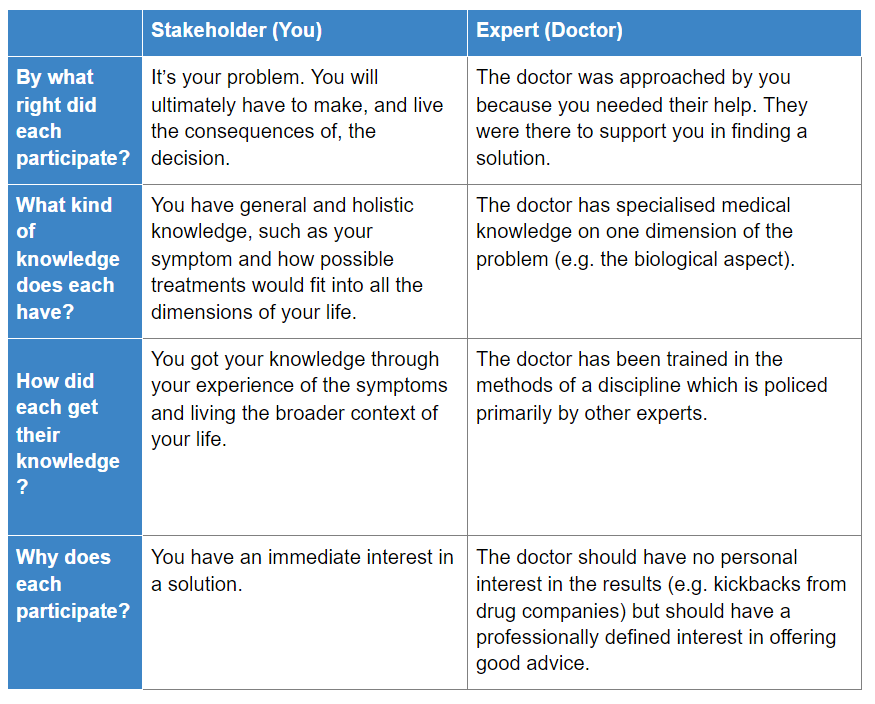
Politicians and policy advisors: isolating and responding to the political dimension of problems
Modern public consultation and knowledge translation practices try to get at the distinct knowledge of experts and stakeholders. In a sense, the policy advisor tries to capture and recreate the above dialogue in their advice to politicians.
However, with many experts and many stakeholders, inevitably the policy advisor’s recommendations are just attempts at striking different balances. How does one determine which is the right balance?
Politicians represent stakeholders in a very special way. They stand in for stakeholders by experiencing the political dimensions of stakeholders’ problems on their behalf
Like in the above scenario, the answer lies with the stakeholder. But since stakeholders are divided and most often don’t decide directly, some proxy is needed. In steps the politician, the “representative” of stakeholders.
How do politicians “represent” stakeholders? The conventional answer is to say they represent them by carrying out their wishes in government. This explanation is troubling for a number of reasons.
Stakeholders wishes are conflicting. People may support politicians based on only some of their commitments. Governments typically govern for all with inevitably only support of some smaller or larger proportion.
Rather, I submit to you that politicians represent stakeholders in a very special way. They stand in for stakeholders by experiencing the political dimensions of stakeholders’ problems on their behalf.
Think back to your visit to the doctor. Your condition didn’t only have a medical dimension. Its causes and possible solutions had environmental, economic, and engineering dimensions to name a few. Many problems have a political dimension. Let’s just say the political dimension of a problem is how the way we live together as a society affects the problem.
Politicians experience this dimension directly because they are made responsible for the deciding the terms by which we live together (i.e. laws and policies) and therefore become the focal point of all those otherwise diffuse pressures that are the raw material of the political dimension of problems.
However, a politician’s experience of these pressures is always mediated through electoral and decision-making institutions. So a politician is like and not like a stakeholder.
Policy advisors should appreciate that they are only ever asked to advise on one aspect of what is necessarily a broader and different problem for the politician
They may not have to live with the direct impact of their decisions, but they will feel the political impact (i.e. on their continued political “survival”).
Their knowledge is general and holistic because they have to be more or less concerned about how one policy issue fits into 100 other policies a government is interested in. Their knowledge is gained not through technical training but through the experience of gaining and maintaining sufficient stakeholder support.
What does this mean for public servants? Policy advisors should appreciate that they are only ever asked to advise on one aspect of what is necessarily a broader and different problem for the politician.
Additionally, when seeking to design more democratic decision-making processes, one may ask:
- How do these institutions insulate or expose the decision-maker to directly experiences different aspects of the problem?
- Who is filtered out?
- Who is amplified?
Through porous institutional design, we can bring all four knowledge types into harmonious dialogue. — Benjamin Miller
We want to hear what you think about this article. Pitch an article to us or send your comments to hello@apolitical.co
(Photo Credit: UnSplash)
Make sure to share your own thoughts with the author by leaving a comment below

Log in or sign up to continue the conversation