
This article is written by Anna Francis, Resilience Manager, Frome Town Council (based on research conducted by Kris Fowler.
I have always been passionate about reducing food waste. When I lived in London I was shocked to see people on the streets begging for food while the bins at the back of supermarkets were overflowing with food that was still good to eat. So after having moved to Frome in Somerset in South West England and started working for the town council, when one of the councillors sent me an article on Spain’s solidarity fridges in 2015 I knew this was a solution I wanted to help develop for the UK.
- Want to write for us? Take a look at Apolitical's guide for contributors
What is a Community Fridge?
The idea is simple: the fridge is publicly accessible and for the use of the whole community. A team of volunteers links with local supermarkets and other food businesses to collect food that is still good to eat but would otherwise be thrown away. That food is then available to be taken by anyone that can use it. The fridge in Frome is supplemented by a community larder for non-refrigerated items. As well as collecting food, the volunteers also check and clean the fridge daily.
Where did the idea come from?
The concept originated in Berlin, Germany in 2012 under the name of ‘Food Sharing’; in 2015 it emerged in Galdakao, a small town on the outskirts of Bilbao, Spain as a ‘Solidarity Fridge’; and in 2016, Frome Town Council worked with Edventure Frome CIC to enable ten of their community enterprise students to set up the first ‘Community Fridge’ in the UK. Since then the idea has continued to spread and today there are at least 95 community fridges in the UK, while globally they are found as far afield as India, Bolivia, Israel and New Zealand.
In practice, the fridges often become an important source particularly of fresh food, for those in need
The primary focus of a community fridge is on reducing food waste. They are not to be confused with Food Banks where food is distributed via vouchers in relation to an assessed need. Community fridges are about diverting as much good food as possible from going to waste in landfill and are open to the entire community to make use of.
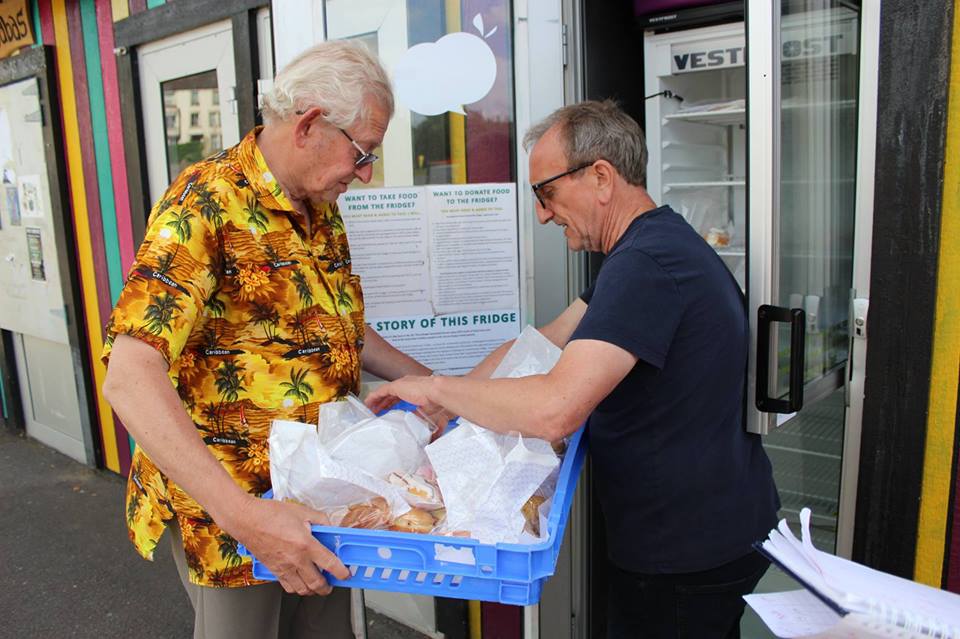
Two volunteers refilling Frome’s community fridge
In practice, however, the fridges often become an important source particularly of fresh food, for those in need. The latest figures from the UN estimate that 8.4 million people — just about 1/8 — in the UK experience some form of food insecurity, while at the same time 5 million tonnes of good food is thrown away. The fridge is a simple solution to reduce waste, emissions and also plays a part in alleviating hunger.
Food waste is generally overlooked as a big environmental issue yet it is responsible for 8-10% of the total human-caused greenhouse gas emissions globally. When organic matter is dumped into landfill it breaks down to release a gas that is around 50% methane and 50% carbon dioxide. Globally this contributes up to 70 million tonnes of methane each year — more than from coal mining and natural gas leaks combined, and almost as much as is emitted by farm animals.
The fridge and larder had saved 90,000 food items annually. This prevents 140 tonnes of CO2-equivalent emissions every year, equivalent to driving 340,000 miles, or taking 43 cars off the road
In addition to the landfill emissions, each item that is wasted has required energy to produce. The fuel, electricity and resources used to grow, harvest, transport, store, process, package, distribute and retail each item, as well as the energy to refrigerate or to cook it at home, are all wasted inputs as soon as the food is discarded before it has even been transported to landfill. A recent study by climate NGO Project Drawdown ranked the top-100 ways of addressing climate change. Reducing food waste came as number 3 — far above electric vehicles, solar panels and recycling. Reducing food waste doesn’t simply mean less going to landfill — it also means less land across the world needs to be deforested and converted into farmland.
For Frome, an independent impact assessment conducted in 2019 found that the fridge and larder had saved 90,000 food items annually. This prevents 140 tonnes of CO2-equivalent emissions every year, equivalent to driving 340,000 miles, or taking 43 cars off the road.
Social Impact
For some people, the fridge has become a lifeline and also serves as a community hub where people from different backgrounds meet, share stories and connect.
Meg, a regular user of the fridge, said:
“I use the community fridge every day. I usually come down when the Greggs collection arrives and take home a bag of food for my 3 kids and me for dinner. My eldest loves the chicken bake. I’m on benefits and my kids have difficulties, so the fridge has been a lifeline when we’ve had no money. I don’t know what I’d do without it.”
Richard, a volunteer, said:
“The community fridge kept me alive for a while, when I was homeless and had no money. I’m a volunteer now — after seeing how it was run and the good it did, I stepped-in to help. For me it was a way into the community. It’s a kind of social glue, and it cuts across class differences in the town.”
As well as helping increase access to food in the town for many of the fridge volunteers the project gives them purpose and an important sense of community. At present Frome’s fridge has 8 volunteers, some collecting one day per week, others on hand 5 days a week. It’s clear that the level of commitment of the volunteers is very high, but also that another couple of volunteers would help to spread the load of the daily collections and enable possible expansion to cover some of the other retailers.
Fridge co-ordinator Terri Pitts said:
“I started volunteering at the fridge because I’m a stay-at-home mum and I wanted a community element in my life. The fridge is a really worthy cause because there is so much food that goes to waste.”
To find out more or set up your own community fridge contact Hubbub who runs the UK Community Fridge Network. More info on the Frome fridge including a short film can be found here. — Anna Francis
(Picture credit: Unsplash)
Make sure to share your own thoughts with the author by leaving a comment below

Log in or sign up to continue the conversation