
This article is written by Hillary Beata, former digital services specialist at the City of Evanston
The Covid-19 pandemic has highlighted the need for data informed policy-making more urgently than any presentation, data dashboard, or spreadsheet ever could.
Who would have thought just a few months ago that we would all be discussing exponential graphs, R-values and even downloading apps to help policy-makers track the spread of the virus? And while this crisis has shocked and upended our lives in unfathomable ways, the slow and steady growth of data literacy and analysis in local governments has given us the tools to tackle the crisis.
The journey of preparation for many of these communities in government started with an initial wave — often by creating an open data portal and populating it with datasets. After the wave came an ocean of data that was infrequently updated or didn’t match community needs or interest. For the City of Evanston, a Chicago suburb with vibrant, engaged, and diverse residents, making this new tool meaningful meant connecting its use to improving a public service.
- Want to write for us? Take a look at Apolitical’s guide for contributors
There needed to be an understanding of the current state of data in the organisation and then training staff in ways that built upon existing skills and project management styles. Ultimately, data use rested on our ability to empower staff who know where the problems are and how data can solve them.
Using data in local government
When I joined local government in 2016, I switched off when I heard words like data, analysis and dashboards. Despite my role in the information technology team, I was intimidated by the idea that I could use data purposefully for my job. As I learned how the City of Evanston worked as an organisation, I realised that most of my colleagues throughout the organisation felt the same.
Not because there wasn’t a need or a desire for data to be an essential part of key city projects. But there was a large gap in the tools and training. To overcome it required experience, empowerment and empathy.
Time and experience are critical to understanding and insights about the data needs and obstacles of any organisation.
I needed to build the skills to manage data and know what would work for other staff at all skill levels
Projects that are now a hallmark of Evanston’s data program could not have happened when I started. For me it took training, research on best practices, conversations with local government peers to go from interested observer to excited and evangelistic data administrator. I needed to build the skills to manage data and know what would work for other staff at all skill levels.
One example I want to highlight is the development of the Evanston Police Dashboard, which went through several iterations and each one taught me more about what was needed to make it more successful. Like many communities across the United States, the Evanston Police Department wanted to use data as part of its engagement with the public.
The dashboard allows users to see a high-level breakdown of the various aspects of Evanston Police Department operations. The data is presented in an easy-to understand way using graphs and heat maps, allowing local residents to get a better understanding of how the police department uses data to inform activities.
The support and attention of the City Manager and the Police Chief and an elected official were pivotal to getting the project started and keeping it a priority. As time went on and we responded to feedback and new technology, I realised that a team of peers who knew the data inside and out were critical to pushing forward and success.
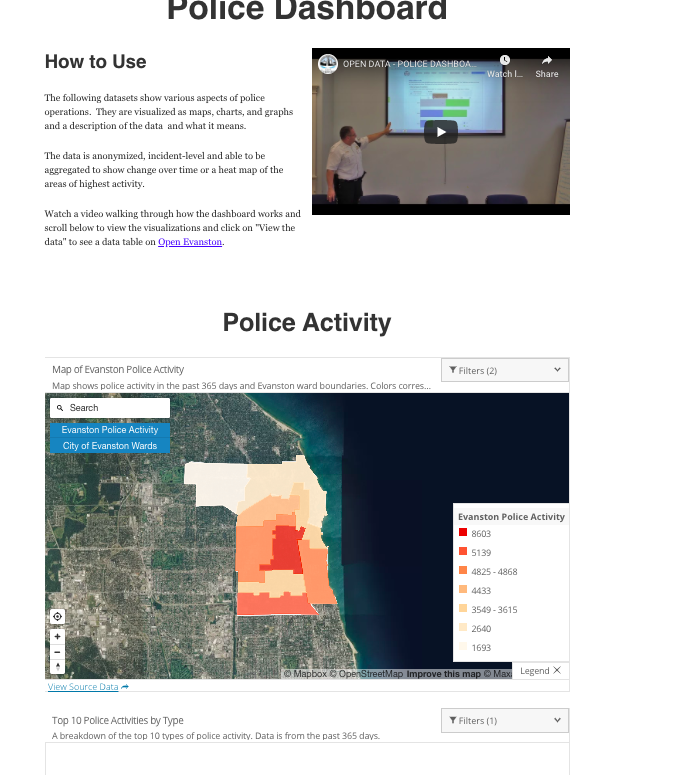
Overall, the police dashboard project not only provided context and a deeper understanding of police operations for staff and residents, but the project empowered skilled staff to automate additional datasets without the need for assistance from our vendors and inspired staff.
Trust your team
Empowering staff was and continues to be a key step on the journey towards using open data in government.
When I began to lead Evanston’s open data program, data projects came either from directives from the top management or I learned of a data need and offered my services. In many cases, I have simply pitched an idea for how a data solution might work when my colleagues have told me about problems they’re working on.
Our work with the police department caught the attention of Evanston’s fire department chief, who approached the data team to work on extracting, analysing, and visualising multiple sources of data. They had data on key budget items such as overtime and the chief wanted to see if trends could be spotted and addressed before the department went over its overtime budget. This engagement demonstrated how to internally start the process of sorting through data and creating actionable insights.
Without staff who felt empowered to take the initiative and start data projects on their own or aware of available resources, such as the open data portal or their colleagues’ expertise, the open data program would not have been sustainable
These two examples and the progress and lessons learned were regularly shared with an internal data governance team. Without staff who felt empowered to take the initiative and start data projects on their own or aware of available resources, such as the open data portal or their colleagues’ expertise, the open data program would not have been sustainable.
The team’s existence and composition were part of raising awareness about both the program and how data adds value. Every city department has at least one representative — usually someone who has either an interest or skills in data analysis and management. Regular meetings focus on sharing training opportunities and progress on both city-wide and department data projects. Data team members influence our fellow department members to share data and provide feedback to open data administrators about the best ways to engage departments on projects to clean, extract and analyse data.
Not a question of tech
At the heart of sharing data and making it a valuable tool for staff and residents is being curious, thoughtful and empathetic.
Experience at the organisation and empowerment with the right tools and knowledge is essential. But what’s brought the most success is my co-workers knowing that they have a supportive team member in me and others involved in data projects. And for me, as a team member with data expertise, it’s about understanding the perspective of my colleagues and adapting my skills to the needs of the project. So if the project needs more technical assistance or just a quick conversation about the best methods, the team members know that I’m flexible.
In short, data sharing at the local level is about more than the technology itself. Experience in the organisation helps you grasp where value can be added. Empathy for your colleagues and an understanding of how training and application affect their work goes a long way to paving the way for success. And when we generously give each other tools to empower each other, we are better able to accomplish a public service. — Hillary Beata
(Main Picture Credit: Unsplash)
Make sure to share your own thoughts with the author by leaving a comment below

Log in or sign up to continue the conversation