
This article is written by Gavin Hayman, executive director, Open Contracting Partnership
If you have found yourself in these last few weeks scouring half-empty supermarket shelves, spare a thought for those buying for governments.
Public procurement professionals across the world are under immense pressure as they shop around to meet the huge demand for medical equipment and supplies — the scrubs, disinfectants, masks, gloves, medicines, and ventilators that are essential to containing the new coronavirus outbreak. And as we’ve seen in news reports of national leaders intervening to stop masks from being exported between nominally allied countries, scarcity has turned the usually undramatic field of public procurement into the stage for a global political arm-wrestle.
- Want to write for us? Take a look at Apolitical’s guide for contributors
There are clear rules about fairness and non-discrimination on how the government should buy things. There must be rules for exceptions too. Even as priorities change, procurement must remain transparent and accountable, and be grounded in sound, participatory decision-making.
The only way to guarantee this in complex, rapidly changing contexts like now is by being guided by open government principles.
Here are our recommendations on policy, collaboration, data, building innovative partnerships, and civic monitoring based on experience working with government contracting teams in more than 25 countries.
Emergency procedures still need to be public and open. During an emergency like the Covid-19 crisis, contracting procedures must be as fast and frictionless as possible, trumping competition and inclusion. Large payments may be made upfront to secure supplies.
The rush by politicians who are eager to show action and secure supplies as scarcity rises can lead to poor sourcing, unqualified or fraudulent suppliers, and poorly written contracts. While emergency procedures are needed, they must remain publicly accountable for every contract concluded and spent.
The UK has set out relatively clear tests that should be met and publicly documented before their use
Emergency decrees lay out when normal rules can be circumvented. The EU, for example, already has relevant directives. The UK has set out relatively clear tests that should be met and publicly documented before their use.
In Ukraine, all emergency contracts need to be published in full, including terms of payment and delivery, and value. These are shared as open data. Civil society has developed a business intelligence tool to monitor medical procurement and emergency spending. Now they can track price differences for Covid-19 tests in the country’s regions and capital to check the price of critical medical supplies to ensure that authorities are committed to filling treatment centres, not private pockets.
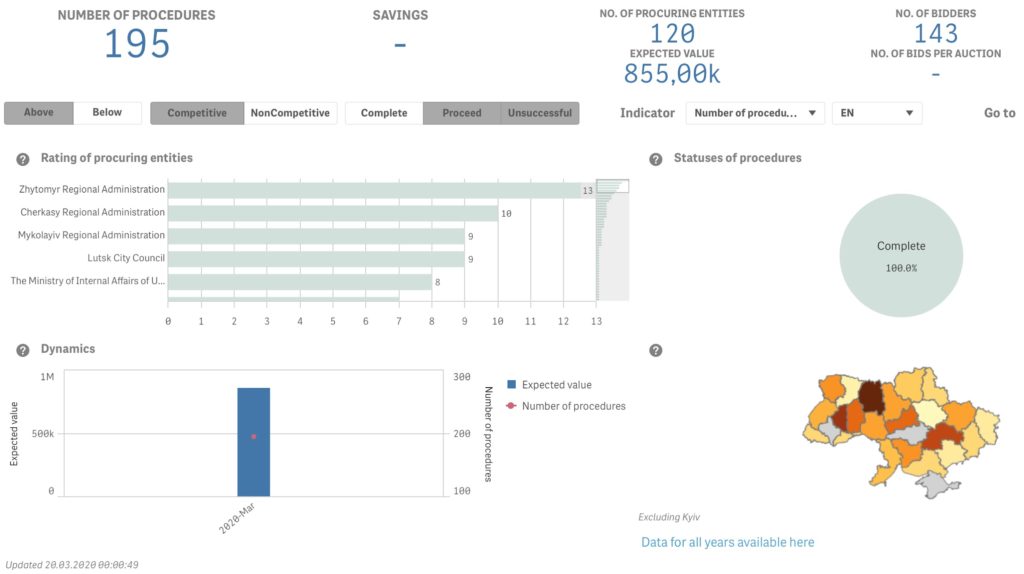 *A print screen from Ukrainian BI: 195 contracts for EUR 855k were signed by 120 contracting authorities during March 18-19, 2020\
Open procurement data provides valuable information to predict and manage the purchase and delivery of critical products. One of the reasons that governments need emergency procedures is the clunking inefficiency of most existing procurement. For a full picture of what is being bought, by and from whom and at what price, all public tenders and contract awards under emergency frameworks should be public. Something as simple as tagging all contracting processes and budget lines with “Covid-19” will ensure high-quality, open and complete data to take data-driven decisions.
Countries that use e-procurement platforms and disclose data in an open format such as the Open Contracting Data Standard, should continue doing so. Colombia is one of the countries that comply with this best practice. Although Colombia’s National Health Institute awards contracts directly, it asks for quotes and delivery times for its Covid-19 test and lab supplies procurement. The institute discloses not only tender data and information but all the technical comments received from potential suppliers.
Governments don’t have all the answers, so they need to reach out to the private sector and other parts of society to ask for solutions
Unprecedented demand requires a rapid dialogue with the market about where those supplies can come from. That is much slower if you have to piece it all together manually rather than conducting an open dialogue with the marketplace online.
Collaboration across agencies and innovative partnerships with business and civil society are needed. We currently have long and congested international supply chains, competing buyers willing to pay any price to get their hands on lifesaving equipment, and a lack of local manufacturing capacity. This is resulting in dire shortages of critical items, putting brave front-line responders and whole populations at risk. Government agencies at all levels need to work together in setting clear goals and priorities, and consolidating emergency committees for quick decision-making and collaborating in buying supplies not outbidding each other.
Governments don’t have all the answers, so they need to reach out to the private sector and other parts of society to ask for solutions. Issue a list of essential medicines and devices so markets can react accordingly and encourage start-ups and data-driven civil tech projects. The UK government asked suppliers to come up with solutions for ventilators, which resulted in a major consortium coming forward to help. These innovative partnerships with the private sector will involve the skills of the government stating the needs clearly, being willing to share the risk, and rapid prototyping and iteration. Again, this can be facilitated and enhanced if bought online. Not all of these partnerships will work and that is fine too.
One promising approach is Chile’s framework agreement for goods and services necessary in case of emergencies. Selected suppliers are pre-screened by ChileCompra, the central purchasing body, to buy products from them in a fast and easy way when disaster hits, avoiding sole sourcing and gouging.
Civil society will play an important role. Governments should trust and support civil society to monitor efficient spending and the delivery of goods and services. Countries that do so will be able to respond better, faster and maintain an open dialogue about priorities and solutions. Open government approaches applied to key functions, such as public procurement, have never been more important.
Civil society needs to be able to hold its leaders to account on the spending decisions they’ve made and ensure that in an emergency the citizens come first
With government staff already stretched thin, civil society and journalists should be seen as a valuable ally and analyst in tracking preparedness and ensuring resources are allocated efficiently and prevent abuse of emergency contracting procedures to buy non-critical items. Where necessary, civil society needs to be able to hold its leaders to account on the spending decisions they’ve made and ensure that in an emergency the citizens come first.
How governments manage emergency public procurement will play a major role in how they contain Covid-19 and how many lives can be saved. It is public procurement's moment in the spotlight. It needs to be fast, smart and open if it's going to shine. — Gavin Hayman
This article is part of the Open Response + Open Recovery article series in partnership with the Open Government Partnership. Explore how open government can tackle the challenges posed by COVID-19 and ensure an open response and open recovery here.
(Main Picture Credit: Unsplash)
Make sure to share your own thoughts with the author by leaving a comment below

Log in or sign up to continue the conversation