
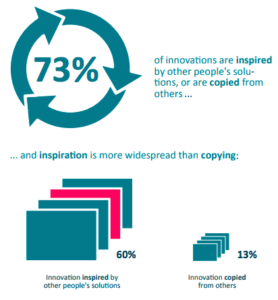
Seventy-three percent of public sector innovations are inspired by or copied from others’ solutions, according to the world’s first nationwide survey on government innovation.
The Centre for Offentlig Innovation (COI), a government agency that works to foster creativity in the Danish public sector, has released an “Innovation Barometer”. It incorporates surveys from 1,255 municipal, regional and state-level offices about their work over 2013-2014.
According to the COI, the findings are “fully representative” of the state of the public sector in Denmark.
“We had a series of wild dreams. We hoped to provide the individual public sector workplace with a basis for inspiration to work with innovation. We hoped to deliver a survey that scholars would use in their research, teachers would teach and decision-makers would use as a basis for decision-making. In a slightly megalomaniac moment we even dreamt that other countries would follow suit,” said Ole Bech Lykkebo, Head of Analysis at the COI.
“As it turned out, the dreams came true. With a lot of help. And luck.”
The surveys were carried out in collaboration with Statistics Denmark, which worked in accordance with international guidelines on measuring innovation in the private sector.
“We were inspired by statistics on private sector innovation that have been conducted in all OECD countries for the past 20 years. When COI was formed, we thought, ‘Hey, why not be the first to deliver an equally systematic knowledge on public sector innovation?’” said Lykkebo.
The COI found that 60% of government-led innovations are inspired by or adapted from others, while 13% are direct copies of existing policies. Smaller municipalities and workplaces with fewer employees are more likely to recycle projects.
“That’s a lot. And it tells you why you can’t fully grasp public sector innovation looking through the same lens as you would when you study private sector innovation,” said Lykkebo.
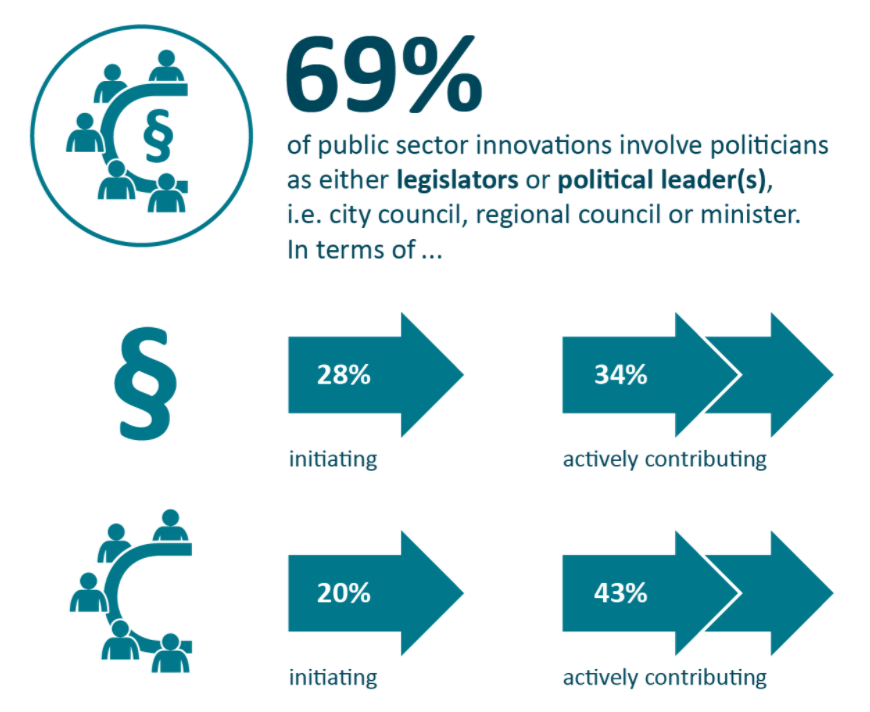
To Lykkebo, the most surprising finding is “the profound importance of political leadership”: the Centre found that politicians are involved in 69% of innovations.
With the report, the COI aims to shed light on what accelerates innovation – as well as what prohibits it. One example of which is lack of funding: one in five innovations is inspired by financial pressure – however, 39% of respondents said that tight budgets negatively impact how creative they are in their work.
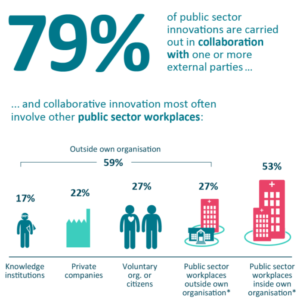
Partnerships also play a key role in getting innovative projects off the ground. Nearly 80% of projects are carried out in collaboration with one or more external parties: knowledge institutions (17%), private companies (22%), voluntary organisations or citizens (27%) or external public sector workplaces (27%).
When workplaces collaborate externally, they are more likely to put out high-quality projects, the COI found.
The report provides valuable insight into what governments should pay attention to if they want to foster more creativity and risk-taking among employees. Why, then, did it take so long for any government to measure innovation within its ranks?
“Nobody felt obligated. Also, perhaps nobody cared to go through all the quarrelling, errors and testing it would take. Nobody likes to be measured, so a lot of people were sceptical at first,” said Lykkebo.
“But in some ways, it was easier for COI to be a first mover. The COI was set up by local and regional governments in a joint venture with all the unions of public employees. A rare construct – but very useful if you want universal backing.”
"Nobody likes to be measured, so a lot of people were sceptical at first"
Now, other Nordic nations are following suit and administering their own surveys. Norway will publish its own Innovation Barometer in February, and Sweden and Finland will soon follow suit, according to Lykkebo.
Measuring innovation is a great first step – but government has a long way to go to catch up to the private sector, he said.
“The public sector is in fact highly innovative. But a lot of things could be better,” he said.
“The public sector needs to improve when it comes to evaluating and actively spreading innovations from one place to another. Also, it would be very helpful if decision-makers made it their rule to have everything tested on a small scale before launching new initiatives.”
The next COI report will be released in May 2018.
(Picture credit: Unsplash/Nick Karvounis, the COI)
Jennifer Guay
jennifer.guay@apolitical.co
Make sure to share your own thoughts with the author by leaving a comment below

Log in or sign up to continue the conversation