
This article is written by Rebecca Heywood, strategic initiative specialist, New York City Citywide Administrative Services. This article is one of the entrants in Apolitical's 2020 American public servant writing competition
The tech sector wants you to believe that the future of transportation is self-driving cars, shared helicopters, and tunnels under cities. Politicians often favour new amenities like Wi-Fi and USB charging on trains and buses.
But rather than simply waiting for technology, policy-makers actually already have the tools on hand to define the future of transportation, including something that can help us to address environmental and equity concerns endemic in the transportation sector.
- Want to write for us? Take a look at Apolitical’s guide for contributors
We live in a world where it’s been normalised to get in your car to drive down the block or around the corner. We need to create cities and neighbourhoods where people can make shorter trips overall and just don’t need to drive as much anymore. What if, with a few political commitments, we could reduce the need to even own a car in cities, while also making our cities and towns more sustainable and equitable?
The tool we already have? The bus.
Buses are the backbone of all public transportation systems but have long been seen in the US as a last resort. Around the world we have seen that when you give riders what they want — a public transportation service that is reliable, efficient and frequent — ridership increases, and congestion goes down. Auckland invested in a newly designed bus network in February 2019 and quickly saw an 11% increase in ridership, four times the rate of population growth. Jakarta is aiming for 95% of its citizens to live within 500 metres of public transport by 2022 and has worked to integrate informal transit operators into its formal system to increase the size of its network.
Why does this matter?
Sustainability and social justice are issues at the forefront of political debates today. In the US, the transportation sector is the largest contributor to greenhouse gas emissions.
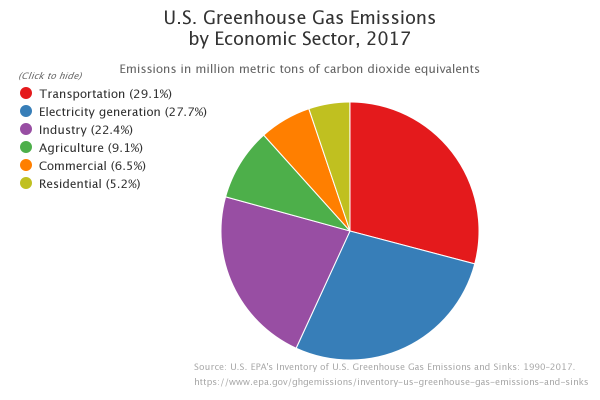 Environmental Protection Agency
Much of the focus on reducing emissions has been on transitioning to electric vehicles, but electric vehicles take up the same amount of space and won’t help us make cities more liveable by reducing congestion. And the emissions benefits depend greatly on the energy source for electricity generation in your region.
American’s dependence on automobiles is growing. People have been taking on an increasing amount of debt just to even own a car, which is often considered a prerequisite to a middle-class life. Americans have a record $1.3 trillion in debt related to cars as of June 2019, and a third of buyers won’t pay off their existing loan before trading in their car for a new one.
More than ever, we need to get people out of their cars and onto sustainable modes of transport. Buses are the best tool we have to help people reduce their car use and, with a few tools, we can get people back on buses by making bus services better, ultimately reducing our carbon footprint and making our cities and towns more equitable.
Sounds great, what’s our toolbox?
In order to get people to ride the bus, we have to make service better. The most important factors when thinking about bus service, popularised by public transit expert Jarrett Walker, are frequency and speed.
1. More frequency
Steven Higashide, the author of Better Buses, Better Cities, has a great example of why frequency matters. “Imagine…there’s a giant wall behind the car that only opens once an hour, and that’s the only time that you can leave your house and go driving. That’s basically what it’s like to live near an hourly bus route. It’s only when you get to the stage where you have a service every five to ten minutes that there’s this sense of freedom, that you don’t have to plan your life around the bus schedule. You can just show up whenever you want and feel confident that the bus is going to be there fairly soon.”
2. More speed
There are many ways to help speed the bus up, both big and small. Some of the smaller moves that you can advocate for are:
- Move bus stops to the far side of traffic lights instead of in front to reduce the chance the bus is caught by a red light after picking up passengers
- Widen stop spacing so that the bus doesn’t have to pull to the kerb, stop, and enter back into traffic as frequently
- Allow passengers to enter and exit the bus from all doors. Passengers can pay using a fare card tap station anywhere in the bus
Some ways to gain even more speed improvements are:
- Plan for and implement bus only lanes. Giving buses a space of their own increases bus speeds, makes riding the bus more attractive and can often be done without massive impacts on general vehicular traffic
- Create bus-only streets. NYC and San Francisco have recently banned or significantly limited car access on major streets, 14th Street in NYC and Market Street in San Francisco. In NYC, bus ridership is up over 15% on weekdays and over 30% on weekends, and travel times along the corridor dropped 30%. Car speeds on nearby streets haven’t changed, despite worry from some politicians and other stakeholders. These are significant gains that have made the street more usable for all — bus riders, pedestrians, and businesses
- Redesign your bus network. Cities around the country and world, including Houston, NYC (in the Bronx, Queens and Brooklyn), Dublin and others are rethinking their bus networks to provide a better service for today’s population. While populations have grown and job centres have changed, many bus networks remain virtually unchanged
Beyond these two points, there is a myriad other ways to continue making public transportation and buses an attractive option in your city. Pay-as-you-go fares with a weekly or monthly fare cap can help make transit more accessible by reducing the cost to riders, regardless of income. Passes that require you to pay ahead are out of reach for many low-income riders. Technologies and apps can be a great partner to help provide real time information, integrated ticketing and route-planning to new and existing transit riders.
What does this all mean for me?
As policy-makers, we have to always keep in mind the tools that we do have at hand to address core problems facing our cities and towns. Tech companies and private interests may be able to sell a shiny product, but we must question whether it is really solving the problem at hand.
Apps and rideshare were sold as ways to save our cities and reduce car usage, but in reality we have seen it increase, along with the negative externalities of greenhouse gas emissions and social inequity. If we really want to think about the future and how we can build sustainability, let’s go back to a technology that we know can work — the bus. — Rebecca Heywood
(Main Picture Credit: Unsplash)
Make sure to share your own thoughts with the author by leaving a comment below

Log in or sign up to continue the conversation