
This article is written by Rashmi Laljee, Senior Master file Maintenance Representative. This article is one of the finalists in Apolitical’s 2020 women in government writing competition.
Throughout history, women have demonstrated the competency, stability and leadership skills needed to rule entire kingdoms. It should be no surprise when they prove capable of transforming the public sector as well.
- Want to write for us? Take a look at Apolitical's guide for contributors
The Council on Foreign Relations, Sept 2020 points out that women make up the majority of the roles in many public services around the world, but a minority in senior positions.
Figure 1: Government Gender Parity Worldwide
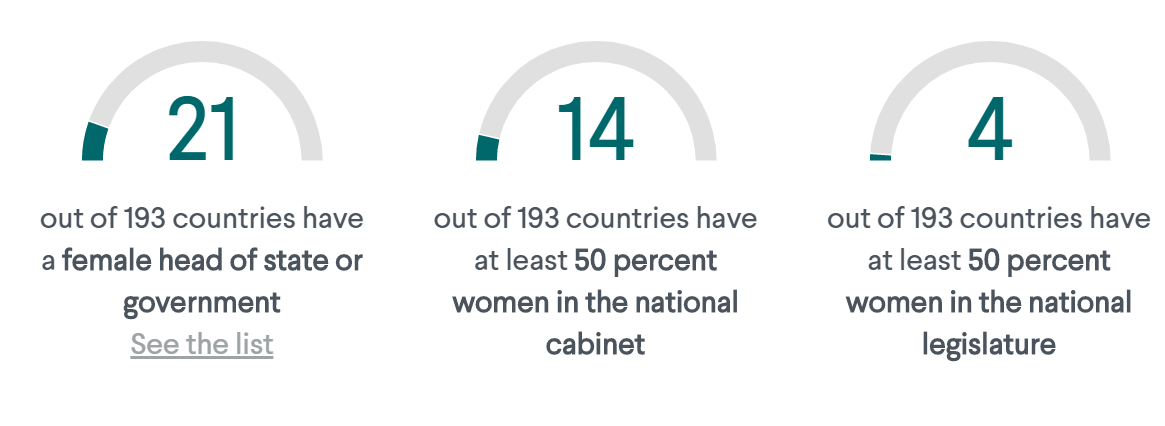
The above statistics point out that, despite 50% women in 193 countries across the world occupying the cabinet and national legislature, a mere 12% are in leadership positions, such as the head of the state or government. These figures point to moral and commercial roadblocks for women.
Personal and professional barriers such as limited access to the informal network, stereotyping, the individual mindsets of the women discouraged from advancing their careers as well as personal priorities, contribute to the dearth of women leaders. The underlying issue is not a lack of qualification however — it is structural.
Behavioural interventions and mentoring programs alone fail to address these issues, causing women to conclude that senior positions within Government are out of reach.
Examining the Hurdles
The existing informal network is patriarchal, homogenous and long entrenched , making it difficult for women to network as well as sparing no leeway for personal commitments. The informal social network is male dominated meanwhile, and unwelcoming. Dina Dublon, a retired CFO of JP Morgan Chase, was told of the reluctance of her male colleagues to have dinner and drinks with female colleagues as it would seem “flirtatious”. Due to such prejudices, there is a lack of support for women to acquire leadership positions.
A good mechanism to cope up with the lack of support for women is by rewarding employees for every successful woman referral
This leads us to another critical barrier to women's leadership. Women face scarcer opportunities, discouragement, and greater expectations of their performance compared to men. They are required to prove themselves more, as they are assumed to be less willing than a man to take risks. Studies suggest that in the US, women win equal election seats as men at all Government levels, but are unwilling to run offices due to similar inhibiting factors.
Notwithstanding these challenges, women such as Michelle Obama, Jacinda Ardern and others have made their mark as leaders. They are torchbearers who prove that, if you have the right attitude towards barriers, you can skew them in your favour. By believing in yourself, you can rise up and become an example to others.
Bridging the Barriers
As a woman, I believe in working smart, not hard. I have differentiated myself by creating a personal touch in my work. I complete the same work as my colleagues faster and/or with better precision, using my technical skills to expedite my work. This has given me an edge over my peers, directing my seniors’ attention towards my potentials opening the doors to the network. This is “agentic thinking” (finding ways to project independence, power and mastery), as typically used by men seeking to advance with the patriarchal network.
Government too has the option to create a task force to monitor the careers of women. After a high turnover and lack of women in the senior positions, Deloitte successfully increased the number of women by 30% by this strategy.
A good mechanism to cope up with the lack of support for women is by rewarding employees for every successful woman referral. Intel used this strategy to successfully report and increase the promotions of women by 33% in 2015. Sponsorship is also another option. An AAUW report shows that sponsorship is more effective than mentorship. In a sponsorship program, the sponsor shares the political skills and opportunity with the sponsoree and tries to advocate female talent in the organisation in conferences and other conversations.
Ladies, you must develop the talent that you already have within you. There are several programs out there initiated by Government and external organisations that help women harness their talents and effectively rise as successful leaders. e.g Women in Local Government Program by the Federation of Canadian Municipalities by the Canadian Local Government aims at closing the gender gap to enable women to advance their careers in public service. Other channels involve undertaking leadership training programs using online learning resources.
Your confidence is the only thing that will get you there. Despite all the barriers we face, I have found simply bringing people’s attention to the work of the talented women I know has the power to mitigate basic biases.
Remember, barriers will always exist in work and life. Never view them as a disadvantage. Your advantage in these conditions is to be able to have the experience of actually breaking through the barriers. – Rashmi Laljee
(Photo Credit: UnSplash)
Make sure to share your own thoughts with the author by leaving a comment below

Log in or sign up to continue the conversation