
This opinion piece was written by David Kenrick, Catrin Rees and Matthew Crane from the Maritime Technology and Innovation Team at the UK Department for Transport. This piece also appears in our government innovation newsfeed.
When people think and talk about transport in the UK, they generally mean road, rail, or aviation. Yet for an island nation such as ours shipping is just as important. Britain’s history is intrinsically linked to the world’s oceans. In the Department for Transport’s (DfT) Maritime Directorate we oversee a wide range of maritime policy areas including skills, infrastructure, trade, environment and technology.
In the technology team, we explore which innovations might shape the future of the maritime sector. This ‘futures thinking’ is often complicated by economic precariousness in the industry and by the fact that vessels are typically built to last 30 to 50 years, making it hard to introduce new technologies. At the same time, maritime innovations like containerisation have transformed the global economy. Our team tries to spot the next big thing.
One contender is maritime autonomy. Debates about autonomous vehicles often centre on road transport, but the potential to use ‘smart’ technologies in the maritime sector is arguably even greater. Autonomous systems can make shipping safer, cleaner, and more efficient. They could transform the nature of work in the sector, offering attractive career prospects to a more diverse range of people.
That’s the hype about maritime autonomy (or smart shipping as it’s also known), but we wanted to understand more clearly what our major stakeholders thought, from shipping lines and port operators to insurers, academics and SMEs.
 The Department for Transport's Futures Lab
As a new team with experience from outside government (in academia, accounting, and industry) we wanted to do something a bit different. We contacted Policy Lab – an innovation group within the Cabinet Office that designs and develops policy collaboratively, in a way that is focused on outcomes and the policy’s end-users. In conjunction with them, we held a ‘Futures Lab’ to help us develop a policy routemap for Smart Shipping.
We wanted this event to produce a vision to inform policy and support the UK maritime industry to embrace these new technologies.
Before the event, we held a cross-departmental ‘challenge setting’ session in the SKYroom at the top of the Treasury building on Whitehall. Representatives from Policy Lab, DfT and the Maritime and Coastguard Agency (MCA), the regulatory body for UK shipping, got together to work through the policy area and plan how to make the agenda and exercises engaging and spark discussion on the day.
Next, we appointed a cross-departmental team to lead discussions on each table at the event and capture critical feedback. We provided training materials to these teams and chose roving facilitators to monitor table dynamics.
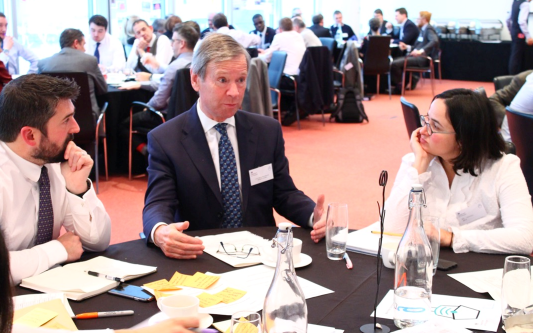
 Participants in discussion at Futures Lab
On 28 February, we joined over 80 stakeholders at our ‘Futures Lab’ to debate the policy challenge: “How can we establish the UK to be a world leader in the uptake, development and use of smart shipping, where appropriate, and ensure benefits are shared widely by industry and citizens?” The day was opened by Nusrat Ghani, the UK Shipping Minister.
The morning focused on the ‘what’ and ‘why’ of maritime autonomy. The afternoon was given over to the ‘how’, exploring how government could support industry to meet the challenge. We encouraged tables to debate and even completely re-write the challenge. Investing a lot of time thinking about how to generate this sense of involvement and participation proved key to stakeholder buy-in.
We began with an evidence discovery exercise, presenting groups with our discussion cards and asking them to assess them in terms of significance and point out anything they thought we’d missed.
We then considered each group’s ‘hopes and fears’ for the policy. Participants were encouraged to consider end-users affected by autonomy (with some picture-drawing involved!), potential utopian and dystopian futures, and seven major roles government could play. Some activities took stakeholders out of their comfort zones, but participants threw themselves into the activities with great enthusiasm.
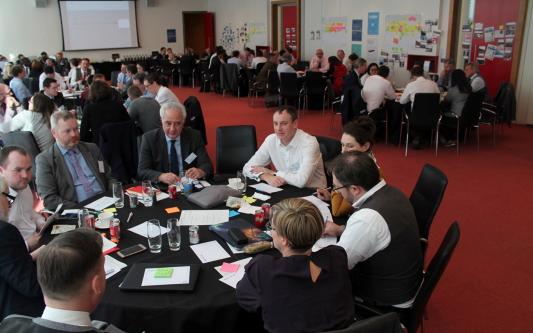 Engaging in discussion about the future of shipping
Each table fed back three key points from their day's discussions to the Maritime Director, Roger Hargreaves. Transport Secretary Chris Grayling closed out an intense and intellectually stimulating day at an industry networking reception that evening.
Our Futures Lab helped to raise the profile of Maritime within government and gave our stakeholders a real sense of ownership in our policy area, reflected in their excellent feedback. The output will form an integral part of our Smart Shipping Routemap. It was inspiring to work with an industry known for its somewhat conservative approach to strategising and forward-thinking, pushing them and us to think seriously about the future through unusual exercises. Inspired by working with Policy Lab, our key takeaways for more open approaches to policy development are:
ul.not-bold li { font-weight: 300;}
- Know your stuff: the most important way to build credibility with your stakeholders is to show you’ve done your homework. Provide materials and discussion prompts that show stakeholders you understand your policy. This also pre-empts hearing things you already know.
- Balance structure with flexibility: our stakeholders appreciated the focus of our agenda, but we made sure to foster a comfortable environment in which they could express their views.
- Choose your people wisely: good facilitation is vital. Why not invite other technology- and innovation-focused policymakers in your department to help them understand what you do, build relationships and share ideas?
- Why not choose facilitators who work in similar policy areas across the department to help them understand what you do and build relationships? At DfT we have separate teams that work on automation across all different modes of transport, and bringing them in to help was a good way of ensuring that we weren’t working in silos. Bringing people in from outside the sector often provides a fresh perspective on policymaking.
- Get senior buy-in: ministerial support helps attract high-profile stakeholders and sends a message that government takes them seriously. Having senior champions helps get things done.
- Don’t be afraid to innovate: pushing people out of their comfort zones can pay dividends, provided you manage it carefully.
(Picture Credit: Pexels)
David Kenrick
Catrin Rees
Matthew Crane
Make sure to share your own thoughts with the author by leaving a comment below

Log in or sign up to continue the conversation