
“Stunted kids are kids that you normally see on the street – they could be chubby kids, it’s very hard to tell. It’s an invisible epidemic because if you see a child and you don’t know their age, it’s impossible to tell whether they’re stunted or not.”
Alessandra Marini, a senior World Bank economist, explained what makes stunting such a difficult public health crisis to deal with. Affecting one in four children under five globally, chronic malnutrition can hamper their long-term health and cognitive development.
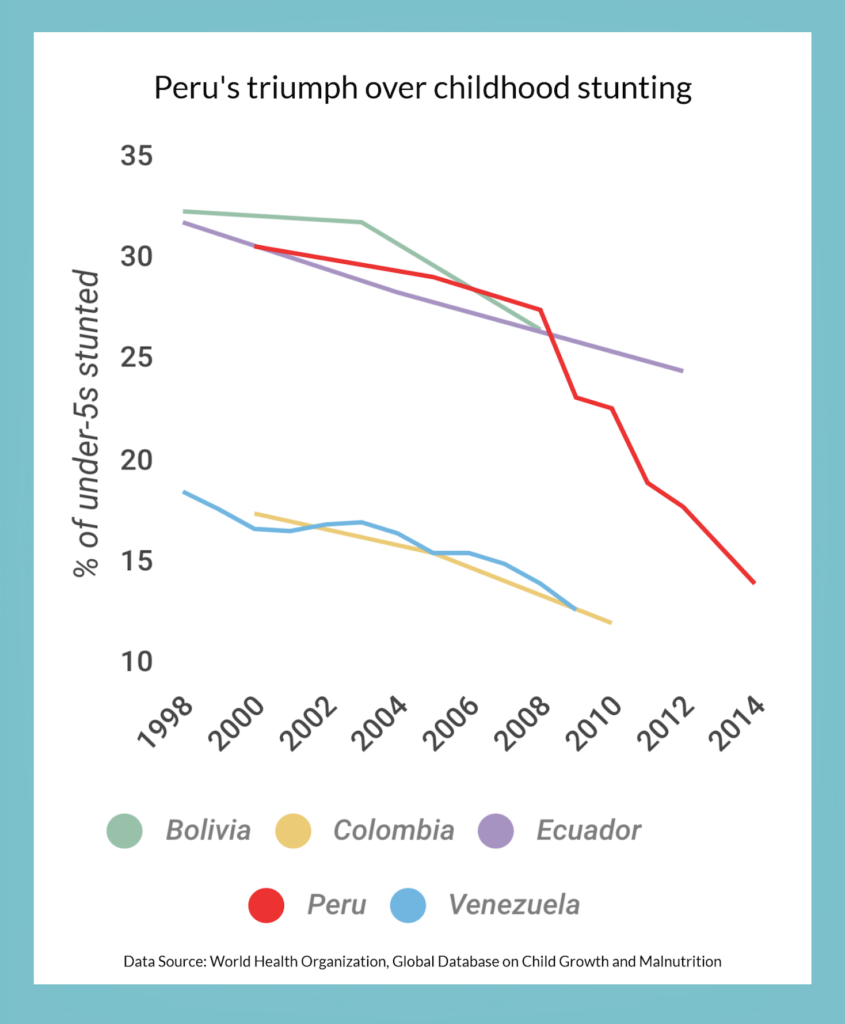
In Peru, however, the government has achieved staggering results in cutting the stunting rate, which was formerly one of the highest in South America. The country more than halved its rate of chronic malnutrition among children under five, from around 28% in 2008 to 13% in 2016. As a result, an estimated 377,000 young kids avoided stunting between 2007 and 2016. Many countries in the region experienced economic growth, but Peru's acceleration in cutting stunting was a result of structural changes in its approach.
At the heart of this was a Conditional Cash Transfer program (CCT) known as “Juntos”. Launched in 2005, the program gives 200 Peruvian Soles ($61) to mothers in poor families every two months in return for them regularly taking their young children to check-ups at health centres. As a result, attendance for growth check-ups for children under three increased from 24% in 2008 to 58% in 2016, and in rural areas 21% to 66% over the same period.
Cash transfers were just one part of a much wider effort, though. A shift of this scale could not be achieved with any one intervention, but only with systemic reform to government itself. From the structural reform of social sector spending, to the powerful use of data for targeting resources, Peru shows how structural changes can lead to huge impact.
How has it worked?
The nation’s success has been made possible by a very supportive political climate, ever since chronic malnutrition first came onto the national agenda around 2005. Lobbying by civil society was making politicians acutely aware of Peru’s high stunting rate, which was hardly changing in spite of rapid economic growth.
The Mesa de Concertacion de Lucha Contra la Pobreza (MCLCP – Poverty Reduction Roundtable) was set up, which became a platform for creating collaboration against child poverty at every level of government. At the 2006 presidential election all major candidates signed the “5-by-5-in-5 Goal”, targeting a five-percentage-point drop in stunting among under-fives within five years.
Reforms were driven by the Peruvian Ministry of Economy and Finance (MEF), which established a Results-Based Budgeting (RBB) system in 2008. This included analysing stunting rates in different areas and targeting resources to where they were most needed. Using real-time data, they could work out which interventions were creating impact or not, and make changes accordingly.
"It was very hard for them to see that the problem was real"
“Peru did a very good job at keeping track of what was happening, keeping track of money and the results, and were very good at publishing those in a regular fashion,” said Claudia Rokx, Lead Health Specialist at the World Bank. “That also helped people see immediately what was working and readjust if needed.”
“It wasn’t necessarily translated into more budget going to nutrition, it was really the reallocation,” she said. “For example, food is not always the answer but takes up most of the budget. To reallocate that is often a very political, difficult decision – they managed to do it there.” The MEF worked closely with other ministries, such as the Ministry of Health, who even had public servants sitting in the MEF’s offices.
Maximising impact
Close collaboration was key for the number of different major policies introduced, which were all designed to converge on targeted areas of need. Alongside the RBB and Juntos program – which was run from the Prime Minister’s office, then by the new Ministry of Development and Social Inclusion – improvements were made to health services as demand increased, the Integral Health Insurance Program (SIS) for the poor was expanded in 2005, and a national nutrition strategy “Crecer” (To Grow) was created in 2007 to target highest-risk groups with nutrition interventions.
“They really restricted it to the most critical period of life when you can still have an impact on malnutrition,” said Marini, who led the World Bank team in Peru from 2007 to 2016. “They started to prioritise interventions for children younger than two, not only younger than five.”
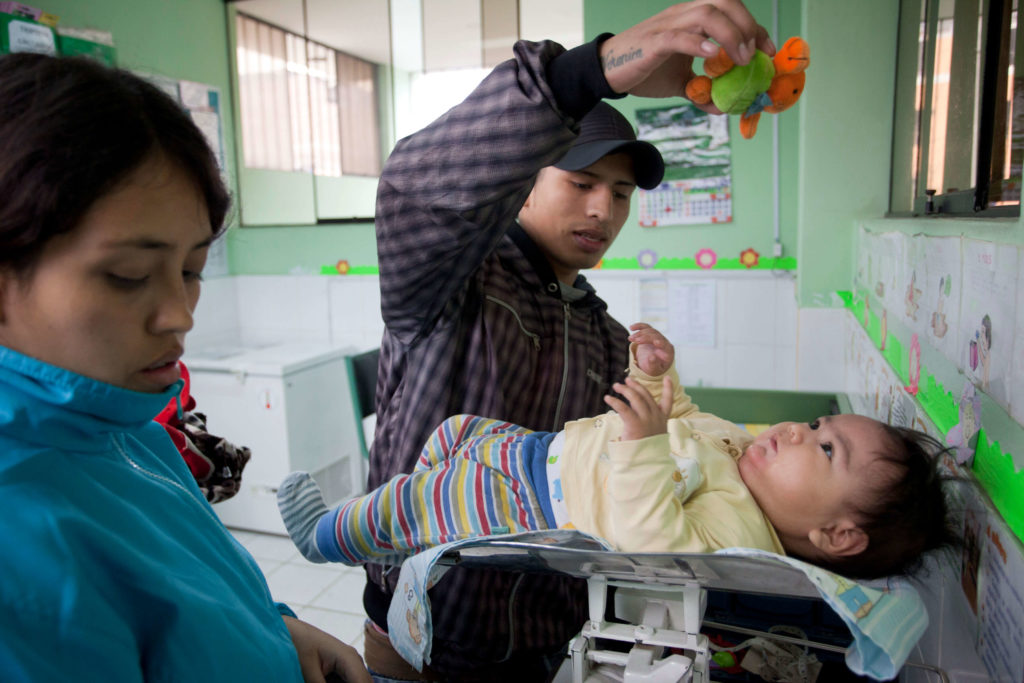 A baby gets weighed at a health clinic in Lima, Peru
Working alongside the World Bank, in 2008 the government set up a multi-sectoral group to analyse how Juntos was working on a local level, focussing on Apumirac, a poor region in southern Peru. “We picked a community which was kind of our live laboratory,” said Marini, “and helped us understand in real practical terms what is going on in the implementation of Juntos and its links with the health and nutrition sectors.”
Called “Grupo Apumirac”, the team found a number of critical elements which could be restructured in order to maximise impact. For example, mothers were receiving cash irrespective of their number of children, which disincentivised them from declaring all of their kids for check-ups, so they began paying more for more children.
“It then led to a result-based operation that the World Bank designed with Peru,” said Marini, “which was the first operation that was purely based on results.” This meant that the World Bank would transfer development policy loans to the MEF on the basis of its progress in reducing malnutrition – using data on results to increase accountability.
The invisible epidemic
“It was very hard for them to see that the problem was real,” said Marini. “What everybody had in their mind was malnutrition meaning hunger, meaning skinny kids, meaning inflated bellies. That was the image that journalists, politicians, and even the directors of hospitals had.”
Policymakers in government, NGOs and international organisations needed to make people understand stunting and its importance, from senior public figures to mothers with new-born infants. One of the ways they did this was through large-scale communications campaigns, including broadcasting videos to educate the public. While it’s difficult to measure, over time they saw a shift in popular attention as stunting became a high-profile issue in Peru.
Another challenge for implementers like the World Bank was making sure that personnel changes in government didn’t harm the focus on childhood stunting. “The changes in technical teams happen very often,” said Marini, “so you really have to start again, and you need to make sure that the priority – that is well understood at the top level – goes down to the directors of the program.”
While stunting rates across the country have been slashed, some communities in Peru are particularly difficult to reach – especially those in the Amazon and other indigenous regions. “How to adapt that to the local culture, to the local beliefs, is a big challenge” Marini said, “which I think is the reason why the rate is still so high in these areas.”
"It has intergenerational effects: women that are small give birth to smaller babies. You have to break through that cycle"
For example, Marini explained, “for risky births and pregnancies, mothers would be asked to move near the hospital and stay there without their husband and family.” Premature babies in particular are at a much higher risk of infant mortality, and of being stunted in the long term. In case of emergency, an indigenous mother and child could be hours from any medical attention, but many are reluctant to move far away from their communities.
“You really need to be creative with your interventions,” added Rokx, “and make sure that the quality of the services provided in those areas are similar to the other areas. This is where the targeting comes in.”
There is also a danger that the success against stunting engenders complacency, and that other important public health issues are prioritised at its expense. “They’re really starting to focus on anaemia,” said Rokx, which affects four out of every 10 children and impairs their cognitive development. “But they should not forget about stunting – which remains high in certain areas.”
A model for others?
Undoubtedly, Peru’s economic boom helped in its success against stunting. Between 2002 and 2013, the Peruvian economy expanded at an annual rate of 6%. However, economic growth long-preceded “the accelerated reduction in stunting rates,” which “is likely to be due to the systemic policy changes,” according to the World Bank’s report.
“They first restructured the way spending was happening in the social sector – they were very keen on admitting growth could not last forever,” said Marini. “The comparison with other countries that experienced similar growth rates, and did not manage to reduce malnutrition at such a high rate are a testimony to it.” For example, Ecuador enjoyed a very similar boom in GDP growth.
Peru’s reduction in stunting has not gone unnoticed. Government representatives have visited the country from all over the world, including Cameroon, Ecuador, Guatemala, Indonesia, Madagascar, Mozambique and Tanzania. Now that these nations are aware of the problem, they are desperate to replicate the kind of results which Peru have enjoyed.
“We know the damage that chronic malnutrition does,” said Rokx, “and it has intergenerational effects: women that are small give birth to smaller babies. You have to break through that cycle.”
(Picture credits: World Bank/Dominic Chavez)
Jack Graham
Make sure to share your own thoughts with the author by leaving a comment below

Log in or sign up to continue the conversation