
Innovative policy is often concentrated in cities. When funding is low, providing small, isolated communities with services may seem high-cost and inefficient.
But today, more than three-quarters of the world’s extreme poor live in rural areas, and 70% of the world’s poor are women.
On almost every measure of development, rural women fare worse than rural men or urban women. And while there are major differences between the Global North and South, many of same problems persist: a lack of infrastructure and services; a need for decent work and social protection; exclusion from leadership and decision-making; and the harmful and violent effects of restrictive gender norms.
In the US, women outside cities marry earlier, experience higher rates of domestic violence, have limited access to good healthcare, and are less likely to earn a university degree.
In developing countries, meanwhile, 43% of agricultural workers are women - but they often don’t have rights to the land, have limited access to water, fertiliser and seeds, credit, and training, and spend more time on unpaid work than rural men and urban men and women. Child marriage is particularly prevalent in rural areas.
Rural women - who make up more than a quarter of the world’s total population - are underserved, from Montana to Mozambique.
But empowering them benefits everyone. When women have access to land, there are improvements in household welfare and agricultural productivity. It is estimated that if women farmers had access to the same resources as men, there could be 150 million fewer hungry people through the rise in output.
Things may be starting to change. This year’s UN Commission on the Status of Women has as its priority theme the empowerment of rural women and girls. And, around the world, there are a number of new innovations and policy solutions targeting this often neglected group. Here, we share some of the best.
Gender in access to resources: entrepreneurship and credit
Women farmers make up almost half of the agricultural labour force in the developing world, and, in several parts of the Global South, this share is increasing. As men migrate to cities and abroad, some are arguing that we are seeing the “feminisation” of agriculture. From 1980-2010, the share of women employed in agriculture increased from 30% to 48% across the Middle East and North Africa. And now, on any given day, most of the people working India’s hundreds of thousands of family farms are women.
But women’s jobs in agriculture are still more precarious; women are overrepresented in unpaid, seasonal and part-time work, and often the majority of rural jobs for women are in the informal economy.
Furthermore, women farmers cannot be as productive as their male counterparts as they have limited access to critical land and assets. Less than 20% of the world’s landholders are women, and women farmers are less able to access credit, agricultural inputs like irrigation and seeds, markets and food chains, and information about weather and climate through the internet or mobile phones.
These gendered limitations destroy productivity and incomes; but projects that target women farmers are starting to make a difference here, too.
In Mexico, a rural finance project has extended credit lines to 40,000 farmers and small rural businesses, with the average loan totalling $2,000. Women account for 78% of recipients, and 6% of them are first time borrowers. On a smaller scale, in China’s Ningxia Hui region, the UN has helped women farmers - who have less access to irrigation technologies - to learn about, acquire and maintain advanced irrigation systems.
Another avenue to extending resources and services to the hardest-to-reach women is through women’s entrepreneurship. Only one in 10 Internet users in rural India is a woman. To improve their access, the Saathi program enables other, internet-savvy women on bicycles to travel to nearby villages with tables and smartphones, so far reaching more than 300,000 women in 18,500 villages.
In a similar scheme, Bangladesh is bringing the internet to isolated rural areas through a social enterprise that empowers women to become entrepreneurs. The women, known as Kallyani, travel between villages via bicycle, bringing with them a laptop, tablet, smartphone, Wi-Fi hotspot and digital camera that villagers can use.
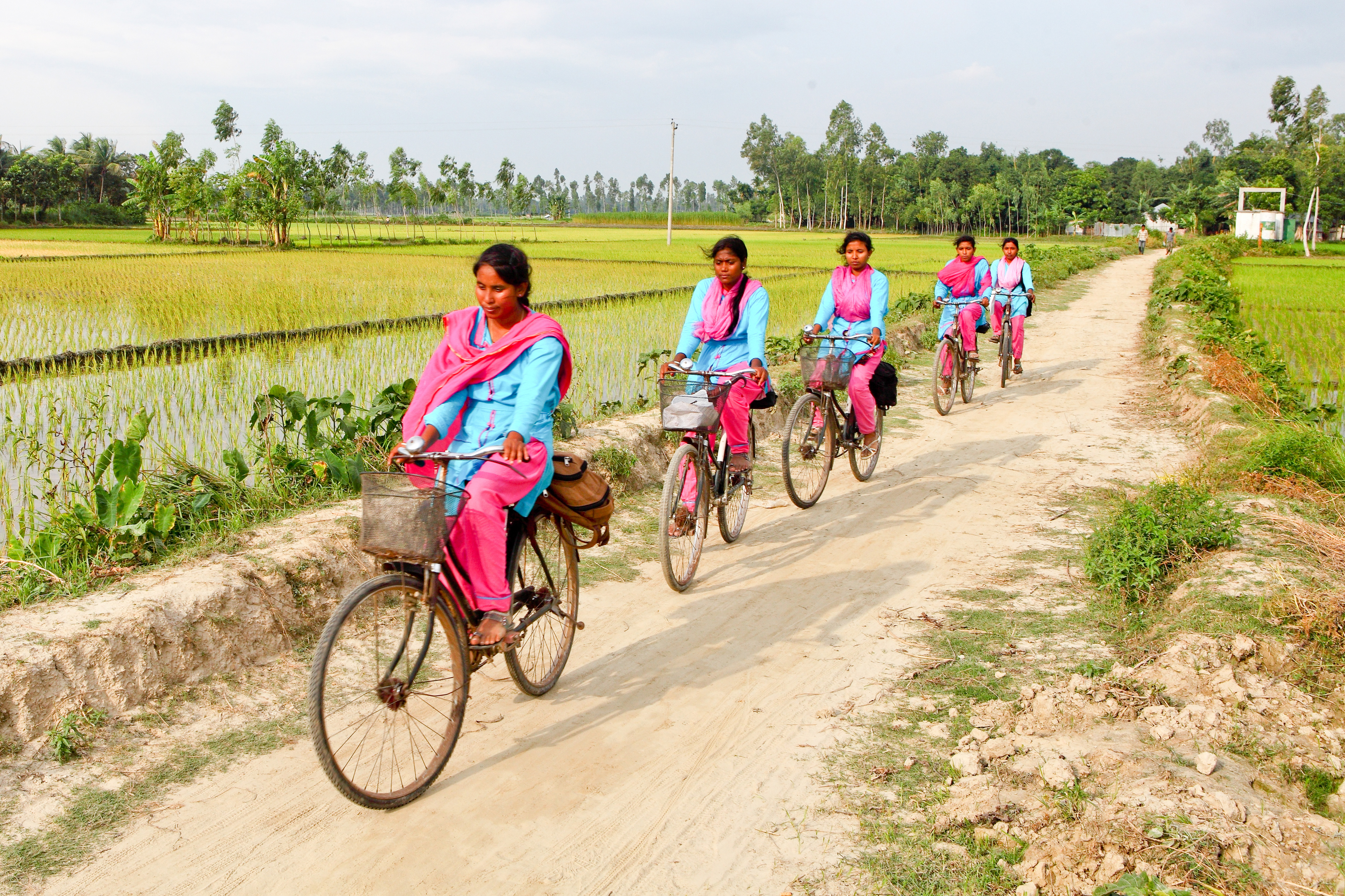 Kallyani bring technology to villages in 16 Bangladeshi districts on bike
Healthcare: technology and community workers
In rural areas, women’s barriers to accessing health information and care provision are often particularly acute, from sexual and reproductive health to domestic violence, cancer and HIV.
In the US rural women are less likely than urban women to receive preventative screenings, and breast cancer is diagnosed later. A 2011 study found Americans in rural and isolated areas report the highest prevalence of intimate partner violence at 22%, compared to 15% of urban women.
In the least developed countries, a rural woman is 38% less likely than an urban woman to give birth with the assistance of a skilled health professional - a well known, preventable cause of maternal death. Rural women in Australia are more likely to die giving birth, and 130 rural maternity units closed in the 10 years since 1995.
Leveraging scarce and stretched professional medical resources over a diffuse population is no simple matter, but some solutions have seen success.
New Zealand is using mobile breast cancer screening services that travel around the countryside to help women get screened and detect cancer early. In the US, the state of Massachusetts’ is using a telephone hotline to leverage the time of scarce, specialist psychiatric professionals in order to combat maternal depression.
Others employ the community and its people. Uganda has partnered with a nonprofit that empowers rural women to become micro-entrepreneurs who sell low-cost, life-saving health treatments to their neighbours.
And Mexico is training traditional midwives in modern medical techniques to help provide culturally sensitive, professional support to support rural and indigenous mothers can’t (or don’t want to) access the main medical system. The WHO supports the use of trained midwives; saying more than four in five maternal deaths could be averted with proper midwifery care.
Data: The World Bank
Data for impact
However, to really generate the political will to make change, what may have the most powerful impact is better, gender-sensitive data on the lives of rural and poor people.
Currently, we measure the poverty of households, not individuals, but the reality is that an elderly grandmother and her twenty-year-old grandson living under the same roof experience deprivation in different ways and to different degrees. And, while 53 of the 230 SDG indicators are gender-related, there is no agreed-upon methodology and limited data availability for close to 70% of these.
The Australian Government has invested $12,3 million AUD ($9.5 million) in a new gender-sensitive poverty metric which measures individuals, not households, and assesses poverty on multiple dimensions beyond money, including access to food, clothing, family planning, and freedom from violence.
It has the potential to provide relevant data for 25% of the gender-related SDG indicators, and has been piloted in several countries. In Nepal, the Individual Deprivation Measure revealed that men own 61% more assets than women, and in Fiji, that more than twice as many women as men suffered health problems linked to unclean cooking and heating fuel.
(Picture credits: Flickr/ United Nations Photo, Infoscape)
Odette Chalaby
@odettechalaby
Make sure to share your own thoughts with the author by leaving a comment below

Log in or sign up to continue the conversation