
In 2017, city leaders announced plans to designate some of the world’s most iconic streets for pedestrians. Mayor of London Sadiq Khan will ban cars from a section of Oxford Street in London by the end of 2018, while his counterpart in Paris, Anne Hidalgo, has pledged to halve the number of private cars in the city and close off a kilometre of busy road for pedestrians. Since 2016, Barcelona city planners have been gradually building car-free “superblocks” in the city’s districts, diverting cars to surrounding roads.
For advocates of pedestrianisation, there is a sense that more and more cities are now moving in the same direction. In 2009, former New York City transport commissioner Janette Sadik-Khan had to work against considerable opposition to pilot a scheme that turned sections of Times Square over to pedestrians. The following year, thanks to a good public response, higher numbers of pedestrians and a reduction in the number of injuries to motorists and passengers of over 60%, the scheme was made permanent.
“I think, for many reasons we are in a very exciting time,” said Skye Duncan, Director of the Global Designing Cities Initiative (GDCI), a non-governmental program set up by the American National Association of City Transportation Officials (NACTO), which helps cities worldwide to redesign their streets.
Duncan believes that pedestrianisation is now building momentum in some of the world’s big cities. “But I wouldn’t want to claim that people haven’t been making this argument for decades already - there’s been a lot of people around the world fighting for a better future for a very long time,” she said.
Despite the benefits that pedestrianisation can bring to city streets - safer environments, cleaner air, and better business for shops and attractions - these changes have been difficult to get off the ground, and even harder to maintain. There have been calls by many in New York, including current Mayor Bill de Blasio, to rethink the changes to Times Square.
Turning streets over to pedestrians inevitably reduces the space left for cars, and can lead to an increase in traffic on surrounding roads. Some have claimed this happened in Times Square. It also attracts entertainers keen to take advantage of visitors: in 2015, there was an uproar over topless women painted with the colours of the American flag charging for photos with tourists. Turning streets into plazas can bring new pressures to cities.
“These are often very affordable, fast mechanisms using paint and chalk to help to show people what’s possible”
Using pilot projects to test pedestrian zones can be the means for cities to weigh up their pros and cons. “When we worked for the city of New York, we noticed that they don’t want to be the innovators - because that’s where you make the mistakes,” said Duncan, who was brought on board to the GDCI by Sadik-Khan to work on replicating the Times Square model elsewhere.
“What they can do is take what smaller places are doing and do it bigger, better and louder, so that more people then sit up and take notice.”
Pedestrianisation can be trialled simply by repainting streets - which can be an easier, inexpensive way for smaller cities to test if it works. GDCI is working with five cities from across the world to experiment with urban space, using street design techniques that can be adopted in a few hours to transform urban areas into places where pedestrians, rather than cars, take priority.
“We work with the cities to get projects on the ground very quickly,” said Duncan. “These are often very affordable, fast mechanisms using paint and chalk to go out and change geometries, to help to show people what’s possible.”
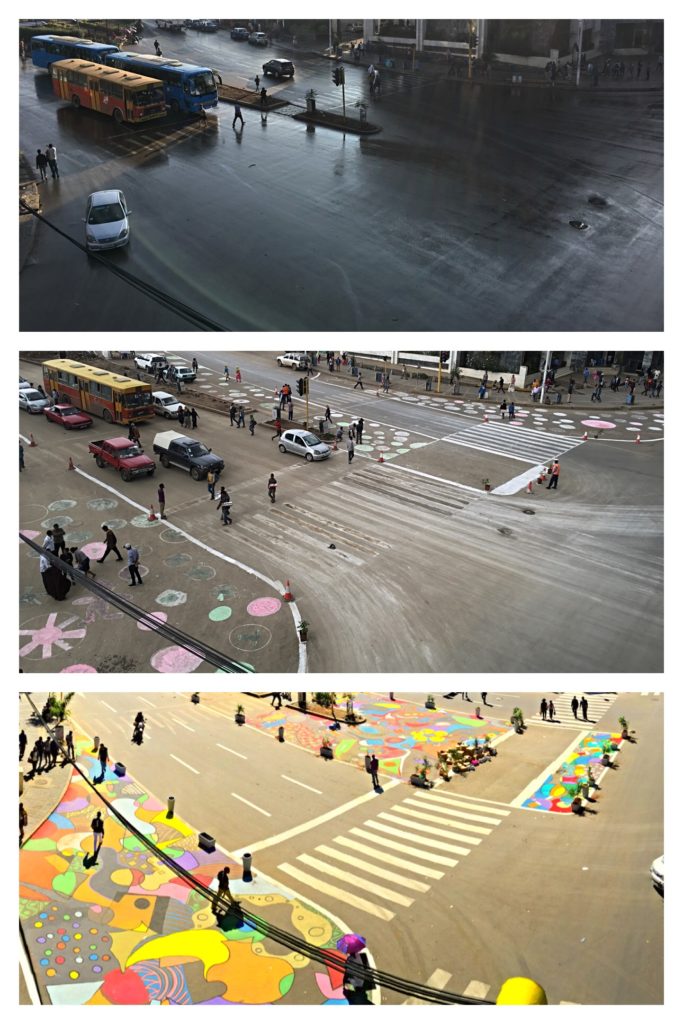 A GDCI redesign of an intersection in Addis Ababa
GDCI, funded by Bloomberg Philanthropies Initiative for Global Road Safety, has completed pilots in Addis Ababa in Ethiopia, Sao Paulo and Fortaleza in Brazil, Bogata in Colombia and Mumbai in India. In each of these examples, GDCI planners worked alongside city authorities and communities to literally redraw the street lines, marking out space from streets for pedestrian use, and reducing the space available for cars.
“They said they never thought they’d see kids play in front of their businesses"
“Working with the City of Fortaleza in the North of Brazil and our partners at the World Resources Institute, we did this project at the end of last year [2017] where we took this central area filled with parked cars and vehicles moving through, and for a ten-day period we closed it off using light and paint and chalk. We put in large play areas, plants and places to sit,” said Duncan.
By the end of the pilot, the share of pedestrian space had increased from 21% to 73%, while the number of pedestrians using the area increased by 350%.
“Within a few days the local business owners had created their own petition to say they wanted it to be permanent,” said Duncan. “They said they never thought they’d see kids play in front of their businesses, and so the mayor said he’ll make this permanent. Now we’re going to work with him this year to make that a city-wide program.”
One area in Sao Miguel, an eastern district of Sao Paulo, saw 1,285 car crashes per square kilometre, compared to the city average of 178 crashes per square kilometre between 2009-2016, according to figures from the city's traffic agency. City workers and GDCI staff redesigned an intersection within five hours by painting streets and using plants as markers. As a result, they increased the pedestrian area and narrowed the space available to cars.
Over the course of the pilot, which lasted a day, average car speeds fell by 30%. A public survey found that 97% of locals supported making the changes permanent.
GDCI has published a guide to help cities worldwide trial their own projects, and are building a network of partners. They currently have 35 cities and 25 organisations which have committed to following the approach.
(Picture credit: Global Designing Cities Initiative)
Anoush Darabi
anoush.darabi@apolitical.co
Make sure to share your own thoughts with the author by leaving a comment below

Log in or sign up to continue the conversation