
“My dad loved to sing. I wanted to be part of that, just to be around it.” Kolbassia Haoussou, who has lived in the UK since being granted asylum in 2005, is one of the members of Sing For Freedom, a London choir run by the charity Freedom From Torture. “It’s kind of therapeutic,” he said. “When you’re singing, you don’t think about anything else.”
Music is only one part of what makes the choir valuable to people like Kolbassia. The group is made up of a mix of refugees, asylum seekers and native British residents. “The choir’s for everybody,” Haoussou said. “It’s a good mix of people, that gives this feeling of welcoming.”
According to a 2013 report from the UN’s refugee agency, only 12% of refugees in France knew a French person. Severe social isolation is often overlooked as an obstacle to refugees’ integration. Initiatives like Sing For Freedom, which bring refugees and locals together over their shared interests, are starting to change that.
Loneliness makes it hard for refugees to settle
“Pretty much all” refugees lack the networks of friends and family that locals, or even immigrants who moved voluntarily, enjoy, according to Jenny Phillimore, director of the University of Birmingham’s Institute for Research into Superdiversity. The French figures, she said, are “completely unsurprising”.
This social isolation can hinder refugees’ ability to settle in a new country. “Our work indicates, in the most explicit terms, that the lower number of social networks you’ve got, the poorer your integration outcomes,” Phillimore said.
“Everything has to be done with, not for, refugees. That is the key to creating social capital.”
The Sing For Freedom choir — which performed at the Barbican in the summer of 2018 as part of the ‘Singing Our Lives’ concert — helps create these social links. But projects like it work at a relatively small scale.
In France, however, a social enterprise called Singa has been working since 2012 to facilitate connections in larger numbers using online tools.
“The founders had a few friends who were refugees, and they realised that the key to integration was not just learning French,” said David Robert, chief operating officer of Singa France. “It was about creating common social capital among refugees and locals. So the idea was to create some inclusive tools, to make it possible for any citizen to create links with refugees.”
Singa began with an app that matched locals and refugees with shared interests — from playing football to visiting museums or the theatre — and encouraged them to meet for a few hours a week.
It has since expanded to run a housing program, Comme à la maison, matching refugees with hosts based on their interests and work areas, and entrepreneurship initiatives including a professional buddy scheme and several incubators.
The common principle, Robert said, is to bring refugees and locals together on an equal footing, rather than as volunteers and beneficiaries. “Everything has to be done with and not for refugees,” he said. “And every group, every meeting has to involve about equal numbers of refugees and locals. That is the key to creating social capital.”
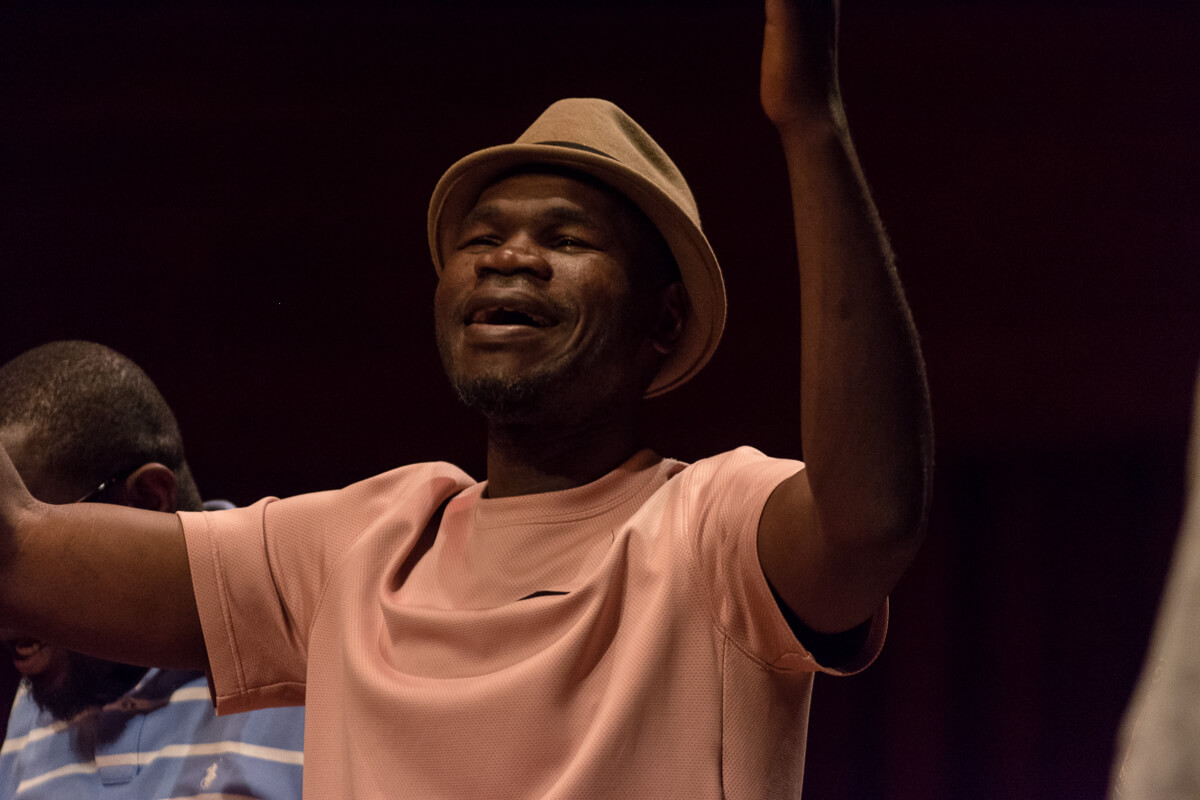 Kolbassia Haoussou sings during the Singing Our Lives concert in London
It’s the same idea that drives the Sing For Freedom group. “When you’ve just come here, for some people it’s really hostile,” Haoussou said. “It’s not easy to find a place where everybody’s friendly, and there are different kinds of people together.”
Social inclusion boosts integration outcomes
The benefits of these projects go well beyond the feel-good factor. The Community Integration Partnership was a similar programme, focused on mothers of young children, in Birmingham, UK. Phillimore said an evaluation found a significant positive impact on women's ability to support their children at school, helping them feel confident engaging with their local community.
New branches of Singa have now opened in Germany, Belgium, Switzerland, Italy, Canada and the UK. The original French group commissioned a study last year to evaluate the impact of its activities, which Robert said now reach 25,000 members in seven cities — approximately 4,000 refugees and 21,000 locals.
The report’s sample size, Robert emphasised, was relatively small. But it found that refugees who participate in Singa activities are more likely to find work, be in stable housing and learn French quickly. “We know that you multiply your chance to have a job by four, three people in ten can go back into study or training, and six people in ten have indefinite housing,” Robert said.
But bringing people together over shared interests alone isn’t enough. Making social connections is very difficult unless refugees can learn the basics of the language and get help with psychological trauma, both of which require professional support. “Both methods are meant to collaborate,” Robert said. “One cannot function without the other.”
Not just a refugee
Where they are viable, projects like Singa’s can be a vital part of integrating refugees into their new society. Creating an opportunity to interact with locals that isn’t focused on charity can be extremely valuable.
For Haoussou, being in that kind of mixed group is a major part of what makes the Sing For Freedom choir so worthwhile.
“We don’t want to be defined by our struggle, but to have people understand and think ‘they are normal people like us’,” he said. “When people can see similarities to their own lives, that is how we integrate better and that is how life is easier for all of us.” — Fergus Peace
(Picture credit: Sarah Hickson/Together Productions)
Make sure to share your own thoughts with the author by leaving a comment below

Log in or sign up to continue the conversation