
When summer comes to Berlin, everyone goes swimming. Though landlocked, the city and its surroundings are dotted with public lakes.
It’s not always a good idea. Because of the canal system which runs through the city, after periods of heavy rain, wastewater from households can end up in the lakes via the river Spree.
Because no-one wants to swim in Scheiße, on 2 July the city released an online tool to help solve the problem. The tool uses data drawn from the cities' agencies to predict the daily water quality of the city’s lakes. Before planning a trip, residents can check a forecast of the condition of each lake to help them reach a decision on which ones are safe to visit.
• For more like this, see our digital government newsfeed.
As the combined work of tech experts, scientists and public servants, the project is a rare example of digital innovation in a country which has struggled with it in the past. Its success could act an example to help encourage public servants to experiment with using new technologies for the public good.
Siri, is the water nice today?
The tool was developed by Technologiestiftung Berlin (TSB). “The question was whether we could develop an early warning system to alert people in advance that they shouldn't go bathing,” said Dr Ben Seibel, who heads the TSB’s Ideation & Prototyping Lab.
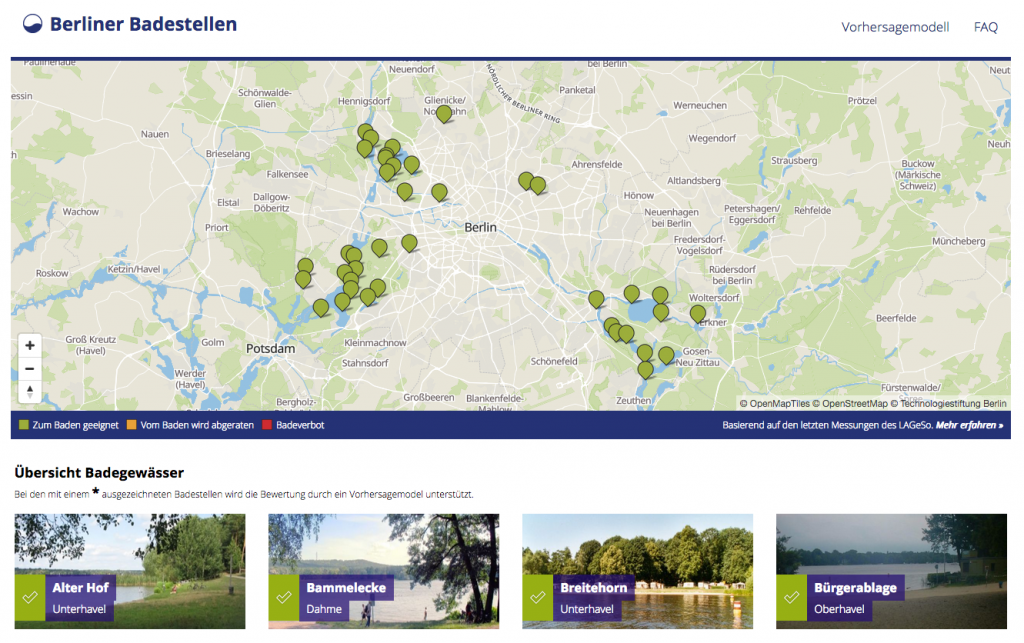 A screenshot of the tool's map view
Working with the region’s water quality body and health ministry, the tool pulls together data on rainfall, sewage levels and the speed of flow in the city’s waterways to make a prediction of water quality in Berlin’s public lakes. These are mapped onto an online plan of the city.
Making Berlin smarter
The project marks a milestone as Berlin attempts to realise its smart city potential. In Germany, the public sector has been relatively slow to adopt digital technology.
"Everyone talks about innovation, but far too few actually do anything"
“The digital transformation of German politics isn't running particularly smoothly,” said Seibel. “There's a lack of IT experts in government, and the structures themselves aren't designed for a digital transformation — that means these new developments of digitalisation are taking place in old structures and institutions.”
But TSB changed its approach last year. Whereas previously it would advise and write research papers on new technologies, it has since used its team of technology experts to quickly deliver viable services and products for the city.
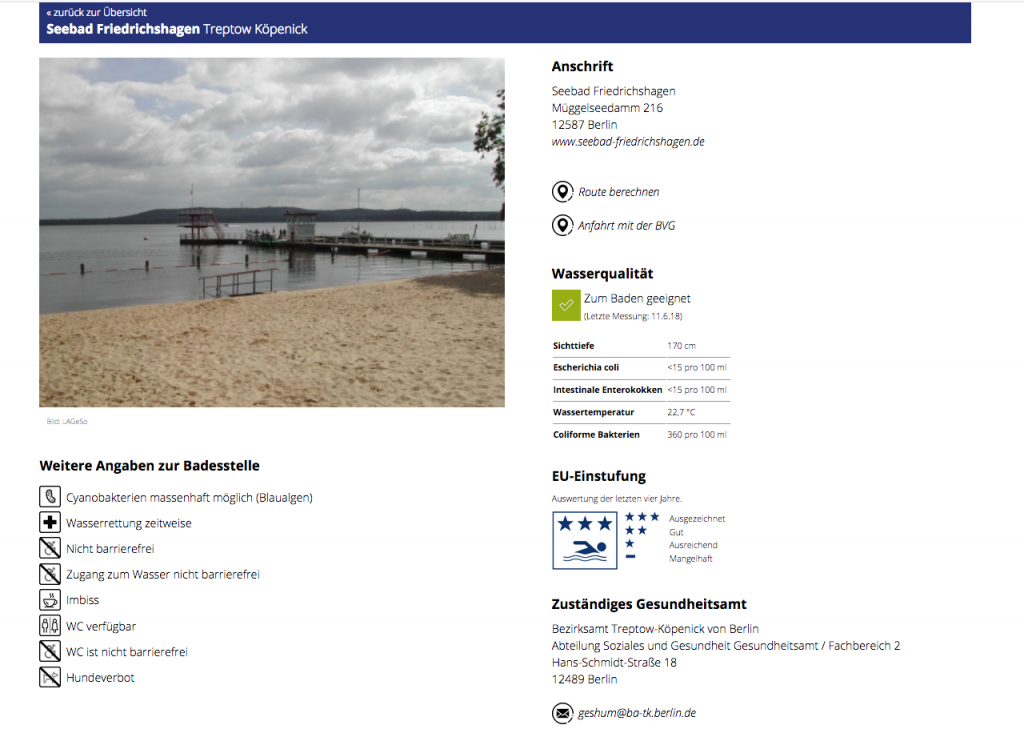 Users can select individual lakes to access water quality forecasts
A small team of developers at TSB work on projects which allow them to build working prototypes over the space of a few weeks. “One of the problems we noticed in innovation politics is that everyone talks about innovation, but far too few actually do anything,” said Seibel. “Politicians themselves mention that there are always loads of possibilities, and they express a willingness to try them, but in the end nobody does it.”
Unfortunately, working with government on innovation continues to be difficult. For Seibel, the traditional bureaucratic structures in the country work to slow down digital reform. For instance, excessive oversight and hierarchies can hamper attempts to use the fast paced, experimental approach favoured by software developers.
But the answer, TSB believes, isn’t avoiding government, but showing it how quick, effective digital projects can improve the city. Besides the water quality tool, the team has completed a project using the videogame Minecraft to help involve children in the planning of urban space, a portal to show available kindergarten places and an ongoing scheme it’s working to encourage local government to work with open data.
The water-quality tool has been released just in time for Germany’s summer holiday: it may help to show government the benefit of experimentation, and elevate Berlin, and Germany, into a higher tier of digital government. — Anoush Darabi
(Picture credit: Pixabay/summerjane85; Technologiestiftung Berlin)
Make sure to share your own thoughts with the author by leaving a comment below

Log in or sign up to continue the conversation