
This article is written by Dr Emma Whittlesea, Senior Research Fellow at Griffith University, Australia.
Climate policy is notoriously complex and poses significant opportunities and challenges for other policy domains.
This is true from both an adaptation perspective, where governments prepare for and adapt society for a changing climate, as well as from a mitigation perspective, where governments and public servants work to drive down emissions.
As a policymaker or public servant, you are no doubt increasingly becoming aware of climate change, together with the risks and opportunities it might bring. However, you might feel that these changes have yet to be manifested in changes to policy making and practice — especially if you work in a sector or policy domain that sits outside the core climate or environment departments.
Inconsistencies between policies persist and trade-offs between climate policy and sector policies or plans are often not understood, or are ignored.
Policy integration is more likely to have support if the costs and risks associated with non-integration and the co-benefits of integration are understood.
The same is true here in Australia where we have experienced a number of U-turns on climate policy at both Federal and State government level, reflecting the fact that climate policy efforts can be vulnerable to politics and short-term thinking.
Those working in the climate policy field continue to grapple with this dilemma of shifting priorities. In particular how they maximise opportunities to strengthen climate policy and achieve change regardless of the politics.
Climate policy responses which need cross-sectoral and multi-level buy-in and leadership and governance structures will have to go beyond conventional institutional responsibilities. This requires high levels of communication and coordination between practitioners in different domains and at different scales. In practice, this means all policy makers and practitioners have a role to play.
How can you most effectively drive positive change?
One of the most meaningful actions public servants can take to advance government’s response to climate change is learning how to collaborate more with their colleagues, with a clear goal of achieving climate policy integration (CPI).
CPI essentially refers to the integration of climate policy objectives into the governance arrangements and policy processes of other policy domains.
This goal requires policymakers from different domains to work together to ensure integration happens. Decisions made need to reflect and react to those made in the other domain(s), in an attempt to avoid conflicting outcomes. There are of course different levels or steps toward policy integration, but primarily it involves coordination and cooperation.
CPI can manifest in two main forms: the first is the specific consideration of different sectors (and the roles they might play in an economy and society) within climate policies. Climate policies and programs that have made linkages to, and align with other policy domains, are more likely to achieve their objectives and get buy-in from other agencies and colleagues (especially if engagement occurred early in the initial climate policy development). The second relates to climate objectives and actions becoming increasingly relevant as a policy and program goal in other sectors and policy domains — ideally with other domains leading.
Queensland Climate Ready Program
An example of a climate change program that makes linkages to and aligns with other policy domains is the Queensland Climate Ready (QCR) program. The program will support the implementation of the government adaptation action plan — Managing Climate Risk:
Actions for Queensland Government (MCR), which aims for a whole-of-government climate risk management approach to policies and processes, investments, services and actions. The program is a partnership between the Queensland Government and Griffith Policy Innovation Hub (PIH) fostering a co-design approach to ensure that climate risk management within Queensland Government is fit-for-purpose. The QCR program objectives are that Queensland Government:
• has a strong understanding across its agencies of climate risks and a capacity to manage these
• has a commonly agreed and understood framework to deal with climate risks in a coordinated way across government
• has demonstrated clear and effective action on priority climate risks
• is accessing and utilising the best available knowledge, skills and resources to address climate risks in Queensland
Queensland Sector Adaptation Plans
An example of climate objectives and actions becoming increasingly relevant as a policy and program goal in other sectors and policy domains, are the Queensland Sector Climate Adaptation Plans — sector led but funded by the Queensland Government. Plans have been developed by, or in consultation with sector and industry stakeholders across eight key sectors. This encouraged collaboration to identify and prioritise climate change activities.
Capitalising on Queensland’s Opportunities in a Zero Net Emissions Future
An example of a climate change program that made linkages to other policy domains is the Queensland Government funded assessment by Ernst and Young into sectoral risks and opportunities of a zero net emissions future. The research reviewed policy needs in response to the risks and opportunities of climate change across 13 regions and eight key Queensland sectors:
How can you integrate climate policy?
Policy integration is more likely to have support if the costs and risks associated with non-integration and the co-benefits of integration are understood. Ultimately, integration is seeking interdependencies between climate and other policy domains, working from independent to shared decision-making, to attain integration through cooperation and coordination. CPI can also reduce potential policy conflict and disputes over responsibilities and accountabilities.
Assuming (or desiring) strong political will and commitment to drive climate policy integration in the first instance, crudely depicted below are four activities that can assist policy integration - an iterative process with no neat logical order:
- Leadership and raising awareness of climate policy within other policy domains, making the case for action and integration at multiple officer levels
- Collaboration and cooperation between actors from different policy domains, co-creating a common understanding of the cross-departmental linkages and authority
- Cross-agency working to determine policy and program entry points in other domains, that can advance climate objectives and attain mutual policy objectives and goals
- Implementation of climate objectives through policy, programs and procedures in different domains including budgets, performance monitoring, standard practice and planning
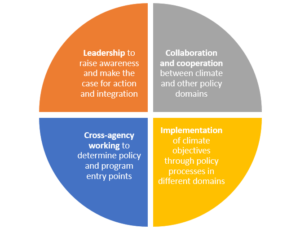 (Image credit: Emma Whittlesea)
The level of effort to mainstream and integrate climate objectives can vary for different policy domains, depending on the specific climate policy goals and challenges. In some policy domains CPI opportunities can be more obvious and advanced, such as energy policy to progress mitigation and disaster recovery to progress adaptation. In others, it can be more challenging such as resource management and state development. Barriers to CPI can include:
- lack of staff resources and capacity
- lack of clearly identified and agreed joint objectives and goals
- organisational fragmentation and competition
- conflicts with traditional and established policy and performance measures.
Other factors of influence to consider are:
- leadership
- regulatory framework and legally binding targets
- organisational culture, dynamics and power relations
- processes for dealing with policy and program conflict.
How can you play your part?
We can all play a role in climate policy integration. It requires support and action from all levels and should be recognised as a legitimate activity for resource allocation.
Cross-agency policy networks and good relationships between government departments play a key role. Policy actors can mutually strengthen coordination to expand climate knowledge and capacity, and to have confidence to learn by doing, as a lot of this is still unchartered territory.
Actors from the climate sector can help by making their expertise and support available to other policy actors and domains, thereby facilitating cooperation. Activities that augment CPI, include a deliberate use of the annual budget as an instrument to implement climate policy, reporting mechanisms and clear accountabilities, re-framing old conflicts, and systems for monitoring and evaluation.
We all have an opportunity to make adjustments in our decision-making that can have an impact, both positive and negative, that either influence the level of emissions released into our atmosphere, or improve or worsen our resilience to changes in climate. Some policy domains are also more important than others as they have potential to affect systemic shifts and change, have larger emissions footprints (such as energy generation and transport), or could have a significant impact in increasing resilience to changes in climate.
All policy domains and departments however, have the opportunity to drive system change through investment, infrastructure, service delivery and every day practices such as procurement and travel.
The opportunity is for us all to work together toward integration in practice, determining the strategic and policy intent and content – whatever our sector or policy domain. For all practitioners and policy officers, we should be working toward a minimum level of climate policy integration, and encouraging and facilitating closer collaborative working to identify and implement the changes required.
Climate policy integration needs to move beyond principles and processes, aiming for appropriate penetration and policy outcomes in all policy domains (recognising some are more critical). Integration in itself should also be a climate policy outcome. Can you play a role? — Emma Whittlesea
👋 You can create a post like this one! Share your thoughts with a community of public servants. Learn more.
(Picture credit: Unsplash)
Make sure to share your own thoughts with the author by leaving a comment below

Log in or sign up to continue the conversation