
Emilia-Romagna is one of the most prosperous regions in Italy. It’s also home to perhaps the greatest density of cooperative businesses in the world—and they account for no less than 30% of the region’s GDP.
Italy, in general, has a formidable cooperative sector. In 2011, there were over 40,000 cooperatives with a turnover of $160 billion, some 12.5 million members and over one million employees. Compare this to the UK, where 7,000 registered cooperatives contribute some $45 billion to the economy. Or to the US, where 20,000 have a turnover of around $200 billion.
Weighted to population, it’s clear that Italy’s cooperative sector is more significant. But in Emilia-Romagna, it’s exceptional.
Many visions of inclusive growth involve expanding the role of the cooperative sector, so Emilia-Romagna makes for a region-wide case study. But how did it come about—and is it something other countries can and should emulate?
The cooperative capital of Italy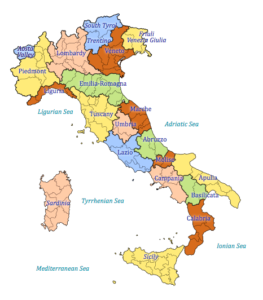
To start with the obvious: Italy’s economy is by no means thriving. So it’s not as if cooperatives are a silver bullet. However, Emilia-Romagna - the cooperative capital of Italy - does have one of the strongest regional economies.
“Emilia-Romagna is the first region for income per capita in Italy,” said Professor Vera Zamagni, an economist from the University of Bologna. “It compares very well to southern Germany. It’s around 35% above the EU average.”
Emilia-Romagna also weathered and bounced back from the 2008 financial crisis better than most of Italy. Two things stand out in its recovery: the strength of its exports and its low unemployment.
“We had a major fall in domestic consumption, so inevitably the entire country was affected,” said Zamagni. “But from the point of view of exports, Emilia-Romagna has been the region that has been most resilient. And indeed unemployment has remained very low in Emilia Romagna, at around 5-6%.”
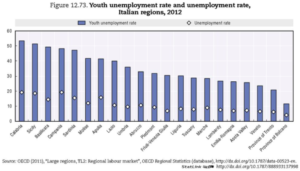
“Throughout the crisis, only the cooperative sector has not diminished in employment,” Zamagni added. “All the rest did, sometimes vastly. But in certain cooperative businesses, the crash actually increased employment.”
Not only did cooperatives continue to hire, but many people who had lost their jobs decided to start their own cooperatives. So, to some extent, the cooperative sector had a stabilising effect on the local economy.
This suggests that increasing the size of the cooperative sector could be a way to enhance economic resilience. And governments should certainly encourage diversity in business size and management in their economies. But to what extent can the Emilian model be exported?
The twin challenges: capitalisation and competitiveness
Above all, cooperatives face two challenges: capitalisation and competitiveness. They struggle to raise investment, and they struggle to compete in the free market.
So how did they rise to prominence in Emilia-Romagna in the first place?
There are historical and cultural elements that are unique to the region. But economic and political support has been integral to the boom in cooperatives.
“First of all, you must note that we are the only country in the world that has cooperatives in our constitution: Article 45 says that any government must support cooperatives,” said Zamagni.
That article set out criteria to define cooperatives and have them registered, rendering them eligible for subsidies and subject to two-year check-ups.
Much of the government support since then has focused on capitalisation. Three laws, in particular, have taken on this problem.
The first endorsed a form of cooperative crowdfunding, which allowed members to loan them money that was subject to lower taxes. This drastically enhanced cooperatives’ capitalisation—particularly in the case of user coops with members numbering in the hundreds of thousands. “These loans,” Zamagni said, “amount to several billion euros.”
The second obliged cooperatives to give 3% of their profits to one of the funds managed by three cooperative umbrella organisations. This money was then used to strengthen the cooperative movement as a whole.
And the third stated that undistributed profits that were set aside in indivisible reserves would no longer be subject to corporate tax. This made it easier to persuade members that profits should not be distributed, and thus boosted the self-financing of cooperatives. “And these indivisible reserves, which are very large in Italy, cannot be distributed—ever,” said Zamagni. “Even if the company is liquidated.”
Government support has been crucial for enhancing cooperatives’ capitalisation. But to improve their competitiveness they have relied on each other.
All Italian cooperatives exist within networks. Those networks connect to other networks, and all sit within huge umbrella organisations that guide the cooperative movement as a whole. These networks give rise to the cooperation and reciprocity that allow companies to access the benefits of economies of scale while retaining their autonomy.
This has allowed cooperative SMEs to work together and excel as exporters in the global market.
The town of Poggibonsi makes a good example. Some 80 small and specialised cooperatives work together in a clustered network of subcontracting to produce woodwork and cabinetry. They export up to 95% of their products—and have made Poggibonsi, a town of 30,000, globally competitive in this area.
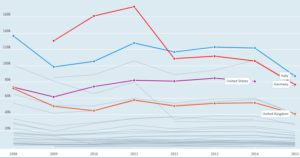
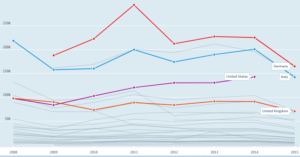
The two graphs below display this effect writ large on the Italian economy. They show the value of exports in millions of dollars through time across OECD countries, with the first graph for small enterprises (less than 50 employees) and the second for medium-sized ones (less than 250). Italy's SMEs export huge amounts of goods.
What lessons can be learned?
The two takeaways from Emilia-Romagna are that governments can help cooperatives with capitalisation, and cooperatives can help each other stay competitive.
But when you take a closer look at Emilia-Romagna, one thing becomes clear: these are not always the cooperatives envisioned by anti-capitalists.
Take Ipercoop. It’s the largest store in the Coop Italia system, a national chain borne of decades of mergers among local consumer cooperatives through the country. Many of its employees are part-time and not especially well-paid or empowered in their workplace. Just 20,000 of around nine million consumer-members actually take part in meetings. It’s a far cry from the “cooperative way”.
But even in this diluted form, cooperatives represent a better marriage of social and economic interests. They might struggle to attract as much capital as an investor-owned business, but they’ve got built-in social incentives that just don’t exist in other corporate structures.
This means they tend to reinvest profits, rather than extract them. They tend to pay better wages. And, as they have roots in their communities, they are less likely to abandon them during a crisis. Enlarging the cooperative sector is one way for governments to make local economies more resilient and empowered—playing to the refrain of "taking back control" in a genuinely constructive way.
As baby boomers begin to retire, there are now thousands of businesses poised to close with no succession plan. Organisations like 50 by 50 in the US are trying to turn these businesses into a new generation of cooperative companies. Similar strategies could work elsewhere in the developed world.
“It’s not my view that the entire world should or could become cooperative,” said Zamagni. “But to increase the amount of cooperatives would certainly be a good thing for society. The countries with more cooperatives are those that are generally considered good to live in: Sweden, Denmark, Switzerland, Netherlands and Canada. The two things go together. They reinforce each other.”
(Picture credit: Flickr/Jess J, Wikipedia, OECD)
Make sure to share your own thoughts with the author by leaving a comment below

Log in or sign up to continue the conversation