
In the Belgian city of Ghent, the red carpet, or Rode Loper, isn’t just laid out for VIPs. Instead, the city’s children trip up it on a daily basis, as they walk and cycle to and from school, the park and the library.
The road, so named because it is marked with red bricks, connects two parks with buildings such as a school and a kindergarten. Cars aren’t permitted to travel at more than 30km/h down its entire length. Children are able to travel between the important places in their life, and play safely as they do so.
In both Ghent and Antwerp, the city’s larger neighbour to the north-east, planners have been working to make their streets more child-friendly for over a decade. City authorities have re-designed the streets which connect playgrounds, youth clubs, schools and homes to make not just the destinations but the roads between them a space for the children to play in.
Playable streets
The origins of the “speelweefselplan” concept — loosely translated as a “play layer”, or “playspace-web” — lie in Ghent in 1997, when Marianne Labre, then a planner for the city, began developing a comprehensive play area policy.
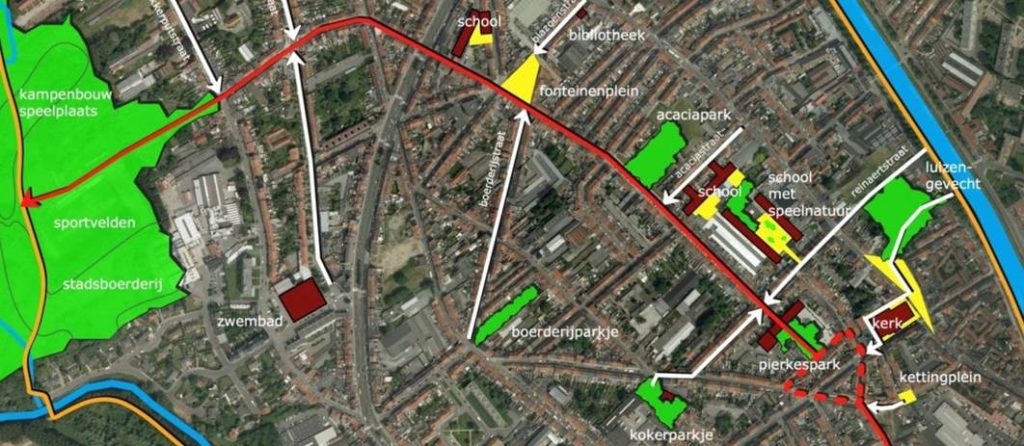 An aerial plan of the "Rode Loper" or red carpet in Ghent
To create a city’s speelweefselplan, urban planners map the places children go to and the roads they use to get there. Wim Seghers, who developed Antwerp’s plan, explained how the planners then transform the most popular thoroughfares into play spaces. A basic intervention would be to widen the pavement, or put in crossing points. But planners also weave “play stimuli” into the fabric of the streets themselves.
“It can be something like a concrete stepping stone, not even a play device,” said Seghers. “But when children find it on their route they know that it's fun, that they can sit on it, lie on it, jump on and off of it — it makes the route more attractive and more child friendly.”
Mapping the child’s mind
To understand how children traverse the city, the planners must consult them directly. In Antwerp, starting in 2006, Segher’s team have used a website to ask children what they want from their playgrounds. They visit schools, youth clubs and the playgrounds themselves armed with iPads, to ask children their views on a particular space and what it offers, and how it could be improved.
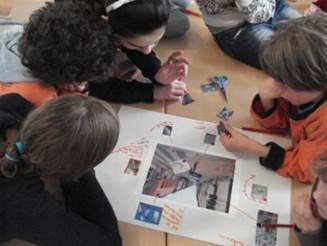 Children in Ghent taking part in a consultation
“We let them draw their own routes,” said Seghers. “We give them a map of their neighbourhood, the children point out where they live, where their school is, where their youth club is, where their sports club is, and then ask them to draw the lines and the routes that they use and the dangerous points they meet going from home to them.”
Before architects even draft a new area or a street modification, they are shown the results of the consultation, so that children’s ideas directly influence any plans.
In Antwerp, the city wants all new developments to include 10 square metres of play space per child, mimicking the standard in London, UK. Each child currently has only around 3.6 square metres of play space, thanks to a growing population. As the city grows, Seghers and his team plan to build new play areas and expand existing ones to improve the ratio.
Building support
Wider and slower streets limit access to cars, which can be politically difficult. “Sometimes you have to make a choice that's not so popular for car drivers,” said Seghers. An initial attempt to pedestrianise Ghent’s city centre led to its mayor being sent a bullet in the post. In Brussels, pedestrianisation schemes have encountered bitter opposition from drivers.
Despite this, Ghent is pushing on with a plan to make its streets safer, reducing car access to built-up sections of the city. In Antwerp, the plan is less wide reaching, but the success of Segher’s speelweefselplan, which won a road safety award in 2016 at the Flemish Congress for Traffic Safety, shows that when important streets are modified, they can be transformed for the children who use them.
With cities set to grow over the next few decades, restricting play to playgrounds and parks will become increasingly difficult, and ever more damaging for children. By working towards the central goal of the speelweefselplan, transforming the whole urban environment into a form of playground, planners can make children feel at home — whatever the pressures. — Anoush Darabi
(Picture credit: Flickr/VISITFLANDERS/Marianne Labre/‘Gent, kind- en jeugdvriendelijke stad’)
Make sure to share your own thoughts with the author by leaving a comment below

Log in or sign up to continue the conversation