
This article is written by Helen Caldwell, Campaigns and Communications Associate at Apolitical, with contributions from Lynn Cooper and Neil Alton, CS Local Delivery & Engagement Lead, Northern Ireland; Laura Besford, HMRC; and Sidrah Pervez, Fast Stream and Early Talent, Civil Service HR.
Want to ace your next interview and land that job you’ve been wanting? Hear from experienced public servants, recruiters and HR professionals on how you can achieve your goal.
What to do before your interview
You won’t want to walk into your interview without first doing some preparation. Find out what you can do to get ready and go into your interview feeling confident.
In addition to using the Success Profiles in your application, you’ll likely be asked to highlight them if you’re given an interview. Let’s look specifically at how you can prepare to demonstrate strengths and behaviours in an interview.
The best way to prepare is to reflect on what you feel your personal strengths are and your preferred ways of working.
The Civil Service has a Strengths Dictionary on Gov.uk — it’s a set of defined strengths that are relevant to the culture of the Civil Service and the type of work it does. Strengths are NOT defined by grade, which means everyone is expected to display them to the same level.
If attending an interview, you may be asked questions to understand whether you have strengths relevant to the job role. It is important to remember that there are no right or wrong answers to these questions. Do not rehearse your answers too much because recruiters are looking for your initial response. The qualities required for the role will be described in the job description.
The best way to prepare is to reflect on what you feel your personal strengths are and your preferred ways of working. Your strengths may be assessed alongside other elements of the Success Profile to get a more rounded picture of your suitability for the role. The job description will outline the elements required for the role and the selection method(s) that will be used.
Interviews can also be used to determine behaviours, the actions and activities that people do which result in effective performance in a job. The Civil Service has defined a set of behaviours that, when demonstrated, are associated with job success. Civil Service Behaviours are specific to the grade level of the job role.
If you’re in an interview, you may be asked to give examples of when you have demonstrated a particular behaviour. This might be at work or somewhere else such as work experience, volunteering, or in connection with a hobby. Alternatively, you may be asked how you would behave in a given situation; for example, by using Situational Judgement Tests or through situational interview questions. Before your interview, look at the list of Behaviours and reflect on which ones resonate with you, with specific examples of when you have demonstrated them.
Your behaviours may also be assessed alongside other elements of the Success Profile to get a more rounded picture of your suitability for the role. The job description will outline the elements required for the role and the selection method(s) that will be used. This means you’ll have plenty of time to reflect and prepare before you get to your interview.
What to do during your interview
You’ve planned and prepared – now what? Here are some tips for what to do when you’re at your interview.
There are usually three people on an interview panel; this can be different from what you’re used to but makes sure the process is open and fair. The panel will usually be made up of the vacancy holder, a colleague or individual who understands the role well and finally an independent person to ensure every candidate is treated and assessed consistently.
Try using the ‘STAR’ format when responding to an interview question (Situation, Task, Action and Result). You can use the STAR format in an interview, in the same way you use it for an application.
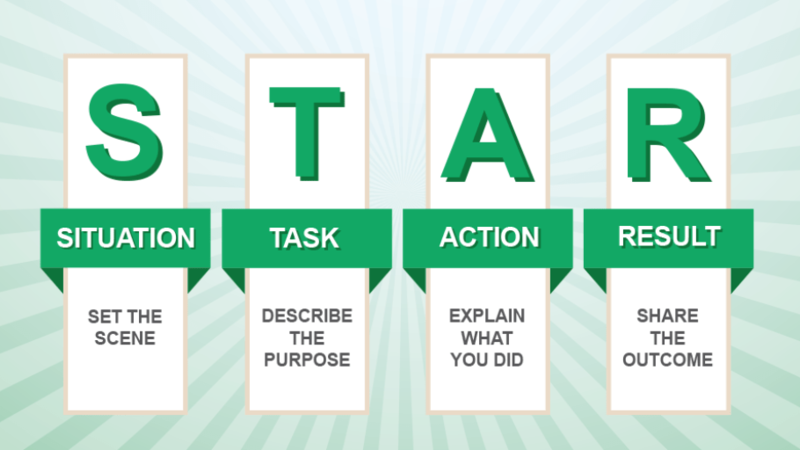
Structuring your answers in this way (and practising doing so) can help you feel confident that you’ve fully answered your interviewer’s question and shown how your strengths fit with those of the job you’re applying for.
For extra impact in your responses, try using PRITI:
- Problem solving: How have you resolved a complex problem?
- Resources: How have you achieved more with less?
- Improvements: How have you done things easier, better, simpler?
- Targets: What have you done faster, cheaper?
- Innovation: When have you created something new?
This can be a lot to remember, so don’t be afraid to use notes throughout your interview. Most panel members will allow this and are there to help make you feel comfortable, so always ask if you can use your notes for reference. You’ll want to make sure, however, that you’re still making eye contact with your interviewer; if you are just reading from your notes, this will not score you enough marks to pass the interview.
Your panel members will usually have an ice-breaker question. Don’t be afraid to showcase your interests outside of work as this makes a great first impression e.g. a language skill, being a governor at an educational institution or even a sport you play. All of these are valid and give the panel a greater understanding about your skill set, and will communicate who you are as a person.
Here are a few more general tips to keep in mind:
- Remember, the interviewer will not prompt or probe for additional information.
- Answer using “I” not “we”.
- Use dynamic language.
- Give structure to your answer.
What to do after the interview
You’ve made it to the end of your interview — congratulations! But that doesn’t mean the process is over quite yet — there are still some things you can do to boost your chances of success.
Take the opportunity to reflect after your interview is over. Think about what went well, what questions you felt you answered fully and which ones you wish you could go back and re-do.
At the end of the interview, if you feel you have missed anything then feel free to ask the panel to make additions to your answers. However, this should be brief. You will likely also be given the chance to ask questions — feel free to take them up on the offer! Most interviewees will usually ask when the sift will be completed, or what the office culture is like.
Use the opportunity to ask questions as a chance to make sure that the job really is a good fit for you. Do you tend to like a fast-paced environment? Prefer to collaborate rather than working alone? Ask your interviewers what the job is like. They’re there to get to know you, and for you to get to know the job better.
You may want to send a brief follow-up email after the interview to thank your interviewers. Keep this brief and to the point, thanking your interviewers for their time and, if appropriate, letting them know that you’re available for any further questions.
Take the opportunity to reflect after your interview is over. Think about what went well, what questions you felt you answered fully and which ones you wish you could go back and re-do. Write down how you might answer those questions differently in the future, so you’re prepared for any future interviews.
If you keep these tips in mind, you’re sure to be well prepared for your next interview. The more exposure you can get, the more successful you’ll be at interviews — and you’ll be one step closer to receiving your dream job offer.
👋 You can write an article like this one! Share your thoughts with a community of public servants. Learn more
(Image Credit: Unsplash)
Make sure to share your own thoughts with the author by leaving a comment below

Log in or sign up to continue the conversation