
This article is written by Ilias Kastritis of the Managing and Implementation Authority for Digital Investments at the Ministry of Digital Governance in Greece
The year is 2035. You’re in your nearest town centre, sitting comfortably outdoors, enjoying a relaxing cup of tea. It is a gloriously sunny Sunday afternoon. Opposite you sits an old friend. For some reason, you’ve gotten onto the subject of 2020, that annus horribilis.
Together you ruminate on just how much of the ‘now’ has its roots in ‘then’. Governments regained their lost institutional right and power to protect our wellbeing. You reckon that over the years they’ve become more resilient by building agile institutions and robust infrastructure to face multiple threats. The future, though, has not been equitable for all countries and people. For experts in foresight as the practice of thinking about the future, 2020 was pivotal. An urge to think our way clearly through the pandemic has laid the groundwork for a new mindset for policymakers.
Perpetual change & uncertainty
In the Age of Unreason (1989), Charles Handy remarked that “we are living in very confused times, a world of constant discontinuities in which major unprecedented changes are taking place”. Robert Olson said that “all our experiences are with the past but all of our decisions are about the future. Leaders at every level have usually assumed that their past experience is a fairly reliable guide to the future – the future would simply be a bigger and better version of the world with which they are familiar”.
But as Pierre Wack said in his seminal article in 1985, “uncertainty is not just an occasional, temporary deviation from a reasonable predictability; it is a basic structural feature of the environment. The only solution is to accept uncertainty, try to understand it and make it part of your reasoning.”
By challenging assumptions, we reveal our own blind spots and inspire other people in our group or community to challenge conventional thinking or flawed patterns of perceiving reality and how it is created.
Since it is not possible to predict the future, scenario thinking and planning is a powerful way to clarify perceptions, communicate, and integrate quantitative and intuitive planning to make sense of complexity and uncertainty.
By challenging assumptions, we reveal our own blind spots and inspire other people in our group or community to challenge conventional thinking or flawed patterns of perceiving reality and how it is created. Scenario thinking is based on the long view - looking beyond the near term into new possibilities by questioning the causal relationship that now exists. By adopting outside-in thinking and allowing multiple perspectives within a collaborative process that taps into the collective intelligence of people we can hone our instinct and insight to create meaningful images of the future which might be compelling.
Public officials at all levels already use various methods of foresight to sense the future and futureproof policy. From the tools for Futures thinking and Foresight across the UK Government and how to use scenario planning, to the actual projects done in the UK, such as how to navigate the post-Brexit uncertainty with scenarios on the long term effects of leaving the trading bloc. Scenario thinking, planning and foresight across UK Government has been on the rise during the last decade. The EU has started embedding strategic foresight into the policy making process and countries like Ireland are working with the OECD to explore the value of strategic foresight for anticipatory governance. Greece recently set up a strategic foresight unit at the highest political level. There is a proliferation of conferences, sites, and media talking about how we can imagine the future in so many different ways.
In an age of increasing speed, uncertainty and wicked problems, government needs to be able to adopt scenario thinking. Long-term thinking helps transcend generational interests and centres responsibility back to the now, a transient future which quickly becomes the past. This allows us to see opportunities such as shifts in working patterns during the pandemic that could become the new normal.
Why is scenario thinking more relevant now for your public organisation (and for society in general)
"People have an innate ability to build scenarios and predict the future,” Peter Schwartz noted. Public organisations who understand the long-term ecological and socio technical implications on their present strategic choices invest in anticipatory thinking to build infrastructure that makes cities resilient. They draft smart regulations for addressing complex social relationships and set up responses for anticipating wicked problems’ impact on community wellbeing like climate change effects. National and international organisations such as the World Economic Forum, European Union and UNESCO offer their valuable insight and tools for a scenario teams to use for inspiration and information. Similarly, distinguished UK Universities like Strathclyde or Oxford with their knowledge, research and unique programs do the same.
How can we co-create scenarios about the future?
Futures thinking and foresight studies and practice have become a very broad subject with a lot of different methods depending on what one seeks to achieve.
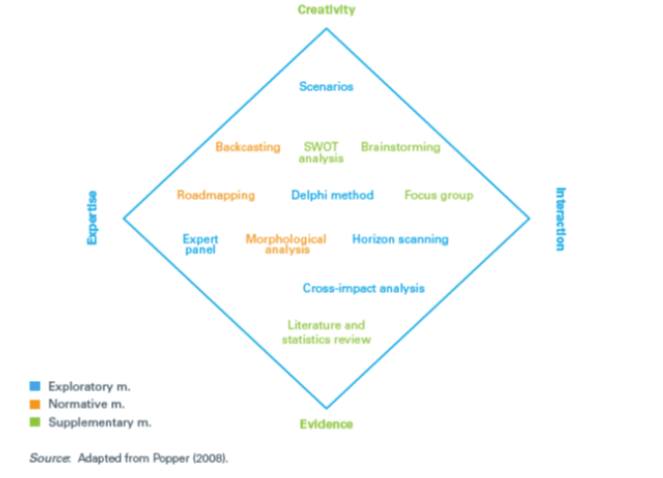
There are many tools that help us create scenarios from serious games or strategic exploration systems to scenario workshops that are based on the intuitive logic methodologies originated from the Shell scenarios. One of them, the intuitive logic method of scenario planning, can be applied within different contexts, policy objectives and levels of government. It uses a highly engaging, collaborative and participatory approach of iterative creative sessions to come up with narratives of scenarios and their implications on how we do what we intend to do or plan.
Of course, we have to be conscious that, as Peter Schwartz (1991) wrote, "scenarios are not predictions." They represent instead, possible alternative dimensions of the future. Scenarios are feasible and internally consistent stories of plausible alternative futures. Their power comes from the learning that participants gain through going through the process and challenging assumptions around what forces and trends are at play at any given time.
We have to dare to think systematically about the future because old mindsets make it hard for us to face the adversities embedded in uncertain futures. That’s never been more the case. Spotting a window of opportunity and creating a space for administration to think about the future creatively and collaboratively using a new language will allow decisions to be fit for the future.
Ilias Kastritis works for the Managing and Implementation Authority for Digital Investments at the Ministry of Digital Governance in Greece and is an advocate of scenario thinking & planning. He supports students in a unique course called “Exploring the International Business Environment” in the Strathclyde MBA and wishes to thank Ron Bradfield, George Wright and Peter McKiernan from Strathclyde University for their trust and valuable support and insights in the world of Scenario Thinking and practice all these years.
He can be found on Twitter, Facebook, LinkedIn,
Picture credit: Drew Beamer(Unsplash)
Make sure to share your own thoughts with the author by leaving a comment below

Log in or sign up to continue the conversation