
This article was written by Ella Mae Lewis, Director of Product at Apolitical.
Public servants are at the heart of running our most important services, and solving our most urgent problems. From responding to a pandemic to ensuring access to education, from transitioning to clean energy and to closing the gender pay gap — the people who work in government play a crucial role in allowing society to flourish.
But how well-equipped are they to do their jobs? What skills and knowledge do they need to be effective? How are they gaining these? Apolitical makes it easy for policymakers to learn from one another, and we were interested in surfacing high level trends in how people are accessing learning both within and outside the traditional government offerings.
We hope this will provide a useful resource for teams across government who are thinking through the same challenges that we are.
Survey methodology
We distributed a survey to Apolitical members (those who have created and claimed accounts on the platform) in December 2019 and January 2020. Some 1,500 people responded to the general call, of whom the largest single group were those who had worked in government for at least a decade (30%), closely followed by those who had been in government from 1-5 years (28%).
The smallest group were people who had been in government for less than a year (8%). 57% didn’t run teams, 21% ran a small team (1-5 people) and the rest ran larger teams of various sizes.
So what did we find out? People were notably curious beyond the scope of their current role’s remit. Public servants are often generalists who move quickly between roles. Policy issues that don’t directly affect their job today may well affect it tomorrow. Top topic performers from our survey included bringing emerging tech into government, the future of work and how to do change management.
A trend to more online learning
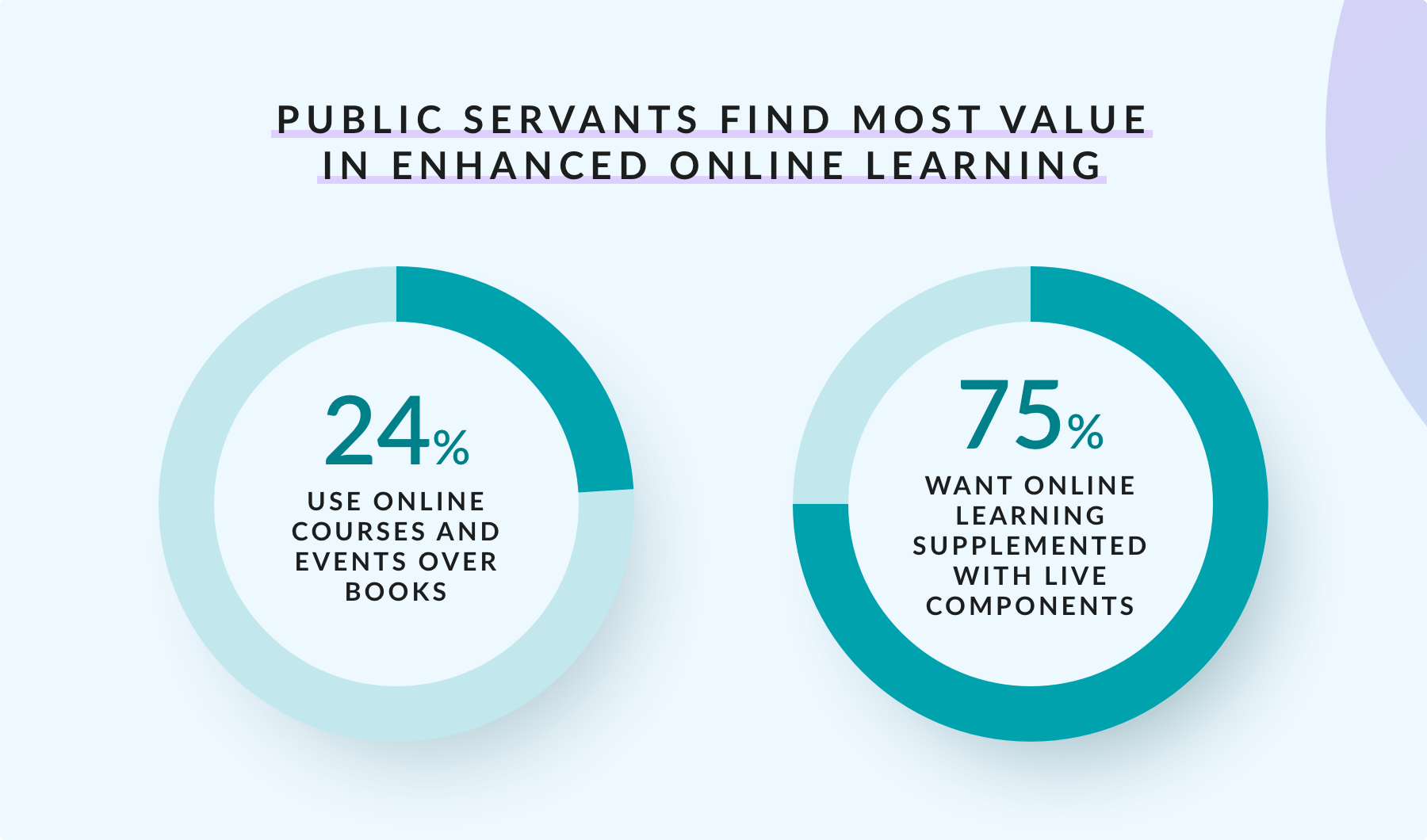
The shift to a preference for online learning is clear, with twice as many people now reporting that they use online courses and events (24%) as read books (11%) to support their learning. However, there is also a recognition that exclusively online, self paced learning often fails to deliver.
This is something that has been repeatedly backed up by focus group discussions — while traditional online content is seen to be a sufficient driver of basic knowledge acquisition, it’s not enough to advance and embed deep understanding, or acquire and develop skills.
An overwhelming majority of people (73%) wanted online learning that was supplemented with live components such as webinars and in person activities, whilst only 22% wanted online-only learning, and a mere 3% wanted exclusively in person learning.
Online works if it is practical and social
 So what’s missing from traditional online learning? Two elements stand out — a) social and b) practical.
More people want insights from their peers than any other kind of written content (14% vs 10%). This was a comparison against other options that were deliberately included for their popularity; for example report summaries, case studies, skills guides and big picture analysis.
We also offered people a variety of social features and asked which would be valuable; from discussion boards (8%) to video calls with other learners (12%) — again, the two most valuable options were seen to be written frontline stories and insights from public servants (17%), closely followed by webinars with experts and peers (16%) and activities and toolkits that allow you to practice with other people (16%).
This last element — that people in government want exercises to take with others — speaks not only to a desire for social learning, but for learning that allows them to really put theory into practice.
A common refrain in user interviews is that public servants have heard about an idea, or know the basics of a new approach, but haven’t had the chance to work with it yet. They want a chance to try things out, and to start to do things differently at work, quickly.
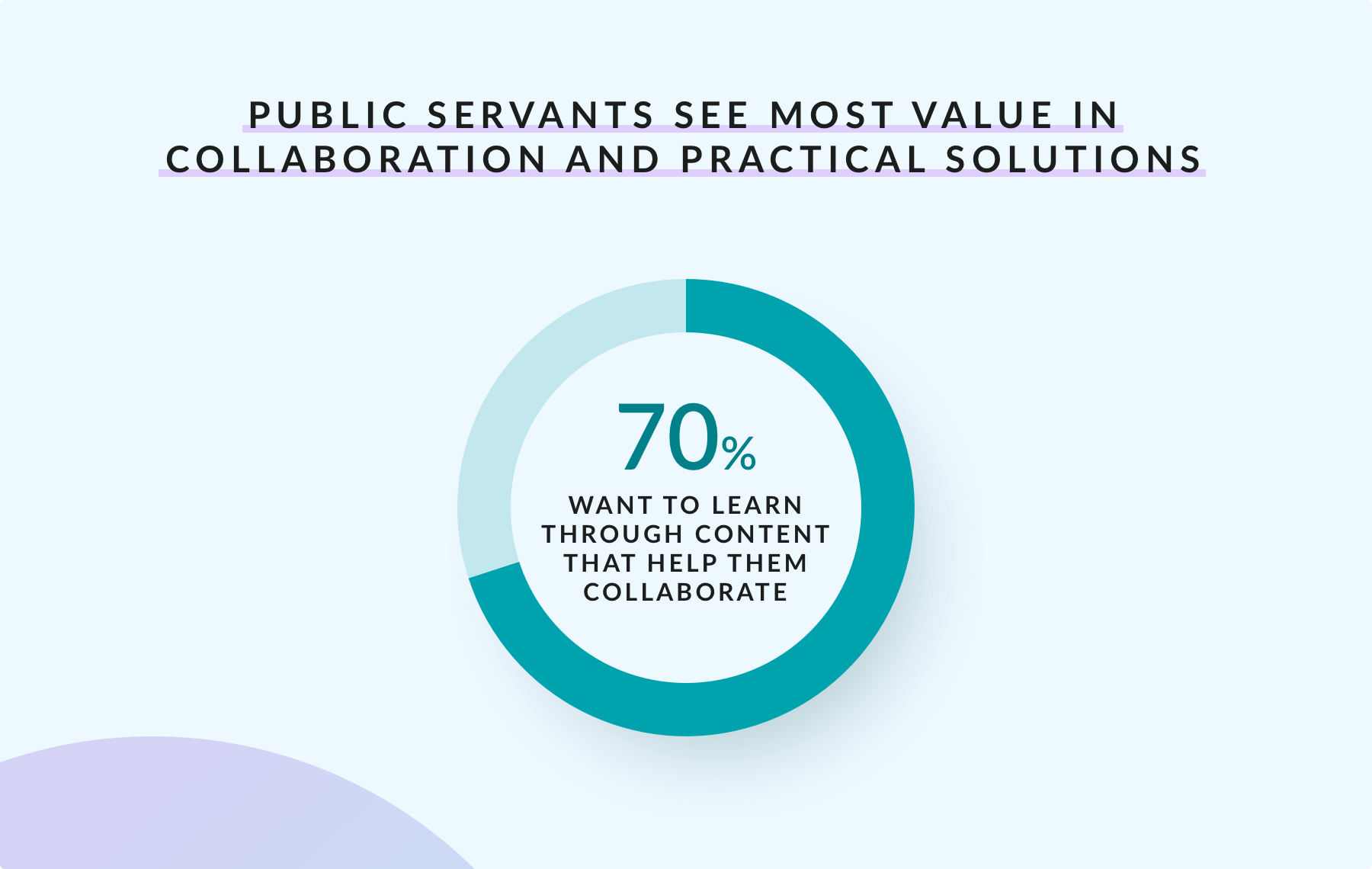
In our survey, 70% of respondents wanted to learn through content that helped them collaborate on activities and exercises. This chimes with other insights we’ve had over the last few years. Practical, engaging content on Apolitical, such as the “everyday bias detector” tool, or the “future skills tracker” learning planner, is consistently some of our most popular content.
So where are public servants getting their learning?
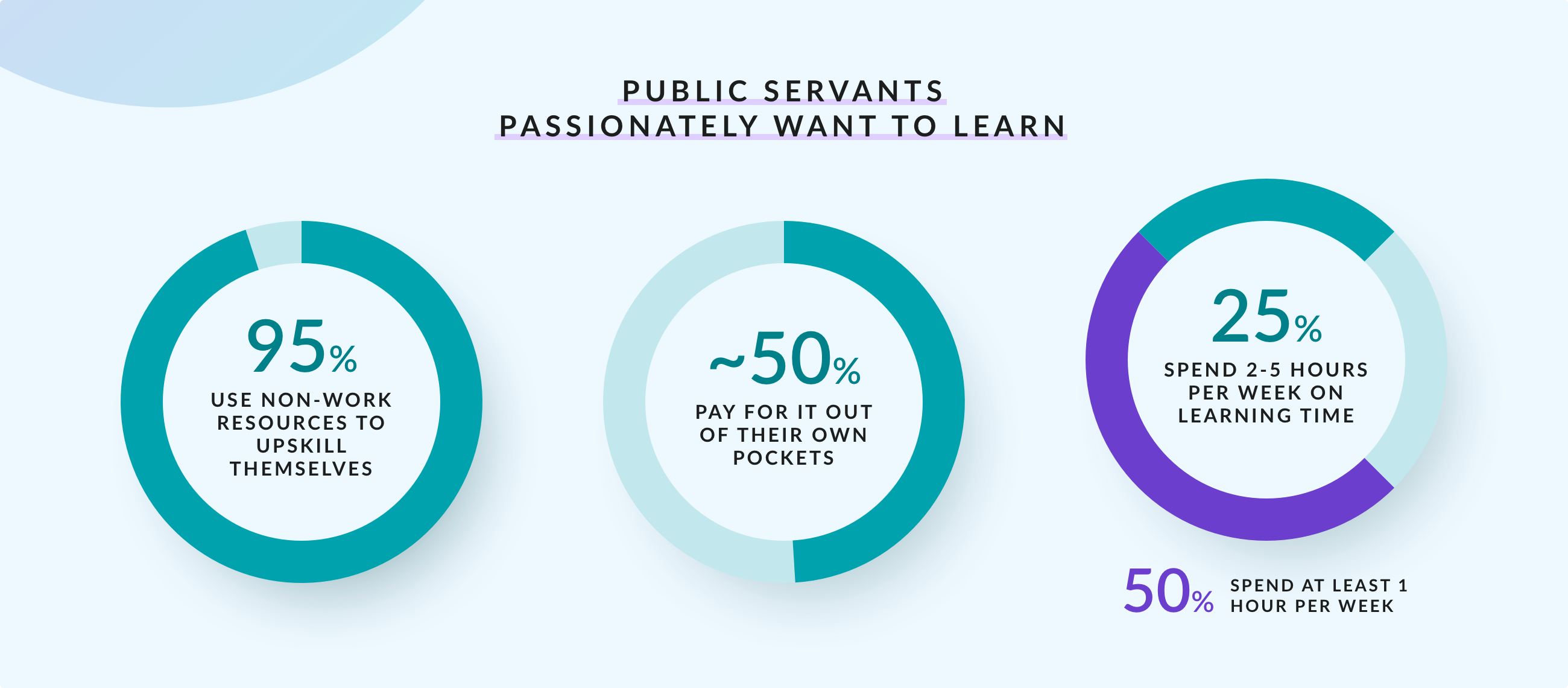
We were particularly interested in the extent to which public servants feel well served in their workplaces, and how many people were going out to seek supplementary learning. We found that 95% of people use non-work resources to upskill themselves, and that a surprising 46% had paid out of their own pockets to access it. Only 9% of people said that they had only ever used a departmental L&D budget to pay for something.
And this external learning seems to be filling an urgent need — only 7% of people spent time every day on learning provided through their work, but a significantly higher percentage (24%) spent time every day on the learning that they found for themselves.
Public servants take learning seriously
As ever, we were positively surprised by how seriously these people take learning — 28% spend 2-5 hours every week on learning time, and 43% of people spend 1-2 hours (only 14% spend less than that).
It’s worth saying of course that this sample represents people willing to take part in a survey for Apolitical. This group are “fans” of a platform that is built to make it easy to learn about what’s working (and not working) in government: in this sense they may not be representative of all policymakers, though may well be representative of a particular persona in government.
We are proud to be a significant part of many of their learning journeys — 83% of them said that being part of Apolitical makes them better at their job, and 91% would be disappointed not to be able to use us again. We are committed to keeping these numbers high and are always open to ideas and feedback to make that happen.
This survey data, taken together with the hundreds of interviews Apolitical has conducted with people in government, makes a few things clear.
People are hungry to wrap their heads around new approaches and ideas. 44% of people said they struggled to be given the time they needed for this vital work, and 36% said they struggled to access a budget for it.
In response to this, public servants are learning on their commutes, and getting out their own credit cards to foot the bill.
People are especially excited to learn from one another (one-off training days run by external consultants were the subject of much vitriol) with people demanding easier ways to access the knowledge and experience of their peers.
Apolitical aims to fill this gap through an online platform that draws on social, live and practical experiences. However we can never be everywhere at once, and we hope that more initiatives spring up within governments globally to initiatie and properly resource in-person connection and sharing. — Ella Mae Lewis
(Picture credit: Death to the stock photo)
Make sure to share your own thoughts with the author by leaving a comment below

Log in or sign up to continue the conversation