
On Tuesday 13 June, Apolitical launched Design&Delivery, a brand new monthly event connecting the global policy community.
Andrew Knight, Head of UK Policy Design Community, was our first speaker and he led an insightful discussion on the UK’s approach to policy delivery. The conversation brought in policy voices from Canada, India, South Africa, Japan and the United States — reflecting the truly global nature of the Apolitical community.
We’ll be running these events every month. You can find out more and sign up for the July event.
Key takeaways from session
- UK policy community is increasingly adopting an outcomes-based perspective when it comes to public value
- There’s a growing focus on distinguishing between the different types of roles within the policy profession (‘stewards’ and ‘shipbuilders’)
- UK provides a research method which other countries could replicate to help them focus their time on tasks that really matter to delivering outcomes for citizens
The ‘sweet spot’ for delivering outcomes
“We’re moving away from perhaps this old version of value, which ministries of finance have used everywhere — that thinks about public value as double-entry bookkeeping: cash-in and cash-out, all about efficiency.”
What is public value?
That’s how Andrew opened his presentation, with a challenge for the audience who responded with a mixture of questions and their own definitions. ‘Something good for everyone’ was one perspective shared by Abril (🇺🇸). ‘The output/impact contributed to society,’ said Nangamso (🇿🇦).
Andrew used these definitions to illustrate how public value can be understood not just in terms of the government’s finances but instead outcomes for citizens. Within the UK policy design community, Andrew says they think about maximising public value in terms of finding the intersection between three key drivers: government intent, people’s needs and system capacity.
‘If the citizens won’t use it and the system won’t bear it, then the policy will fail.’
The hard part is balancing them. Ministerial intent on its own does not guarantee outcomes: ‘If the citizens won’t use it and the system won’t bear it, then the policy will fail.’ Everyone one in the policymaking process should have a vested interest in getting this balance right.

Stewards and shipbuilders: unpicking policymaking roles
In the second part of his presentation, Andrew discussed how traditional policymaking models – like HM Treasury’s ROAMEF Cycle (presented below) — often come up short when put to test in the real world. Based on questions and reflections from the audience, he cited a few reasons for these shortcomings.

The most important reason Andrew cited was the absence of delivery in the model — there’s no D in the ROAMEF cycle.
Second, the model is more conceptual than it is practical, and it's not always a realistic representation of how government makes policy. In reality, Andrew said, the responsibility for many of the functions described in the ROAMEF cycle aren't clearly defined or distributed to people across the system.
And third the series of processes which occur between rationale, evaluation and feedback (for example) can often be linear and slow, unlike the faster more iterative development cycles which are increasingly common in the service and product developments worlds within government.
To address some of these challenges, Andrew says the UK design community is thinking in more detail about differentiating policymaker roles; distinguishing between system stewards and those tasked with making and remaking policy. Andrew compared these two roles to a crew of sailors who have to navigate a ship across sea (the stewards) and those who build the ship (builders).
These are two different roles with different skills. Stewards manage 80% of what government does: delivering essential services and “keeping the lights on” (literally and figuratively). The other 20% is where we need the kind of design skills which Andrew and his team are working to spread across the UK policy design community.
So what do policymakers actually do?
In the final section of his presentation, Andrew shared findings from a research project conducted with hundreds of UK policymakers about how they actually make and deliver policy.
The graphic below presents all of the practical tasks they described; the work UK policymakers actually have to get through before a bright new idea becomes reality on the ground.
Andrew challenged the Design&Delivery audience to think about which parts they think are the most important and which take the most time.
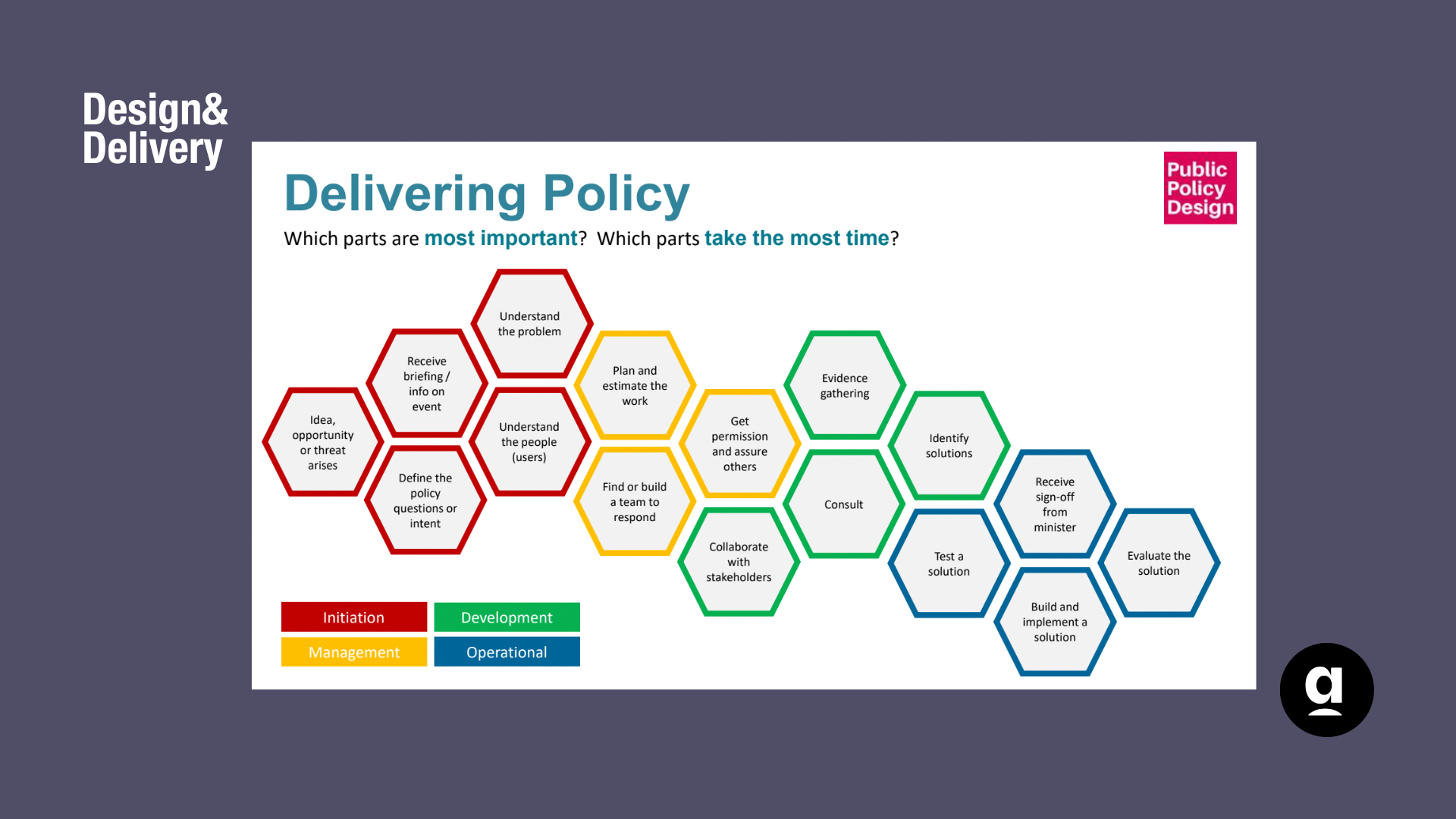
Audience members shared a few interesting perspectives.
“It seems like there's always a lot of good intent behind government design and policy… But then the issue, I think, arises when you're trying to bridge the gap between intent and implementation. So I'd say, ideally, development and operationalising a theoretical solution is where focus ought to be probably.” (Vibhav, 🇮🇳)
“I'll say in Canada if there was one piece that was biggest on this board [it would be] consultation… I think that is something special to our values, geography and history. And meaningful consultation, not tick-the-box consultation.” (Katarina, 🇨🇦)
Andrew then shared the data from the UK policy community, presented in the image below. The black line represents frequency (tasks that happen a lot or take a long time), the red line is value (the number of policymakers that said it was a worthwhile task), and the green line represents outcomes (the number of policymakers who believe the task contributes to meaningful change for citizens).

The findings drew a lot of interest, particularly the low rating for consultation (no. 11) both in terms of the frequency and value rating. Andrew was quick to point out some nuance in the findings.
"I think often it’s [consultation] confused with research on what citizens need, but it doesn’t serve that purpose. No citizen responds to a consultation, it’s organisations and institutions; so it’s good for understanding stakeholders but not users."
By contrast, evaluation was rated very highly but Andrew pointed out that UK policymakers rarely do it. The research is helping the UK policy community to find discrepancies between the tasks and activities they regard as meaningful and worthwhile and what they actually spend their time doing.
It’s a worthwhile point for other policy communities around the world to reflect on, and a research method which could be easily adopted and replicated in other countries to gain similar insights
You can download a full copy of Andrew’s presentation here.
You can also find out more about Design&Delivery here.
Make sure to share your own thoughts with the author by leaving a comment below

Log in or sign up to continue the conversation