
This article is written by Kelly Ann McKercher, Design Lead at NSW Health Pathology and founder of Beyond Sticky Notes.
In public sector innovation and reform, we often set our sights big and wide. Short of changing the world, we want to change the system. When I began my career as a public servant, I also started out thinking big.
That changed when I met disability advocate turned Buddhist monk, ThayThich Truc Thong Phap late last year and had a chance to talk to him about his work, which is focused at the intersection of social justice and Buddhism. He shared the following quote from Quaker Mystic Rufus Jones (1863 - 1948):
“I pin my hopes to quiet processes and small circles,
in which vital and transforming events take place.”
After a decade of work in community, organisational and systems change, I also pin my hopes there. I see improvements in the quality of outputs (e.g. service design, policy, practice) and outcomes (e.g. reducing social isolation, improving access to healthcare for vulnerable groups) through strengthening relationships between colleagues, levels of hierarchy within agencies, across agencies, and importantly, between public servants and citizens. How might we pursue ambitious change while also tending to a deep change in relationships, power differentials and mindsets?
Experience tells me small circles, such as shared meals, communities of practice and co-design groups are one of the few reliable places where change happens, and small circles are influential in creating larger circles. While the small can seem the very antithesis to what our world needs, where so many people talk about scaling impact, I want to share some practical suggestions for how to make it happen and other points of inspiration that I have picked up over the years.
Thinking about scale
Common models of scale tend to describe three levels:
Scaling Up: Impacting laws and policy
Scaling Out: Impacting greater numbers
Scaling Deep: Impacting cultural roots
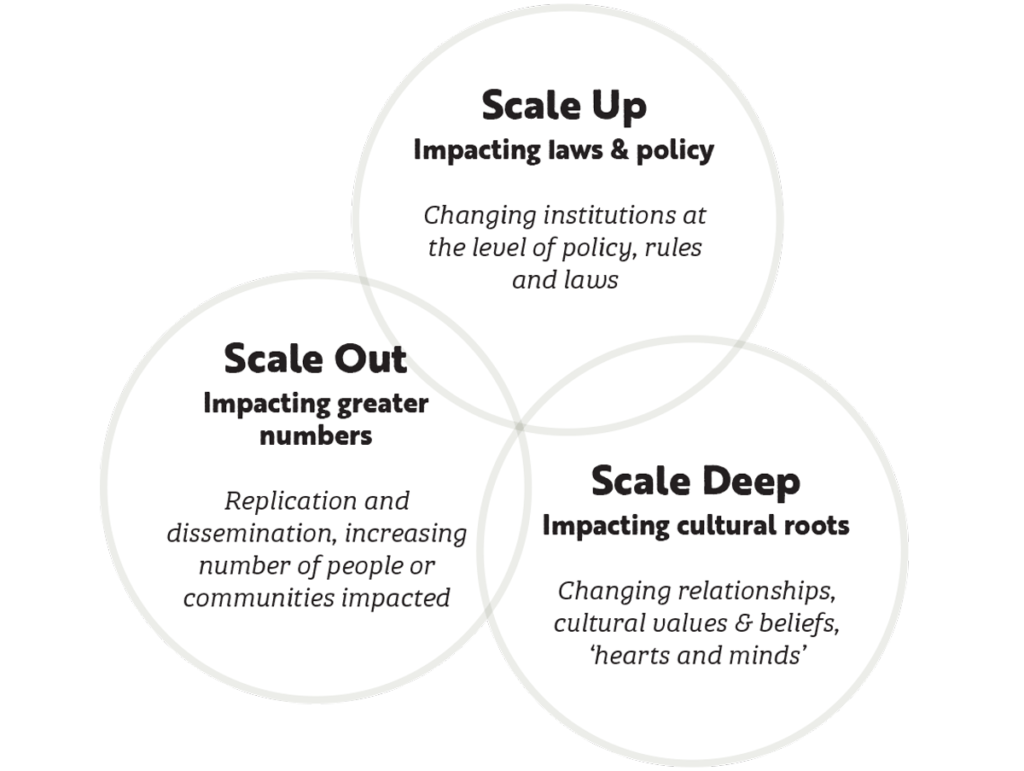
(Picture credit: InWithFoward)
For example, recent healthcare reform across Australia, Aotearoa New Zealand, the UK and Canada has focussed on elevating patients from passive recipients to co-producers in the design, delivery and evaluation of their care. For example, the Mental Health Lived Experience Framework from the Department of Health and Human Services (DHHS) in Victoria, Australia.
In cases like these, policy and frameworks are introduced to mandate patient participation (scaling up) and professionals on the ground are directed to adopt new practices such as gathering patient feedback through surveys during and after care (scaling out). Those things are important, but they are not enough. There is no reform without culture change at a systemic, organisational, individual and team level.
While we can make people do something through changes in policy, we have to work much harder to gain people’s energy and support
Over the past decade working as a participatory design lead across across state, federal and not-for-profit mental health, domestic violence, child protection, ageing and Indigenous health, I have met many front-line professionals and managers who remain stuck in the paradigm of doing to service users_,_ instead of with. Who do not know how to listen to feedback, who feel citizens accessing public services should be grateful and are not entitled _nor capabl_e of playing a role in service design, delivery and evaluation. If those are our values, our systems will not meet the goals of any reform that seeks to restore power to the people who the public service exists entirely to serve.
While we can make people do something through changes in policy (compliance), we have to work much harder to gain people’s energy and support (commitment). Experience tells me that one of the most meaningful ways of doing that is through the shared meals, communities of practice and Co-design groups that I introduced earlier — where we shift the mindsets and practices of professionals through getting up close to, listening and learning from citizens and each other. That calls for the intimacy of small circles where it is safe for professionals and citizens to share and learn together and where sharing power moves from an aspiration to a reality.
What do we do?
I offer two suggestions for refocusing our efforts and some places for inspiration;
- Small experiments, ‘knitted’ together
- Co-design: Many small circles
This article explores the first approach with a separate, upcoming article exploring the second suggestion.
Small Experiments, ‘knitted’ together
We commonly talk about the need for agility and adaptability in the public sector. At the same time, we know that large institutions are typically not set up well for experimentation.
Organisations tend to be geared towards top-down approaches to implement change (pictured below on the left). These approaches can be slow, disempowering and often fail to make change stick. While figuring out the “right thing” at the top (for example, how to change a service to improve outcomes, imagine a new program, work practice, workforce or policy) we can become stuck in planning paralysis and miss a window of opportunity (for example, politically, for local buy-in, resourcing). We miss the important element of changing hearts and minds.
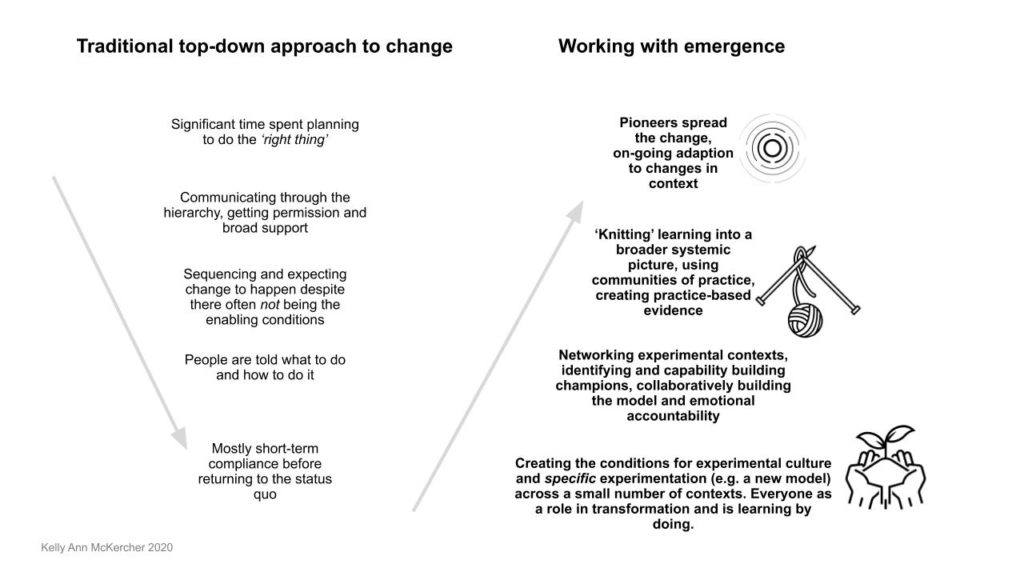
What if we turned our typically top-down approach on its head, and instead focussed on learning by doing? (as represented by the triangle on the right). In the model above, we’re moving from the role of the traditional project or program management and to that of a convener.
Conveners:
Connect – people, resources, systems, ideas and insights. They build bridges where there was none, help the system to see itself and individuals see themselves in the system.
Build on what is strong – seeking strengths, champions and bright spots. Reinforcing and scaling where change has already happened or is happening.
Work in the open - are committed to sharing knowledge, relationships and ways of working.
Maintain a helicopter-view – a broad and systemic view of the context. Helping people to see beyond their frame of reference.
Build capability – supporting people to use mindsets, methods and relationships to identify, design and spreading change.
Additionally, they are:
- Creating the conditions for experimentation, alongside supporting specific experiments (e.g. a new practice, role, policy or service). That might involve work with formal and informal leaders, building innovative mindsets, building prototypes or mapping the citizen journey.
- Decentralising effort and decision making to those closest to the context. Supporting their discovery and curiosity. As (Barabasi, 2002) shares: “the structure of networks is the key to understanding the complex world around us. Small changes in the typology, affecting only a few nodes or links, can open up hidden doors, allowing new possibilities to emerge.”
- Scaling what works with people who have already been doing it. Moving away from a cast of one or two ‘implementers’ to a diverse cast of peers who have already made the change, and who are likely to be more influential to their peers than a change, design or project management professional.
Doing this requires a shift in the mindset and practice of senior leaders, to create the authorising conditions for project teams to work emergently. That includes sharing power with those best placed to act (the pioneers) and focusing on creating a context for learning over control.
It also requires a shift in individual practice, to de-condition ourselves from needing to have all of the answers before doing anything (e.g. trialling a new service). I strongly believe in this approach, but it’s not the only one. I will be back next week with another article describing an alternative method of co-designing many small circles. — Kelly Ann McKercher
This post is part of a series written by members of The Residency, a global learning collective of public servants, civil society and social designers and innovators. The Residency exists to spark curiosity, nurture lifelong learning and to provide a space for shared learning across disciplines and sectors. Click here to read more and see how to join.
Make sure to share your own thoughts with the author by leaving a comment below

Log in or sign up to continue the conversation