
In Freiburg's Vauban quarter, there are no parking spaces: cars are relegated to two multi-storey car parks at the district’s outskirts, leaving the majority of street space to pedestrians and cyclists. Many residents live in ‘passive houses’ without conventional central heating systems, which draw in heat from south-facing fronts, triple-paned windows and wall insulation. Other types of homes are also highly energy-efficient: it is estimated that the district uses around 50% of the energy that a regular district does.
Vauban is known to be the greenest part of Germany’s greenest city. Situated in southwest Germany at the foot of the Black Forest and the Schoenberg mountain, Freiburg was proclaimed Germany’s capital for climate protection in 2010, and won international acclaim at the world expo in Shanghai in the same year.
“There’s better air quality, much less noise and much less risk of accident"
“There’s better air quality, much less noise, much less risk of accident, shorter and more paths between the streets, and lots of money is saved for people who don’t use cars,” said Andreas Delleske, a software developer and resident of Vauban who used to guide visitors' tours through the district.
“Through the reduced use of cars, public transport in the area carries far more passengers. Our tram system is more efficient and economically sustainable than many others.”
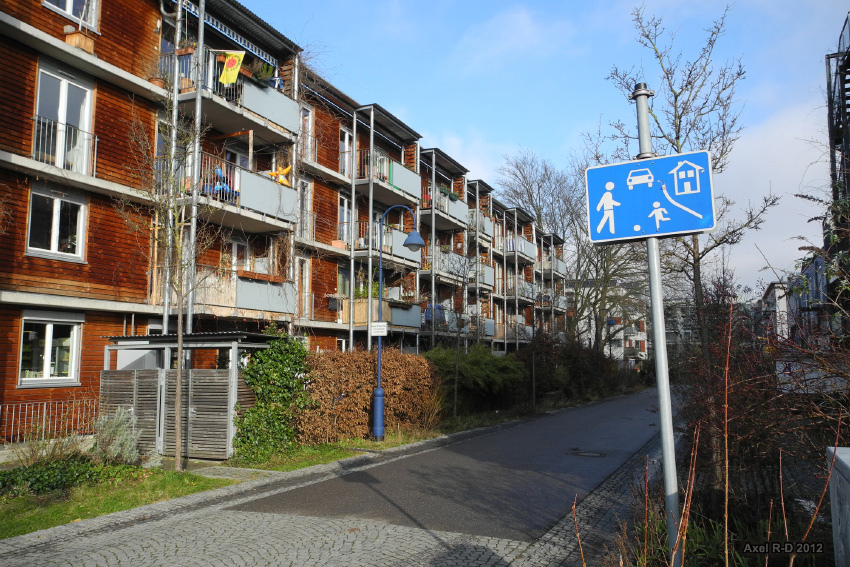 Housing in Vauban wastes far less energy than elsewhere in Germany
The sustainability has been built into the environment over the years through conversations - and sometimes conflict - between the residents and the city.
“There have been many constructive but also lengthy negotiations,” said Delleske. “In all of the well-known disputes I’m aware of, at the end of the process it was found out that the citizens were in the right.”
But all of this grew out of something very different, the memory of which is shown at Haus 037, a former barracks now used as a kindergarten, religious centre and restaurant.
"If Germany has learned anything from both World Wars, then hopefully it’s that citizens can’t just surrender their responsibility at the election booth"
Up until 1992, the only residents in the Vauban were French soldiers, who had occupied the district since the end of the second world war. Following the fall of the Berlin wall and the reunification of east and west Germany, the troops moved out, leaving their barracks empty and the streets deserted. Then new residents moved in to occupy the empty buildings: students, single parents, and low-income earners banded together to form the organisation SUSI (Self-Organised Independent Settlement Initiative). Since then, the district's growth has been driven forward by ecological activists and radical ideas.
There have been disputes over whether or not to pull down all of the barracks, rather than renovating them - eventually, the city agreed to renovate Haus 037 into a cultural centre.
"There has been a critical public in Freiburg since the beginning of the 1970s," said Delleske. In the 1970s, local activists successfully opposed plans to build a nuclear power plant near the city. The character of the district has since been driven by the ideals of the squatters who initially moved in.
"Freiburg definitely had luck in that it’s a university town: for students, at least, it used to be possible to put one or two unpaid years into the project," said Delleske. "If Germany has learnt anything from the catastrophes of both World Wars, then hopefully it’s that citizens can’t just surrender their responsibility at the election booth. I hope that is the case for a majority in the city."
In 1994, the city opened up the development of the area to a public competition. The winning company, Kohlhoff & Kohlhoff, was tasked with creating a mixed residential and working district for different social groups, with a built-in preference for walking, cycling and public transport infrastructure alongside low-energy housing. The first new residents started to move in in 1998.
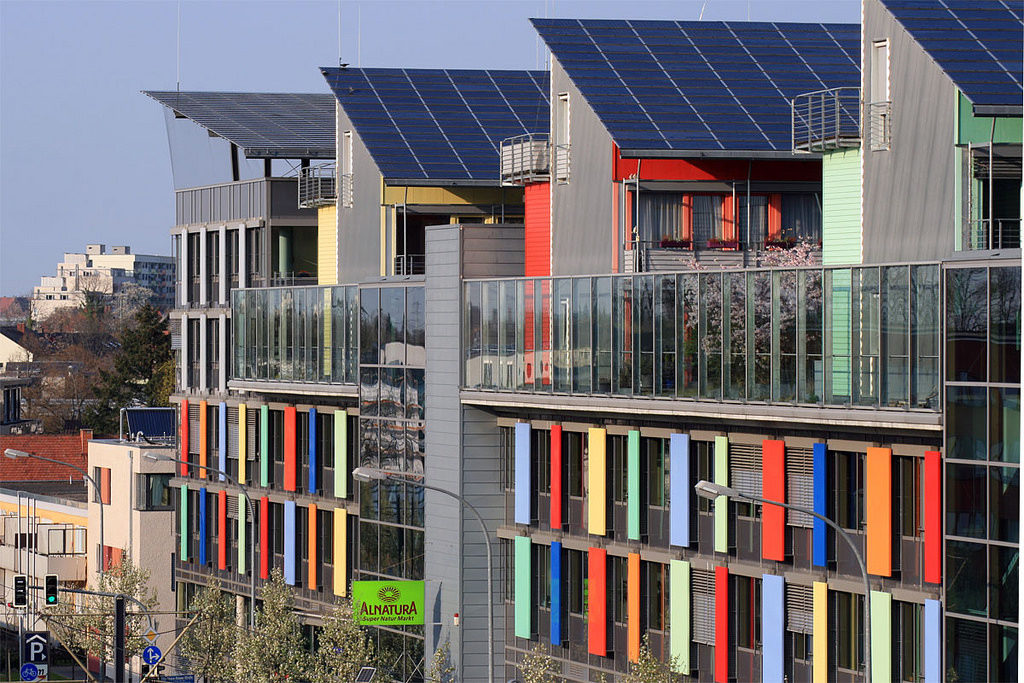 Vauban's Sun Ship
Vauban is the most densely populated area in the whole of Freiburg: over 5,000 people whose average age is 28.6 live within 41.6 hectares of land, 2.6 hectares of which is green public space. The district’s two centrepieces are the Sunship, a block of housing run entirely from solar energy, and the Heliotrope, a glass building which rotates to follow the sun and which draws in five times more energy from sunlight than it uses.
"City authorities should accept that critical citizens aren’t always just moaners and busy bodies"
With growth, the district has become more expensive. In 2012, the average rent for a new flat in Vauban was €750 ($922), compared to Freiburg's average of €691 ($849). For some residents, the social mix of the area has not lived up to Vauban's radical beginnings, and is now more of a haven for environmentally conscious middle classes.
Buildings in the city are required to only use 65kWh of energy per square metre, compared to the 75kWh requirement in the rest of Germany. The passive houses use just 15kWh. The district's landmark buildings, the Sunship and the Heliotrope, are designed to push the boundaries. They were both designed by Rolf Disch, a local architect and former activist himself. Despite this activist pedigree, Delleske is keen to point out that none of the residents are forced to take part.
"The Vauban district has actually been an entirely normal one from the very beginning," he said. "Everyone can go their own way, and no one is bothered by any social pressure."
Owning a car in Vauban is not prohibited, but is made difficult by the lack of parking spaces. Some residents have said that cars left in the streets have been damaged by other residents, and remarked on peer pressure from their neighbours. The difference between the district and wider Freiburg is clear: in the city, there are on average 495 cars to every 1,000 adults; in Vauban, there is 85. This leaves more space available on streets for pedestrians to walk and for children to play.
There remains the question as to whether or not the Vauban model could be replicated elsewhere. Few cities are likely to find an area in which to plan and build new a new development overnight, and Green Party successes in Freiburg's local government have supported ecological development in the district. The example does, however, prove that urban planning done with the environment in mind is possible.
"We've simply taken the chances to improve how construction is done," said Delleske. "City authorities should try to accept that critical citizens aren’t always just moaners and busy bodies, but are a necessary impulse to better urban development. Furthermore, they should always be listened to and allocated resources which they can use to organise and coordinate."
(Picture credit: Flickr/micagoto/Axel Drainville/Stadt Freiburg)
Anoush Darabi
anoush.darabi@apolitical.co
Make sure to share your own thoughts with the author by leaving a comment below

Log in or sign up to continue the conversation