
This book review was written by Coco Chan, a data analyst & researcher in UK Local Government. For more like this, see our digital government newsfeed.
Title: Digital Transformation at scale: why the strategy is delivery
Authors: Andrew Greenway, Ben Terrett, Mike Bracken and Tom Loosemore, with foreword by Francis Maude
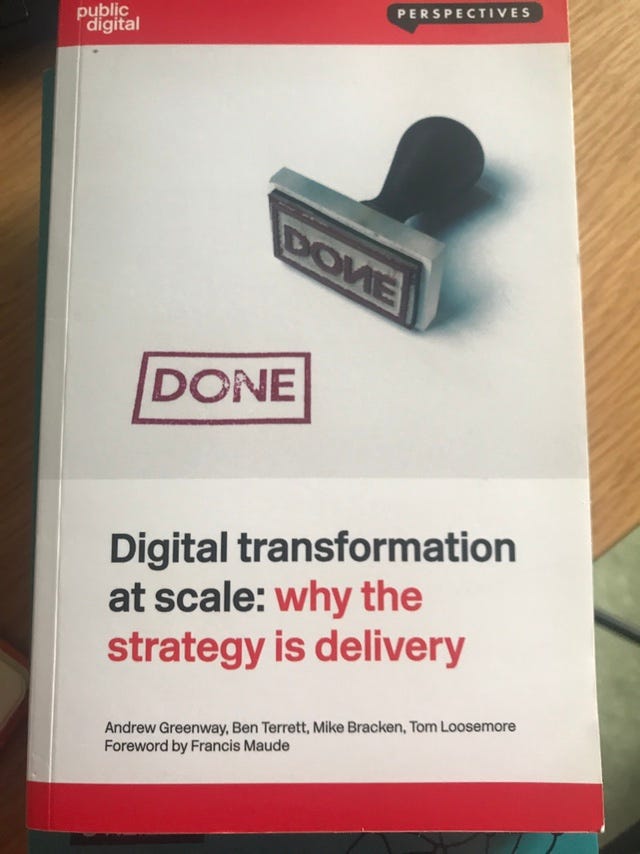 Picture credit: Coco Chan
Cover: Red and white, with a rather satisfying looking "DONE" stamp. A5-ish, paperback
Publication date: May 2018
Publishers: London Publishing Partnership
Price: £14.99 from Amazon, The Book Depository and Foyles
Read time: Approx. 3 hours over 9 days
Synopsis
If you work in UK Government, you’ve probably heard of the Government Digital Service; the team founded in 2011 to transform public services, which has become synonymous with pushing boundaries, focussing on user needs and working in the open. This book composed by a number of its senior staff tells of GDS’s progress from inception to present day (and gives a small insight into its potential future).
It is set out in a series of 13 chapters which chronicle the evolution of a digital team, from the driver which informs its purpose, through getting started, recruiting the team, delivering early results, staying on course and appointing leaders, to pushing back and finding a sensible work balance.
It is peppered with useful anecdotes and top tips, and on reflection it is a useful insight into the maturity of my team as we embark on an ambitious programme of Transformation.
I think we are somewhere around Chapter 6: Building Credibility. This book gave me a glimpse into what might be next.
Strengths
Short and sweet. Containing a mere 200 pages, this book is relatively short compared to its fellows in the business, management or "smart thinking" (Waterstones’ words, not mine) section. I find this refreshing. I think many of us will have read one or two, maybe more, books with a strong core message but where the author has attempted to stretch this to 400 pages or more, and it becomes repetitive and uninspiring. Every page of this work contained a nugget of something interesting, and as a bonus it is printed in an easy-to-read font size 14–16, so no eye strain.
Helpful summaries. Each chapter closes with a brief summary, of no more than five or six bullet points; ideal for the reader who is short on time, or wanting a refresher. These summary boxes are particularly powerful, as every point contains a verb. These are not meaningless platitudes, or management slogans: they are a call to action.
This example, from the end of chapter 6, resonated with me: "Be careful about describing yourselves as "innovators"; the digital teams should be working at the heart of and organisation, not the periphery."
Be careful about describing yourselves as "innovators"; the digital teams should be working at the heart of and organisation, not the periphery.
No sugar coating. Despite the many theories and models, there is no silver bullet solution to creating a great team (if there was, I think we’d have found it already…). There are multiple acknowledgements throughout of the challenges faced by teams who work at the forefront of organisational change, both in terms of practical issues (e.g. negotiating rigid procurement rules or budget discussions) and emotional strain. If you are in any doubt of the value and heart that the Transformation / Change / Improvement Team brings to your organisation, I highly recommend reading page 186.
Focus on learning. The closing message goes to the core principles of agile, that we should place great emphasis on learning and continuous growth. We are bound to make mistakes along the way, especially when attempting things we have never done before, but in showing humility and sharing the good and the bad, we can make public services 1% better every day.
Weaknesses
GDS-heavy. It is hardly surprising given the list of contributors that much of the content would be lead by stories of GDS. While I do not doubt their achievements have been impressive, I would liked to have heard of other organisations who are paving the way to better Government. Who was there before GDS? Who inspires their leadership team to keep doing better? Perhaps I am being greedy, and wanting too much out of one book. Perhaps this can be version 2.
Lack of diversity of authorship. I hesitate to bring this up, and this takes nothing away from what is otherwise an enjoyable read, but I was somewhat disappointed to see an all-male list of authors. I appreciate this is built on the work of many many people behind the scenes, but I also worry what message this limited public representation sends to young and prospective civil servants.
Does it fulfil what it promised? While I found much to admire in this book, I am not convinced it truly answers the question of scale. That’s not to say these ideas can’t scale, but I think we have more to do across the entire UK public sector to work collaboratively and openly before we can say we are ‘done’.
If you liked this…
I have read and would also recommend:
- Creativity, Inc.: Overcoming the Unseen Forces That Stand in the Way of True Inspiration by Ed Catmull
I’ve not read yet, but I’m interested:
- Content Design by Sarah Richards
- Radical Candor by Kim Scott
- The People vs Tech by Jamie Bartlett
- Liminal Thinking: Create the Change You Want by Changing the Way You Think by Dave Gray
This was first published on Medium — Coco Chan
(Picture credit: Unsplash)
Make sure to share your own thoughts with the author by leaving a comment below

Log in or sign up to continue the conversation