
“I was just bowled over and frightened by some of the things that I saw: children high-up in trees, children using sharp knives.”
Jane Williams-Siegfredsen, director of an outdoor learning consultancy Inside-Out Nature, recalled her shock when she visited a “Forest School” in Denmark for the very first time in 1993.
Since then, the country has seen its number of Forest Schools nearly double, with around one in ten Danish preschools now held outdoors. The movement has been gathering steam elsewhere, with early years professionals visiting from all over the world to see how Denmark does it.
Playing and learning outside is not just a new fad for urban dwellers desperate to reengage their children with the great outdoors. It’s been found to boost children’s development in various ways.
"They have better concentration, they are much better socially, more creative, more innovative. They are actually just more happy"
“With many kindergartens all around the world, you’re just in a classroom all day with books, focussing on academic skills," Søren Emily Markepramd, the Director of Stockholmsgave Centrum, which is based in a forest outside Copenhagen and teaches around 66 children from the ages of two to six. "We’re more focused on the whole child.”
Forest Schools have become culturally accepted in Denmark, where they originated in the 1950s, and have spread to countries including Germany, where there are around 2,000 outdoor kindergartens.
To the uninitiated elsewhere, though, the idea of children running around in the freezing cold, dangling on precarious tree branches, and using sharp knives (for basic woodwork and whittling), takes some getting used to.
What’s the fuss about?
“A lot of research says spending time outdoors is great for children: they have better concentration, they are much better socially, more creative, more innovative," said Markepramd. "They are actually just more happy.”
Such improvements in childhood development were found in a study on Forest Schools in England and Wales, which listed increased language skills, higher motivation to participate, and greater knowledge of natural surroundings. There is also evidence that it stimulates motor development.
"We can tell the children who’ve been to a forest kindergarten – they’re ready to start learning"
“They’re working far more in social groups when they’re outdoors than when they’re indoors, and across ages and abilities,” said Williams-Siegfredsen, who has written a book titled "Understanding the Danish Forest School Approach". “They work together far better," she said, "which aids their emotional development”.
Far from disadvantaging children academically, learning these skills and developing these attributes are thought to help prepare young children for school.
“When they start school, they are ready,” said Williams-Siegfredsen. “I hear this from the schools that the children go to and they say: we can tell the children who’ve been to a forest kindergarten – they’re ready to start learning”.
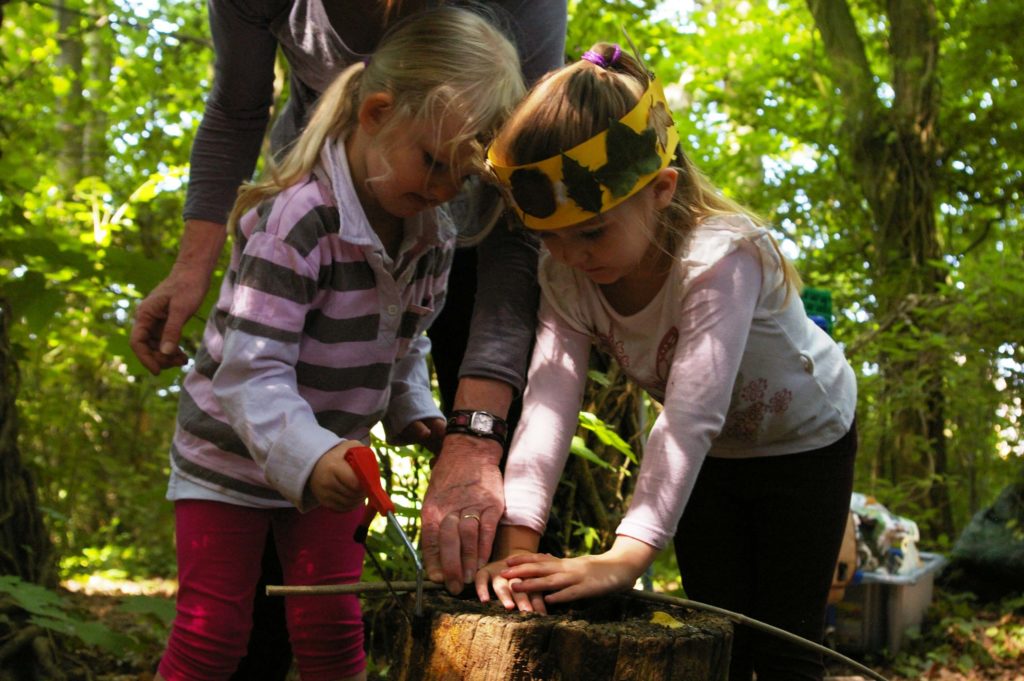 Toddlers learn how to use knives and tools at Forest School
These results haven’t gone unnoticed. “We have a lot of visitors from people all around the world, from Korea, China, all over Europe including the UK, to come and see how it’s working,” said Markepramd.
In South Korea, just seven years after the creation of the Korean Forest Kindergarten Association, almost 40% of South Korean kindergartens were conducting some form of outdoor learning.
The approach is also gaining popularity in eastern Europe. Zilvinas Karpis, a former composer and banker, decided to create a Forest School in his native Lithuania after seeing them on business trips to Sweden. With a school in the forest outside Vilnius, he is building a movement there from scratch.
But is it really safe?
“Children are allowed to use real tools, real knives, real saws, climb trees, and run around,” explained Markepramd.
This does increase the likelihood of minor injuries. Studies of Forest Schools in the Czech Republic have found that children are more likely to get ticks and insect stings, and there is inevitably a higher occurrence of small injuries such as scratches and splinters.
Serious injuries, however, are actually very rare. “Parents trust us perfectly,” Markepramd pointed out, “and we’ve never experienced serious injuries.” Similarly, the UK's Forest School Association (FSA) commented that "No FSA Recognised Provider has had a serious accident".
"Sometimes you get a little hurt and that’s part of life"
Concerns have increasingly been raised in many developed countries about "helicopter parenting" when parents are overprotective about their children, who are considered members of the “cotton wool generation”; soft and ill-prepared for the dangers of life.
Forest Schools could, therefore, be a way of building greater resilience in young children and the small injuries just another opportunity to learn. “It’s part of the teaching philosophy that children should be allowed to do things themselves, and sometimes you get a little hurt and that’s part of life,” said Markepramd.
“If you don’t have the environment with an opportunity to take risk, they never learn their own limits. How can you know the limits of your own body if you’ve never tried it before?”
Who is looking after the kids?
Children in Denmark’s Forest Schools are supervised by “pedagogues”, who are not your typical pre-school teachers or play workers. They complete a special three-and-a-half-year bachelor’s degree, and are trained to provide holistic support for the toddlers.
Pedagogues work hard on knowing when, and when not, to step in and help. The interactions between children of various ages and abilities can play a significant part in their social development, and often it’s best for the pedagogues just to let it happen.
“A three-year-old girl was trying to climb a tree,” said Williams-Siegfredsen, recalling one of these special moments. “She was trying to lift her leg up onto the first branch and there was no way she was going to do it.
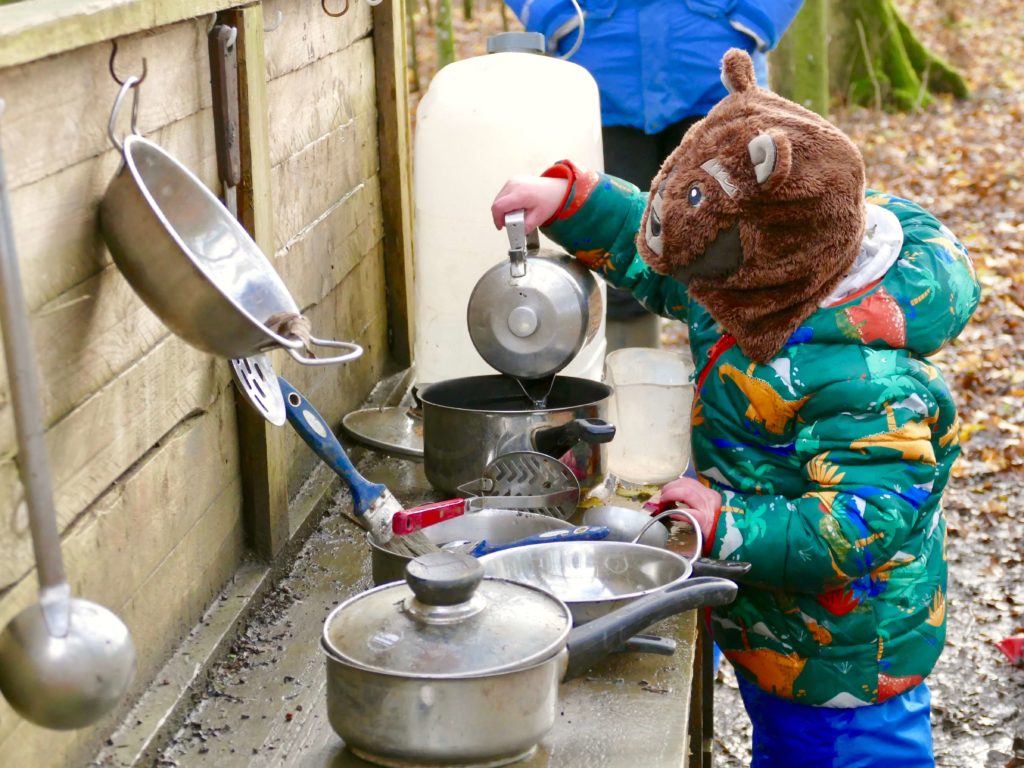 The UK’s Forest School Association have helped to train more than 12,000 teachers
“One of the older girls, who was five, saw her trying. She climbed down from her tree, took the younger girl by her hand and went to a very small tree. She quietly said to her: ‘I think if you try this tree you might find it easier – this is the tree I started on’. The little girl made it onto the first branch.”
This kind of hands-off role doesn’t necessarily come easily in all cultures. For example, Williams-Siegfredsen argues that in the UK a supervisor is still “seen rather like the old-fashioned teacher on playground duty”.
The UK’s FSA, however, is working to promote best practice in Forest Schools, largely based on the Danish model. They have helped to train more than 12,000 teachers and other professionals.
But not everyone’s convinced
Aside from safety concerns, advocates of Forest School also face questions about its academic value and place in a tech-driven modern world.
“Some people have this picture in their mind: oh you’re just outside all day, how can you learn anything when you’re just playing around?” said Markepramd.
"Children should have time to play because a playful child is a meaningful way of adapting to the real world"
With preschool children spending so much time outdoors, there's a concern that they may be missing out on important literacy training. Some experts argue that reading and writing during the early years creates the foundations for school learning, a view which holds sway in the UK where formal schooling begins by the age of five.
Finland, however, which is the world’s most literate nation, doesn’t start formal education in these areas until the age of seven. Instead, more emphasis in Scandinavia is placed on creative play, much of which takes place outdoors. And this has been supported by recent studies which extol the benefits of play-based, informal education at a young age.
“We’re putting too much pressure on them,” argued Markepramd. “Children should have time to play because a playful child is a meaningful way of adapting to the real world. They need to have time for that.”
Meanwhile, with the coming of the so-called fourth industrial revolution, young people are expected to be brilliant with technology. Could outdoor learning therefore disadvantage young children from their tech-savvy peers?
“Of course we have iPads, we have cameras, we have technology, but we’re using it in a pedagogical way,” Markepramd explained. “Children are not allowed to spend time on an iPad by themselves because we think they should have the opportunity to be social and play with other friends.”
Forest Schools expect that most toddlers will use technology at home anyway, so perhaps it's less necessary at preschool. Yet this is by no means a given for all young children: as tech plays an even greater role in people’s lives, this criticism is unlikely to go away.
What can governments do?
In Denmark, Forest Schools work the same way as any other public kindergarten, with parents paying whatever price is set by the municipality. They are very much a part of the system.
“The government, in the curriculum and the regulations, wants the opportunity for children to spend time outdoors," said Markepramd. "Even if you are a kindergarten in the city centre, you have to work with the natural environment.”
The regulatory environment plays a key role, and remains a major obstacle to Forest School in some countries.
"It’s not about an export of Danish kindergartens – because you can’t do that"
An outdoor nursery in Saffron Walden in the UK, for example, was denied an "outstanding" rating by Ofsted – the organisation responsible for inspecting schools across the country – because children had insufficient opportunities to use technology. In Australia, meanwhile, a Nature School was denied status as a legitimate educator by the New South Wales Government.
“It’s not about an export of Danish kindergartens – because you can’t do that,” said Williams-Siegfredsen. “The culture is different, the environment is different, the curriculum, and what we’re allowed to do under health and safety are different.”
As the benefits of Forest School become better-known, though, governments may take increasing steps to facilitate their creation.
Perhaps, as Markepramd ponders, reengaging children with nature might have broader implications.
“The thinking is that if you have joy and positive experience in nature, you will grow up and take more care of our world.”
(Picture credits: Flickr/Bob Cox, Flickr/John C Bullas)
Jack Graham
Make sure to share your own thoughts with the author by leaving a comment below

Log in or sign up to continue the conversation