
The #MeToo movement and the explosion of public outrage around the pervasiveness of sexual violence, abuse and harassment at all levels of society took some by surprise. But for many – survivors, activists, policymakers, researchers – this was not news.
“This has now been brought to public attention, but that is after many decades of work, started by the women’s organisations across the world and a few brave women who were able to say what was going on in their lives,” said Purna Sen, Director of Policy at UN Women, and recently appointed UN Women’s Executive Coordinator and Spokesperson on Sexual Harassment and other forms of discrimination.
But even if the revelations may not surprise those who have worked in the field for years, something new has caught their attention. What has changed is the sense of possibility - that the future can be different, and that the public will no longer accept the status quo.
"The exciting thing about #MeToo is this idea that things can really change"
“The exciting thing about #MeToo is this idea that things can really change - all of a sudden we’ve reached a tipping point. I think being able to ride this wave and not have it just be a blip will be critical for us as a field,” said Daniela Ligiero, CEO of a world-leading violence prevention partnership and an outspoken survivor of childhood sexual violence. The partnership, Together for Girls, is made up of the US and Canadian governments, six UN agencies, and the private sector.
Critical to riding the wave will be engaging the learning and evidence accumulated over years of quiet research around violence prevention by organisations like UN Women and Together for Girls. Apolitical spoke with Sen and Ligiero to find out what they’ve learned from their years in the field.
Sexual violence is everywhere
The first step to solving the problem is recognising just how ubiquitous it is. Sexual harassment and abuse are not just about individual relationships or groups, but part of a system of inequality and gender hierarchy that pervades everything.
“There’s no country that’s immune. There are very few workplaces with no harassment; there are very few streets that are safe,” said Sen.
"Violence against girls and women is universal. It happens in every age group, setting, country, social class, race"
Ligiero agreed: “This isn’t something that happens in one setting, like Hollywood. Violence against girls and women is universal. It happens in every age group, setting, country, social class, race - and we have the data and decades of research to show it,” she said.
Ligiero has been at the forefront of a drive for better data about this global problem. Through multi-country surveys, Together for Girls has collated data on victimisation and perpetration of violence for 10% of the world’s adolescents and youth, and by the end of next year will almost double that.
The data has been used by governments, like Tanzania’s, to drive political will and accumulate resources for violence prevention. It paints a stark picture: more than 30% of girls experience some form of sexual violence before age 18. One in four girls worldwide said their first sexual experience was forced or coerced.
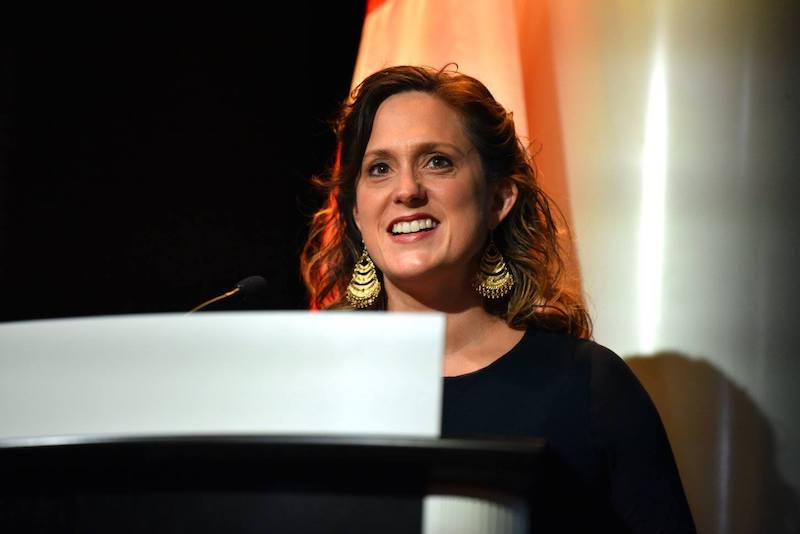 Daniela Ligiero speaking at the UN's International Day of the Girl
Systems and structures
The recognition that violence is everywhere is critical, but even more important is analysing what that means: that there is a system in place that allows, and even encourages, that behaviour.
“While it’s really important to work on individual people who are abusive or violent, if we see that it’s all around us, we can recognise there are patterns and connections - systemic violence and inequality. So, then the question is how do we undo those,” said Sen.
"There are accepted ways of power operating in our everyday surroundings: most of the people who make decisions, who are in control, who run our political and economic life are men," she added. "And the vast majority of those who use violence are male – which again tells us that this inequality between men and women is what we need to unpack.”
"Most of the people who make decisions, who are in control, who run our political and economic life are men"
Research has shown that a key root cause of both violence against women and children is gender inequality. In Sweden, for example, national surveys have shown that young men who agree with stereotypical statements about gender roles have a higher risk of using violence.
And the ground-breaking work of the Global Early Adolescent Study in over 15 countries has found that such gender norms are usually set by the age of 10.
“Part of it is to do with power dynamics, with norms, with the scripts of masculinity and femininity we teach,” said Ligiero. “From an early age, girls are taught to be submissive; that they’re not the ones making decisions about sex and don’t have the power to control when and if sex happens. And, we define masculinity around power and dominance and force. We also don’t teach boys about consent - we just assume they understand, but it’s very complex.”
“Those things together just create this perfect storm, and you add to that this complete lack of accountability, where if someone is sexually assaulted and goes to a police station they’re asked what they were wearing and they’re shamed and blamed,” she added.
Breaking a culture of silence
But, while violence is everywhere, and policymakers have for years recognised that this ubiquity stems from systems of inequality and discrimination, few have spoken in public. Until the 1980s and 1990s, sexual violence was rarely discussed on popular TV and radio shows, Sen said.
And, even today, most survivors live their experiences in silence. Together for Girls’ national surveys have shown that half of those that experience sexual violence never tell anyone, and much fewer still - less than 5% - receive any kind of service, including health, justice, and social welfare.
"You have this massive pandemic happening in silence"
“You have this massive pandemic happening in silence, and communities are built around allowing that to continue with very little accountability. So, it’s a recipe for disaster,” said Ligiero.
At a recent conference in Sweden, Ligiero told the audience that the reason she had personally started telling her story - of being a survivor of sexual violence in childhood - was this perpetual, deafening silence.
It’s only in recent months, with the social media storm around #MeToo and #TimesUp, that the silence has begun to be broken at a more public level.
“It’s not that women hadn’t been telling their stories. It’s that no one has listened before"
“It’s not that women hadn’t been telling their stories, it’s that no one has listened before. More women are coming forward because now there’s a real opportunity to be heard,” said Ligiero.
“It’s basic social norm research: someone takes a risk and exposes something, and if the reaction is to blame her, to shut her down, or she has some kind of a negative consequence, other people won’t do it. But all of a sudden to say, 'This time others are listening and believing; there are consequences; the perpetrators are losing their jobs or going to jail' - that creates this movement where more and more people feel safe. How we nurture that and empower more survivors to come forward is critical right now,” she said.
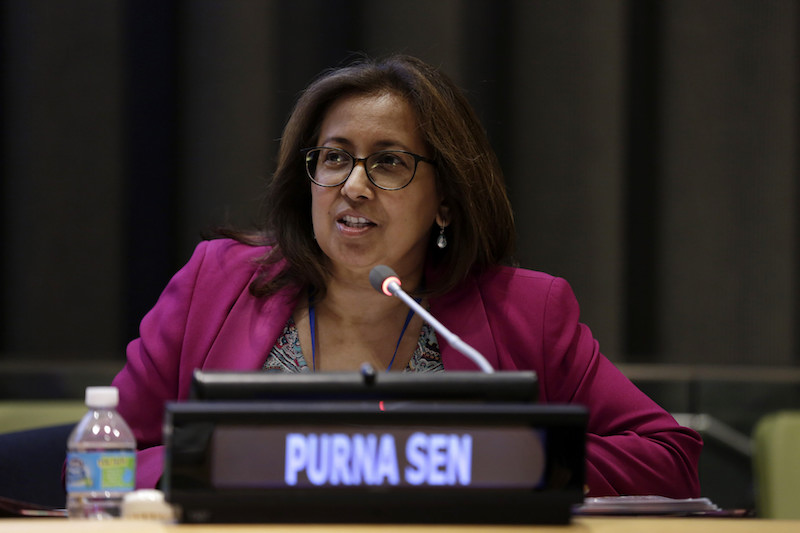 Purna Sen at UN Women's High-Level Political Forum
What now? From recognition to prevention
As Ligiero points out, this moment may be critical. The public is engaged; this is an opportunity to build political will to create lasting change. There will be backlash and setbacks, of course, but the conversation may have taken a big leap forward.
“Once we start talking about it, we start to say, 'Actually this isn’t such a great thing - and our governments and criminal justice systems and schools and workplaces should be addressing it'. We start to discuss what people who have been abused need, and we start to talk about what to do to reduce the violence. The latest development has been thinking about how we can stop it – about that word prevention,” said Sen.
"The latest development been thinking about how we stop it – about that word prevention"
The first part of prevention involves work across society, families, communities, and schools, to change young people’s toxic norms and beliefs about masculinity and femininity.
And beyond gender-stereotypical norms, another factor shown to increase young boys’ risk of perpetrating violence later is their own childhood suffering. The Together for Girls surveys have found that boys experience a lot more sexual violence than we ever anticipated. Girls and young women are three to five times more likely to experience it, but 10-15% of boys are still victims.
The surveys found cycles where these boys are much more likely to perpetrate violence later in adolescence and in early adulthood. This is backed by a wealth of evidence that child victims of violence or neglect have an increased risk of becoming either perpetrators or victims of violence as adults. Even witnessing intimate partner violence against their mother can make children more likely to experience violence in future relationships, whether as a perpetrator or victim.
So, the second part of prevention involves working to keep children safe. To do this, many evidence-based solutions have been tested globally. Some of the most effective can be found in the WHO’s landmark INSPIRE package, which identifies seven strategies that have shown success in reducing violence against children: implementation and enforcement of laws; norms and values; safe environments; parent and caregiver support; income and economic strengthening; response and support services; and education and life skills.
“We need to treat sexually assaulting or harassing someone as a crime no different from mugging someone on the street"
Then, it’s about reducing tolerance and acceptance of the crimes that do happen. How, on the back end, we ensure there are consequences and accountability mechanisms for those who still perpetrate. “We need to treat sexually assaulting or harassing someone as a crime no different from mugging someone on the street: you don’t ask mugging victims what they were wearing, or why they were wearing an expensive ring,” said Ligiero.
In recent weeks, France has introduced a €90 fine ($110) for sexist remarks and gestures in public places and street harassment. The on-the-spot fines could rise to as much as €750 ($930), depending on how quickly the perpetrator pays up. And in Belgium, the first man has just been convicted under a similar law. This is just one small intervention, but an indication of what is easily possible.
“We have the evidence in terms of what works: now it’s really an issue of political will and investment. It’s not expensive but we don’t invest in violence prevention, even in the richest countries," said Ligiero.
"We need to change the narrative to yes, it’s happening everywhere, but we can change that; we know what to do. And everyone has a role to play - this isn’t just the government,” she added.
And while it may not be down to government alone, the public sector in many countries has itself made huge promises. The Sustainable Development Goals, for example, say that we must eliminate all forms of discrimination and violence against women and girls by 2030.
“All governments now across the world have promised to get rid of this violence - and they’ve promised to do it in the next 12 years. So, the task is huge and that means the imperative, the pressure to act and make change is really, really intense,” said Sen.
(Picture credit: Flickr/UN Women, Together for Girls)
Odette Chalaby
odette.chalaby@apolitical.co
Make sure to share your own thoughts with the author by leaving a comment below

Log in or sign up to continue the conversation