
The best year for women in UK film was 100 years ago - in 1917 - when women made up 41% of cast members. Since then, women's representation has lingered well below parity: since the end of WW2, consistently only one in three UK film cast members have been women. Both off-screen and on-screen, women have tended to have shorter careers and have worked on fewer films.
This is just some of the striking data researchers at Nesta have visualised using the British Film Industry’s newly released filmography of UK film history. Yet, the stark underrepresentation of women is not just restricted to the UK.
In the top 250 grossing US films of 2016, a mere 7% of directors were women. The vast majority of those films (77%) did not have one single female writer. And, according to a recent study, on average US viewers will see 2.18 males for every one female character on screen.
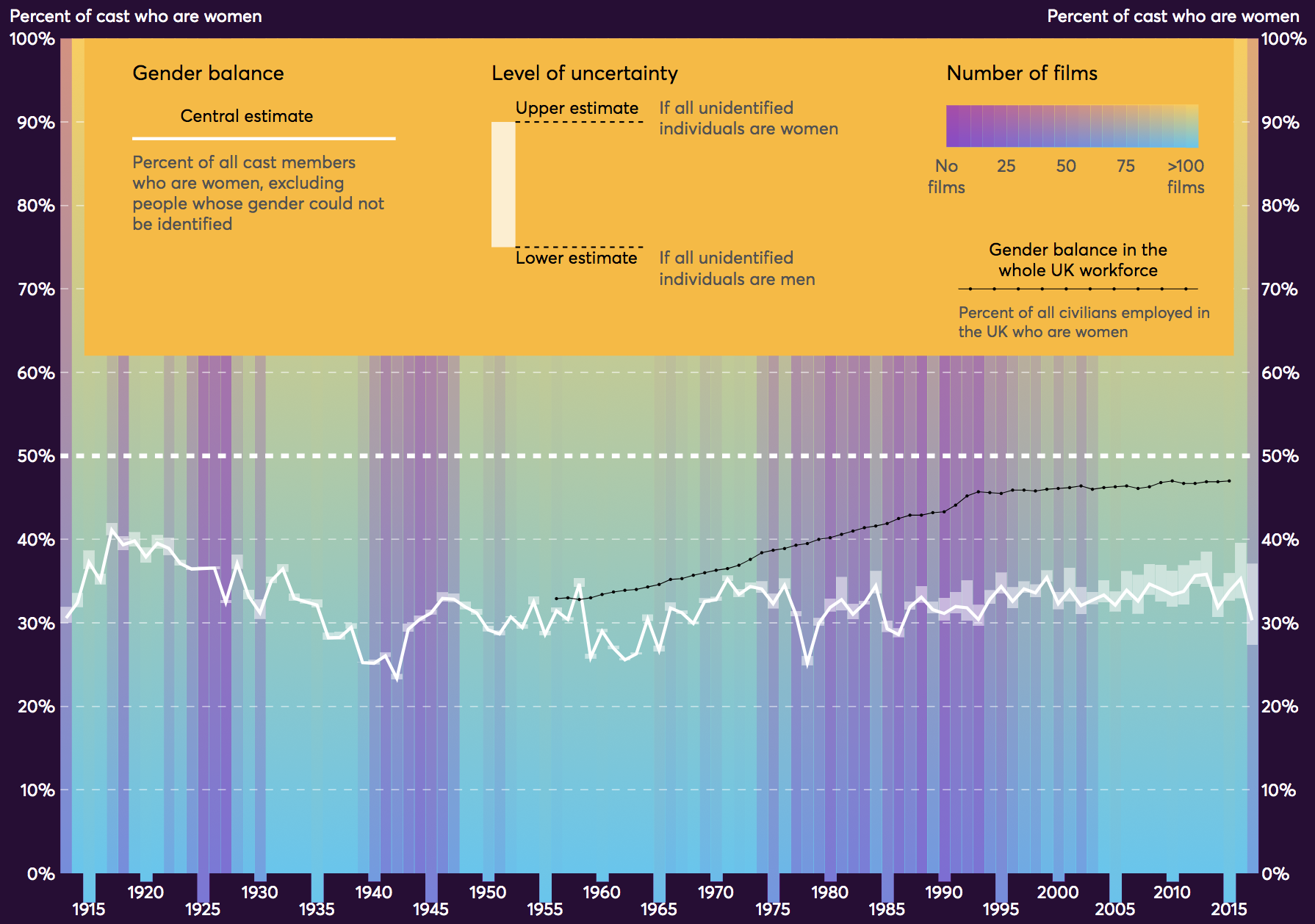 "The lack of diversity in the arts is an issue that has received widespread attention. We're interested in showing how the analysis of big data can supplement qualitative evidence," said Nesta.
Source: Nesta's research on the BFI Filmography[/caption]
Why is this so important?
As policymakers are increasingly realising, gender stereotypes are a barrier to equality (see this 2017 EU Report). The role of media in generating those stereotypes cannot be ignored; as activist Marian Wright Edelman famously said: "You can't be what you can't see."
Just as one example of the power diversity in film can have, a new study from Oxford’s economics department found that showing Ugandan secondary school students the film Queen of Katwe - which is about a girl from the slums of Kampala who became a world chess champion - just before the national exams made those students perform better and improved their chances of securing the grades needed for university. The study “highlights the power of a role model as a cost-effective way to improve secondary school students’ educational attainment.”
Studies show that people overestimate the presence of women and their speech in daily life - we generally think women are louder and more numerous than they really are. The non-presence and silence of women on screen reinforces such gendered misperceptions in real life: people learn from what they watch.
Is there a role for government?
Until very recently, women’s representation in the media and arts has been left unaddressed by most governments. However, things are now starting to change.
In 2016, New York City announced an unprecedented group of measures targeting women’s representation in the media, which will cost the city $7.5 million over five years.
“Study after study has found that women are underrepresented both onscreen and behind the camera. With the production industry booming as never before in New York, we felt it is our duty to address that gender imbalance with thoughtful, effective programs," said Julie Menin, Commissioner of the Mayor’s Office of Media and Entertainment (MOME).
"We want to make sure that all New Yorkers have access to well-paying jobs in these burgeoning industries, and ensure that stories by, for and about women are told," she said.
One of the new programs has been a city-run Finance Lab, a fundraising “speed dating” event, in which filmmakers from 57 nominated film projects made by, about, and for women can pitch to and network with potential financiers for their films. Participants can even attend city-funded pitching workshops in preparation beforehand.
A $5 million fund has been set aside to provide grants to support film and theatre projects by, for and about women. “It’s been set up as a finishing fund - the idea of the grants is that they would get a project to completion, whether it's a grant for editing that’s necessary, or funds for finishing a film,” said Alia Jones-Harvey, Director of Education and Workforce Development at MOME.
And the city has also run a scriptwriting competition showcasing women in film and TV, with the winners chosen from over 300 scripts by a panel of industry leaders. The two winners - a script about a mother trying to re-start her career and another about a young woman who works at a Bronx nursing home - will have their ideas made into shows aired in 2018 on the NYC Media channel, which has an audience of 18 million households.
The Swedish Film Institute has also been a pioneer in this sphere. The Institute runs the NordicWomenFilm portal - an online directory of female directors, actors, and producers. It also has a mentorship scheme in which women having trouble funding their second or third film can find support from experienced filmmakers. Through measures like these, over the last five years, Sweden has reached gender parity in film funding, and women now dominate the Swedish film awards, taking 69% of the prizes.
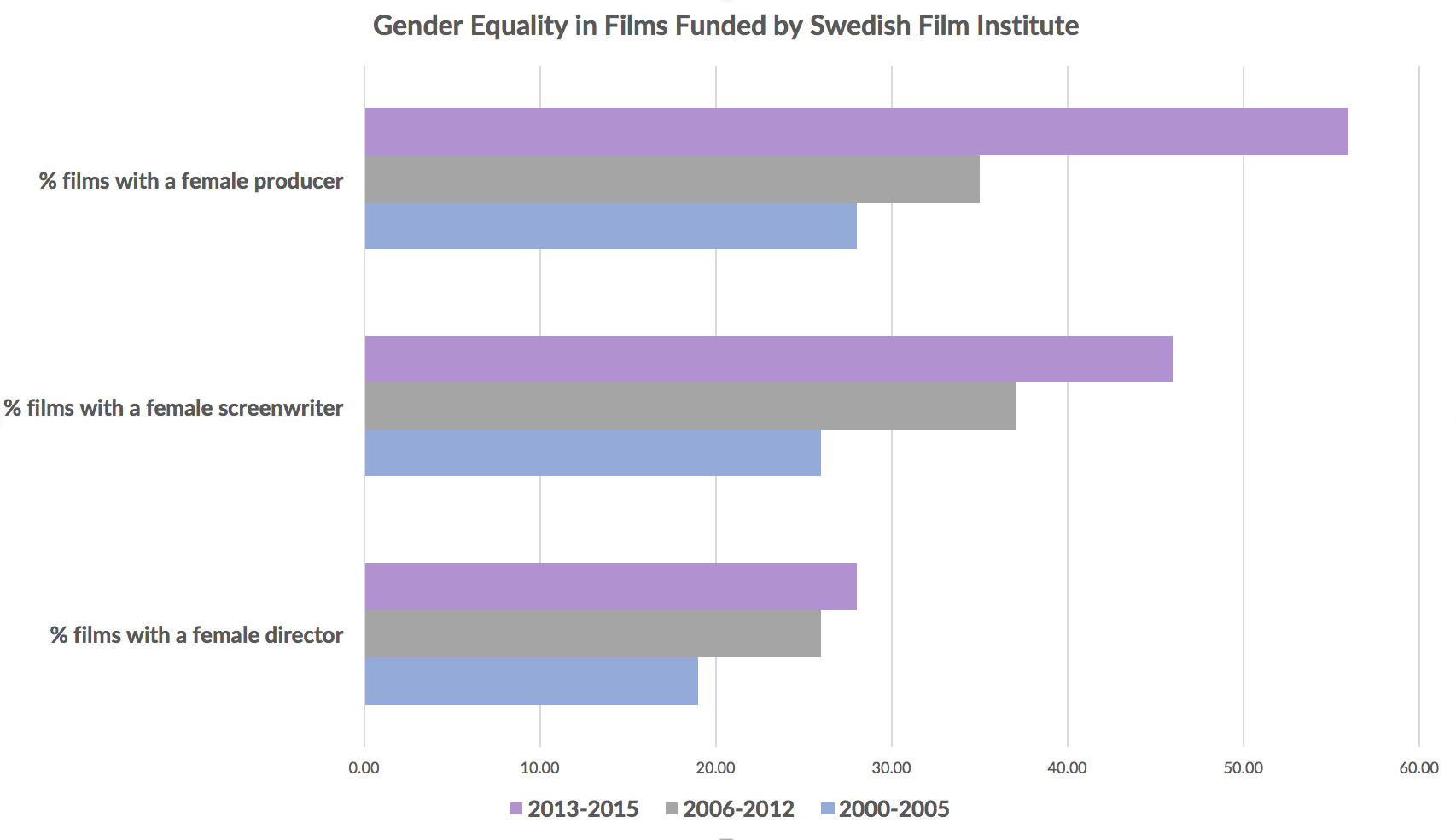 Source: Swedish Film Institute
In the UK, the British Film Institute, which invests over $35 million each year in new productions, is also stepping up. Under its “three ticks” system, started in 2015, projects applying for funding must demonstrate a commitment to diversity. To be eligible, films must receive a “tick” in a minimum of two areas, ranging from the genders of the cast and crew to the stories and characters on screen. Throughout 2017, the BFI has also run a year-round celebration of women in film, partnering with women’s organisations to showcase more gender-diverse cinema.
With new data reinforcing how stark the media representation problem really is, ever more governments are now taking this issue seriously. In the last year alone, Canada announced plans for new gender parity measures for film and TV, and this summer The Irish Film Board announced a new funding initiative for female directors.
Sexist attitudes and stereotypes represent a real challenge for policymakers aiming to shift perceptions about women's roles and value in society. Changing hearts and minds is not an easy task. But initiatives encouraging better diversity in our media could represent a simple, untapped way to shift some of the gendered ways of thinking that are holding women back across all walks of life.
(Picture credit: Flickr/Craig Duffy)
Odette Chalaby
odette.chalaby@apolitical.co
Make sure to share your own thoughts with the author by leaving a comment below

Log in or sign up to continue the conversation