
This article was written by Harshitha Rajashekara, Project Manager at the Department of the Premier and Cabinet (DPC) in the ICT and Digital Government Department, Adelaide, South Australia. This article is one of the finalists in Apolitical’s 2020 Women in Government writing competition.
Women make up the majority in many public service organisations around the world, but are a minority in senior positions.
The reasons are numerous, but because women are less qualified is not one of them. How can we therefore break through this statistic and get more women into leadership positions?
“Women belong in all places where decisions are being made. It shouldn't be that women are the exception.” These words, spoken by the late Supreme Court Justice Ruth Bader Ginsburg 16 years ago, are still valid.
This indicates the slow progress that has been made with respect to women’s growth in executive positions. It is the end of 2020 and the struggle for women to climb the proverbial ladder continues to persist. Women’s committees have been formed, gender equality conferences have been run, powerful people both in business and politics have spoken about promotion of women in the workplace, but still no radical change is seen.
Leadership roles in 2020 and in the future are a whole different ball game. They are increasingly demanding, in terms of emotion, time and energy
This might be a disappointing outcome after so many visible efforts, but the good news is that the fight and voices supporting women to achieve leadership roles continue to this day.
A fact worth celebrating is that the public sector has a higher share (~41%) of women employees than in the private sector (~38%) (Shi, KAY, and SOMANI 2019). This is because of equality between both genders regarding pay and fewer working hours which translate to a better work-life balance (Gomes and Kuehn 2019).
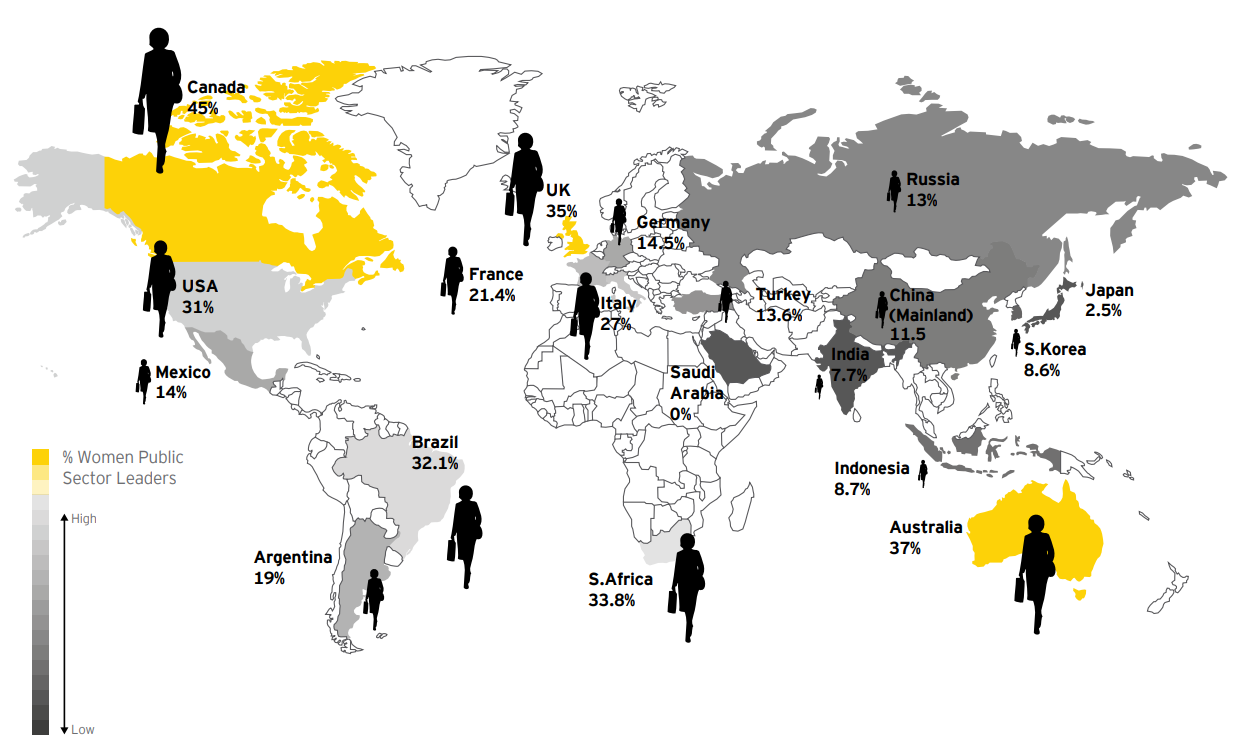
The unpalatable truth is that only a few women are in leadership roles. The picture below represents women in public sector leadership roles across the globe.
Who is leading is crucial
The decisions made by the public sector leaders affect millions of people. Leaders from local council to central boardrooms affect the public in their day to day lives with regard to transportation, welfare, health, parking, water supply, electricity, sewage system and even garbage collection in the suburbs. The public consists equally of women and men. Thus, making decisions for the public should be done with equal representation from both genders. When a citizen looks to see who is leading, both men and women should be visible. Having equal representation of women and men brings diversity in thinking which results in fairer decisions for both genders. Also, women by their nature have a high level of empathy and this skill helps in better decision-making.
Problem spot
According to data, more women are graduating than men (Medhora 2018). They are not just graduating but out-performing men in terms of merits. Regardless, women are not able to make it into leadership roles.
Academics need to develop exclusively female practical subjects that provide insights for women to assume public sector leadership positions. These educational programmes should inspire women to become leaders. Later, it is the responsibility of the government agencies to have programmes in place that can illuminate a path for women to move up the management ladder.
Government should develop initiatives like ‘Male champions of change’, so men in power feel and take the responsibility.
Women supporting Women
Nothing is stronger than a social structure in which women support other women. However, this is often not the case in the real world. Women often consider other women their competition and this mentality is a massive threat for women in the leadership ecosystem. Women leaders need to mentor, raise and nurture other women.
This should involve a two-way mentoring relationship that involves an exchange of skills from both parties. Having this type of ecosystem not only helps women to move into leadership roles but also helps to sustain women in leadership for longer by creating a solid support network. Every woman in a leadership role should strive to replace her job with another woman when they are promoted or retire.
Women need to kick the illogical “good woman” traps and put themselves first to be promoted to leadership.
Social structure
Leadership roles in 2020 and in the future are a whole different ball game. They are increasingly demanding, in terms of emotion, time and energy. Society still defines a “good woman” as someone who can take responsibility for the home, which includes domestic chores and childcare.
It is inbuilt in some cultures that if a woman cannot perform these responsibilities, then she is failing. Most women fall into the trap of getting approval from society and end up staying at a managerial level. After a few years, they no longer consider climbing the ladder or growing.
Women need to reflect at least once a month about their goals and priorities. Reflection with a clear mindset towards goals can help them navigate their way to the top leadership roles. For now though, the following still holds true: “Women will have achieved true equality when men share with them the responsibility of bringing up the next generation” (Kacala 2020).
Performance Indicators
Government agencies are trying to become more like corporations in an attempt to drive and deliver massive projects.
Government agencies’ performances are measured in terms of customer satisfaction. In this game of obtaining approval of citizen satisfaction, the public sector is losing its focus on advancing women.
Success of a government agency should be based on how many women are in leadership/decision-making positions and not just based on how many women are in the organisation. There should also be incentives given to these agencies, along with recognition for their efforts in making women in leadership a priority.
It is a fact that, when it comes to women in leadership, there is a lack of bold thinking with respect to opportunities. Equal representation of genders needs priority on the agenda of any government organisation.
One woman should be a cheerleader for another, and each should be the other's anchor. Academia must create programmes to pave paths for women leaders. Women need to kick the illogical “good woman” traps and put themselves first to be promoted to leadership. Finally, Government agencies should be credited for nurturing women leaders.
There is still a long and hard journey ahead, but the goal remains 100% achievable.
This article has no connection with the author's role or relation to their employer and its contents are strictly a reflection of their opinion.
👋 You can create a post like this one! Share your thoughts with a community of public servants. Learn more
(Image Credit: Unsplash)
Make sure to share your own thoughts with the author by leaving a comment below

Log in or sign up to continue the conversation