
This article is written by Ibrahim A. Elbadawi, Founder and CEO of 01Gov
During the last week of April, we in 01Gov — a Dubai-based digital startup for enabling government innovation, ran our Virtual Government Innovation Lab, a first of its kind in the United Arab Emirates (UAE) and the region. The lab was sponsored by the Chief Innovation Officer at the Ministry of Energy and Industry and the participants were representatives from various federal and local government entities in the UAE. The lab was so successful, it was featured in the UAE News Agency.
- Want to write for us? Take a look at Apolitical's guide for contributors
A Virtual Government Innovation Lab is a digital space in which government officials can remotely collaborate to experiment with new ideas and test new solutions to create greater public value. In our lab, they pursue their organisational innovation agenda using a wide range of practices and digital tools that enable them to work completely online without the need for in-person interaction.
As you might imagine, we launched this virtual lab as part of our efforts to enable governments to respond and adapt to the new reality of the Covid-19 pandemic. The timing of this lab was lucky considering that the UAE government has already started looking beyond containing the crisis to designing the future of government in the post-Coronavirus world.
Considering that this virtual lab was a first for the UAE government, and considering that many government agencies around the world might be considering running similar virtual labs, we thought that they might benefit from our experience.
Here are seven key takeaways from our virtual lab experience:
1. Start with why: Before rushing to the tempting remote-work digital tools, it’s imperative to have a clear answer to this question: why do you want to run this virtual lab? In our case, the group wanted to explore and find answers to the following key questions:
- To what extent it’s possible and easy to move the innovation process from the labs and meeting rooms to the virtual space?
- How is this virtual experience different from the physical one?
- What are the appropriate tools to enable this virtual innovation experience?
- And what lessons can we learn from this experience that enable us to sustain it as a normal practice in the post-Corona world?
Moreover, it would be helpful to approach your virtual lab with an open mindset and an eagerness to learn and explore a new way for pursuing the same innovation agenda.
2. Apply an agile design process: If this is your first fully virtual innovation lab, then it’s best to avoid the temptation to go for a perfect and detailed delivery plan before you launch the lab. In our case, we quickly developed a concept note and produced a high-level design for the lab delivery process before discussing it with the Chief Innovation Officer at the Ministry of Energy and Industry, Ms. Hala Al Marri.
We don’t see the virtual innovation lab as just a digital version of the physical one. Rather, it's a different mechanism to enable the organisation to practice the same innovation agenda while working remotely over the internet
This plan initially didn’t offer details such as the exact agenda of the lab sessions. We mutually approved the initial design, and agreed to start converting this blueprint into a detailed agenda one session at a time. Here, we leveraged the fact that we’ve designed the lab to consist of three sessions over five days, which gave us a space to reflect on the experience of each session while finalising the details of the following one.
We highly recommend referring to your organisational remote work policy if any, in our case we used our own guide (Arabic) we published a few weeks earlier.
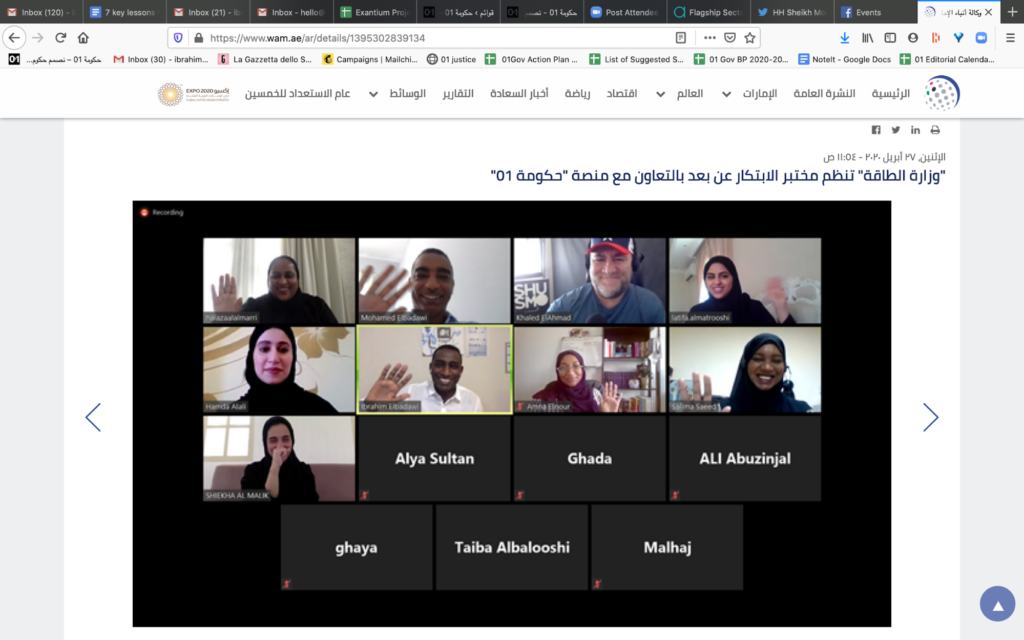
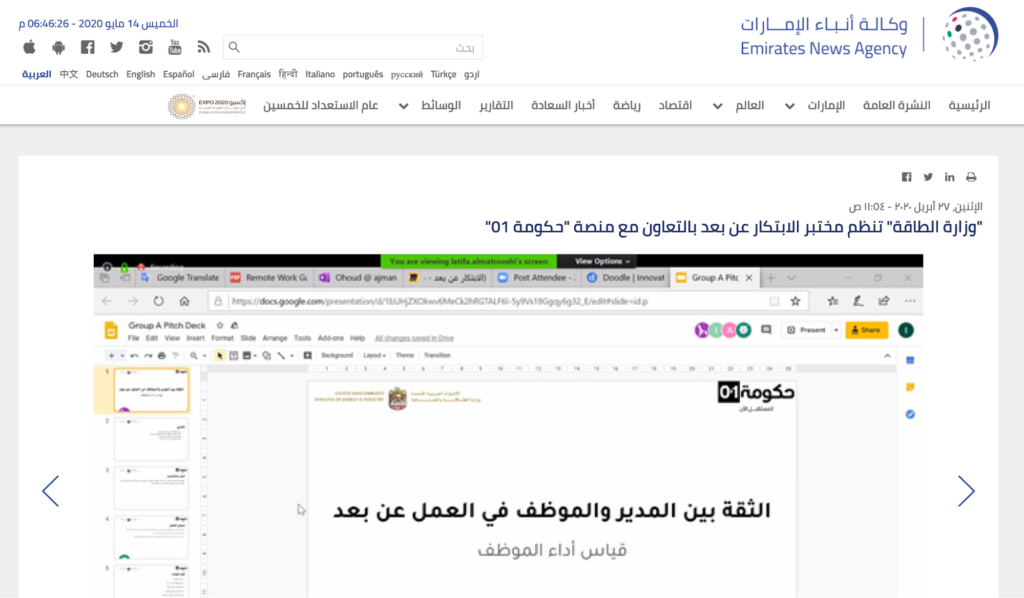
The Virtual Innovation Lab coverage on UAE News Agency website
3. Follow an open collaborative approach: while it might be very tempting to the innovation ninjas in your team to work on their own and quickly design and launch this lab, we don’t recommend this solo approach.
Instead, we applied an open collaborative approach in which we involved the client in the process from the early steps. And if you are concerned about the delay that can result from this approach, you can involve your typical innovators and early adopters from the client side or the circle outside your immediate innovation team. In our case, we approached the Ministry of Energy and Industry because we have an excellent history together, and they have already experienced our flagship product, “The Innovation Studio” many times in the past.
4. Don’t just “digitise” your physical innovation lab: we don’t see the virtual innovation lab as just a digital version of the physical one. Rather, it's a different mechanism to enable the organisation to practice the same innovation agenda while working remotely over the internet. For instance, the physical version is usually limited to those who can physically make it to the room, while the virtual one offers you the opportunity to engage participants from all over the world. Such differences in the design parameters can have a significant impact on the final product.
Therefore, it’s better to “start with why” and then create a “virtual by design” experience rather than aiming at creating a digital twin of the current physical one.
Watch a snippet of our lab in this Instagram video:
5. Design it for humans: one key design parameter in the virtual lab is that the participants are working remotely from the comfort of their homes and under different circumstances. This can result in some interesting encounters. In our case, we had fifteen participants and facilitators who checked in to the lab from ten cities, from Sydney, Australia where I’m based out of all the way to Cairo, Egypt.
We found out that the participants didn’t all have the same level of digital skills, and not all of them were comfortable turning the camera on during the sessions as you can see in the image above. Factors such as these can greatly shape the group dynamics and the level of contribution of each participant.
To make sure that our lab was actually designed for humans, we applied a collection of techniques including for example, reaching out to the participants prior to the sessions through a pre-lab survey, breaking the lab into a series of short sessions (max of four hours each) and intentionally allocating time and space to allow the participants to progress through the learning curve. In addition, one of our facilitators had one job: Virtual Space Concierge whose job was to help the participants deal with any technical or non-technical challenges and make sure they enjoy the lab while contributing their best.
6. Pick the appropriate digital tools: it goes without saying that an essential part of the “virtual by design” approach is picking the appropriate digital tools to enable the participants to communicate and perform a variety of innovation activities such as ideation and brainstorming, research and benchmarking and pitching. This step can be both overwhelming and confusing due to the unlimited number of tools available on the internet. In our case, we decided first to start with the tools that our participants are already used to — their comfort zone. So, we made Zoom our lab HQ. And from there we kept adding more tools to our toolbox which ranged from Miro to Slack to Google Drive among other tools.
Governments can’t afford to be overwhelmed by the tragedy and multi-faceted impacts of Covid-19 pandemic
It’s not a necessity to pick the fanciest tools, rather, we recommend picking the “appropriate ones”, the tools that enable you to achieve your lab goals and can be the most suitable to your participants.
7. Journal the experience: from the start of the lab, we created a shared Google Doc and made it our lab journal in which all participants and facilitators could jot down their thoughts and reflections in real-time. In addition, we allocated the last part of each session to have a group discussion and reflection and capture the group experience: what worked in this session, what didn’t work etc.
This activity turned out to be very helpful in empowering the participants to shape how the agenda of the lab unfolded, and exchange their experiences with the group. As a result, this reflection and journaling practice made the whole lab space more welcoming and inclusive.
Moreover, the resulting journal document itself turned out to be very valuable, not only for us to improve the next rounds of this virtual lab, but also for others who are planning to launch their own similar labs. Therefore, we are happy to share it with you openly (in Arabic).
While I consider the above seven lessons essential to the success of our virtual government innovation lab, my greatest personal takeaway from this experience is that governments can’t afford to be overwhelmed by the tragedy and multi-faceted impacts of Covid-19 pandemic. It‘s crucial that government leaders collaborate with the society in learning from the crisis as it unfolds and jointly design the future we all want. — Ibrahim A. Elbadawi
(Picture credit: Unsplash)
Make sure to share your own thoughts with the author by leaving a comment below

Log in or sign up to continue the conversation