
Imagine a kindergarten with a ceiling like an athletics track, trees to climb and slides leading students into classrooms.
That’s what Japanese architect Takaharu Tezuka conjured up on a train journey in Tachikawa, Tokyo. With the help of his wife, Yui, he made this vision a reality: the Fuji Kindergarten in 2007. In the decade since, Fuji has been celebrated all around the world, and has even led the Japanese government to change their standard for kindergarten education.
The building’s donut shape, with a circumference of 183 metres, means children can run continuously without reaching a barrier. On average, children move for a staggering 4 kilometres a day. “One of the kids made more than 6,000 metres before lunchtime,” Tekuza said.
This has a significant impact on the health of the kindergarten’s 640 kids, who are aged between four and six. “They have much more motor skills than others because they keep running,” he said. “They’re healthier.”
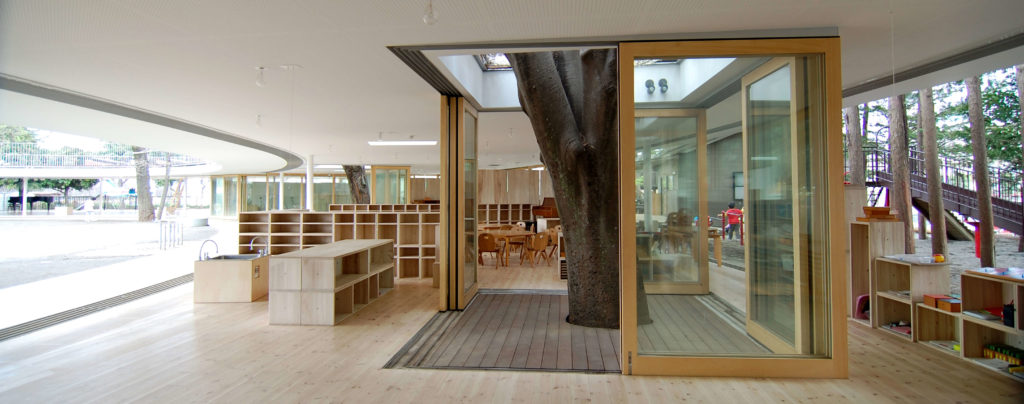 Fuji Kindergarten is built on the principle of openness
Three 25-metre zelkova trees grow through the roof, with nets stretching around them so that up to 100 kids can climb them at a time. Not only does this improve the children’s physical skills, but can help build their resilience.
“I’ve never said that the kindergarten doesn't think about safety, but we tried to set up expected, calculated risk,” said Tezuka, pointing out that teachers are always on hand to supervise. “When kids are ready to climb, they want to climb. But if somebody forces them to climb a tree they get an injury, because they are not ready.”
Changing the mould
With a radically different appearance to typical preschools, the Fuji Kindergarten’s iconic shape is built on the principle of openness. “The kindergarten has no boundaries between classrooms, and no boundaries between inside and out,” said Tezuka. “Because there’s nothing in the middle, you can always see another side.”
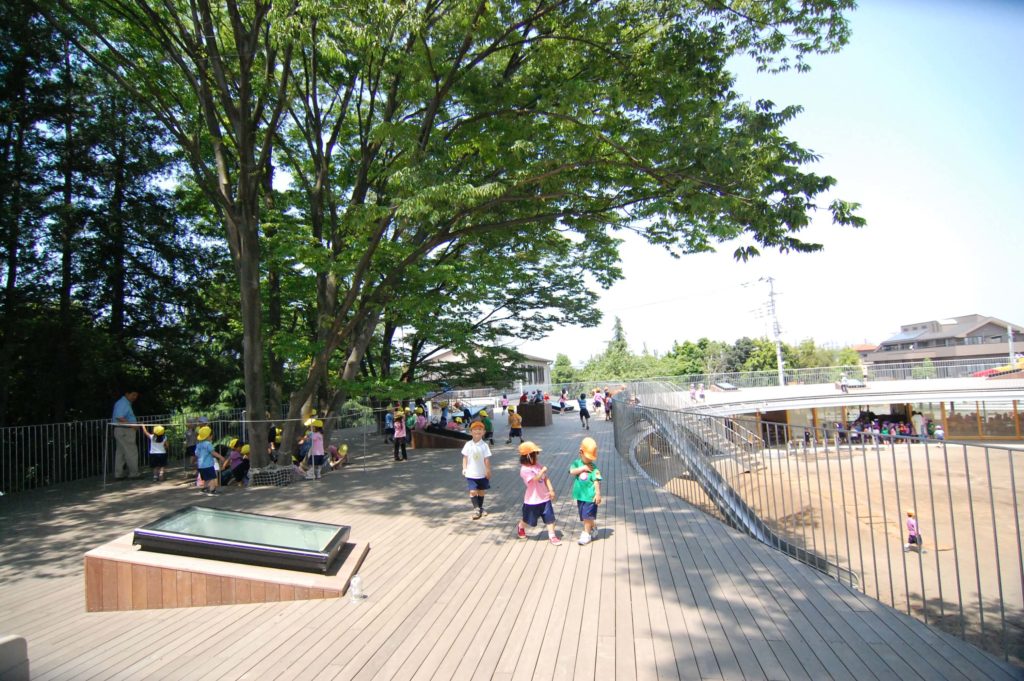 Children can run around the roof, covering an average of 4 kilometres a day
The circular structure also means there are no corners to hide in, and the kindergarten staff believes this improves children’s social skills, helping to prevent them from forming hierarchies in the classroom – which can happen more easily in an enclosed environment. Instead, classrooms are delineated by furniture like wooden boxes.
"It’s easier for the government to make standards with a box"
Like other kindergartens, children have designated teachers, and the school day has a similar schedule of lessons and play. However, Fuji Kindergarten has a far higher level of background noise, which actually helps them concentrate more effectively in class.
Fuji kindergarten follows the Montessori method, which means its teachers are trained to focus on personal development more than overly formal learning.
 Lessons at Fuji are similar to any other typical kindergarten
The kindergarten has been particularly helpful for autistic children, more than 30 of whom are enrolled. There is evidence to suggest that when autistic children hear white noise at a frequency of more than 20 kilohertz, they no longer show obvious symptoms. Staff members have noticed this change amongst autistic children, and some parents have sought out Fuji because their child was struggling elsewhere.
They may also be benefitting from Fuji’s original shape, Tezuka suggests. “In normal strategy in the pedagogical field, when they have an autistic child, they try to find a small space so they can hide. Instead of making a hiding space, the kindergarten is giving freedom,” he said. “If a child is having a problem in the classroom, they can keep their distance. When you put a kindergarten in a box, there’s no place to run.”
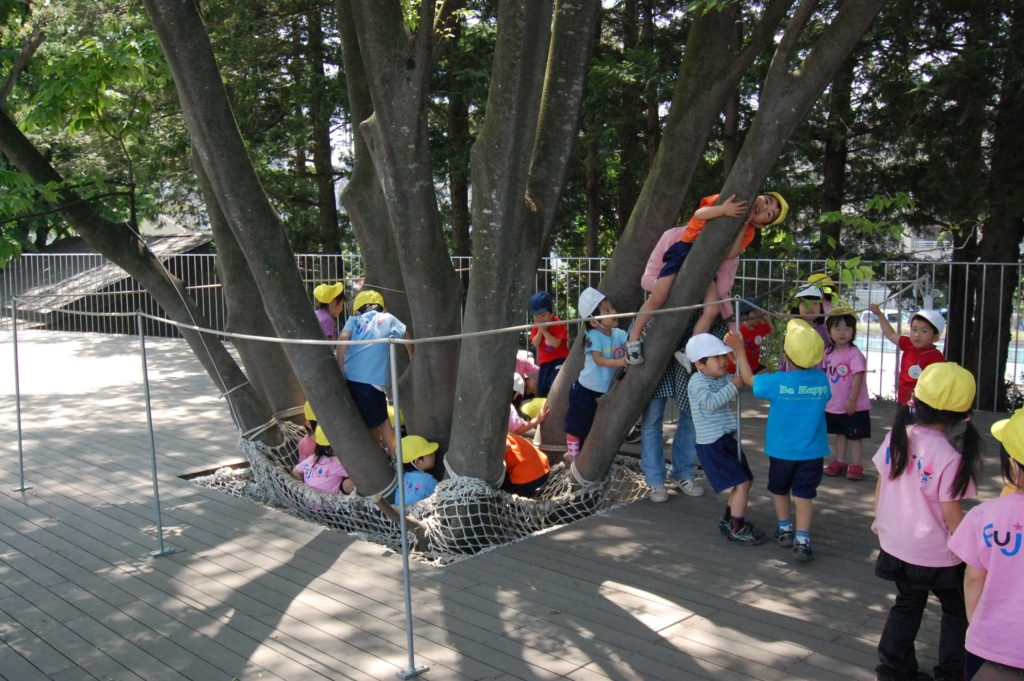 Up to 100 children can climb at the same time on the kindergarten's trees
In 2011, Tezuka Architects added an annex next to the kindergarten. The idea was to build a classroom without any furniture, and it was created around a twisting zelkova tree, resulting in its name: "Ring Around A Tree". Five metres tall, the building has seven levels, with clearances ranging from 600mm to 1500mm, designed to provide suitable challenges for children of all sizes.
The kindergarten is massively over-subscribed, so they accept children living the closest. Inevitably, this has led to something of a postcode lottery as parents move into the area for their kids. Despite its popularity, though, the price is similar to other kindergartens in Japan – where nearly all preschools are private – and it did not cost significantly more to build than other preschools: coming to around ¥500 million ($4.75 million).
What can government do?
The Japanese government took particular notice of Fuji when the kindergarten won an OECD prize for education facilities in 2011. Most kindergartens in Japan had always looked like white concrete boxes, standardised after the Second World War, but preschools like Fuji have begun changing the mould.
“It’s easier for the government to make standards with a box,” Tezuka explained. “It’s quite simple. When you really think about quality, it takes more time and energy.”
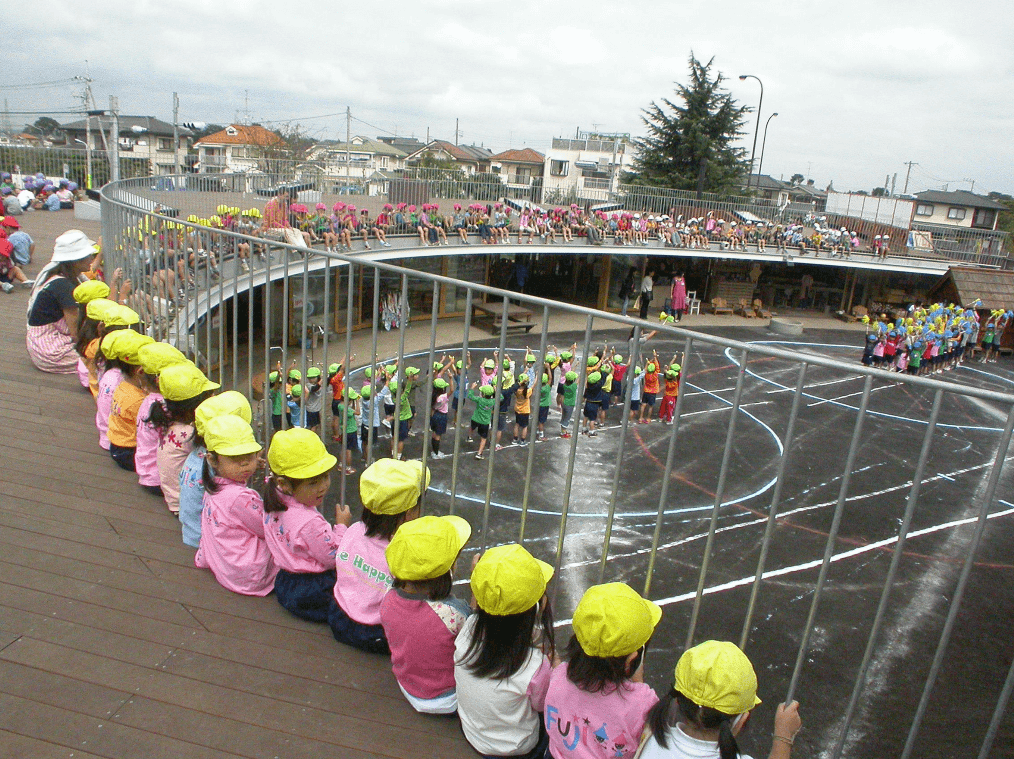 Fuji Kindergarten has around 640 children aged between four and six
Due to Fuji’s success, the government altered its approach to preschool regulation. For example, Fuji’s 2.1-metre ceiling height – which means anything happening on the roof can be seen from the ground floor – was actually in contravention of the Education Ministry’s three-metre standard. However, the ministry dropped the restriction in response, and invited Yui Tezuka to sit on its construction committee.
"Design is not just for artwork: it's a kind of service for people"
More recently, Fuji won the coveted Moriyama RAIC International Prize in Toronto in 2017, an architecture prize which awards a building that “transforms the society around it". A member of the jury said “it is one of those rare buildings —comprised of a geometric plan, a single section, a roof, and a tree—that in their utter simplicity and unfettered logic magically transcend the normal experience of learning.”
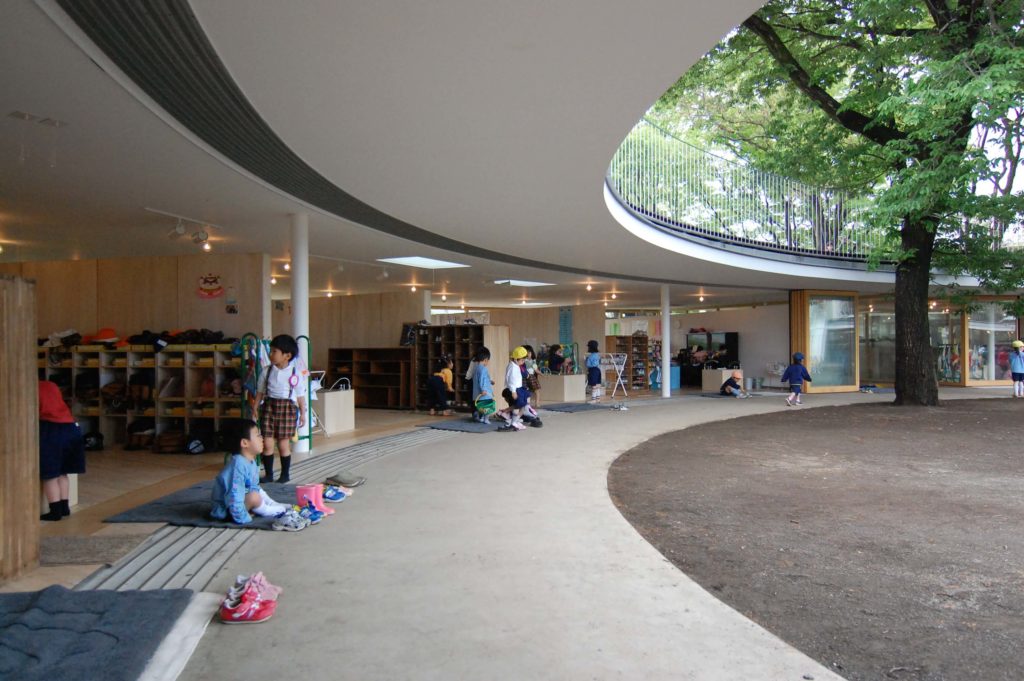 The 2.1-metre roof height means you can see everything from the ground floor
“Many people in the world understand what we’re doing,” said Tezuka. The kindergarten has received visits from various other countries from the US to the Middle East. They’ve even had requests from governments including Turkey, Russia and Kazakhstan.
“It doesn’t mean that other architects have to copy the design,” he pointed out. “For example, we are completing a few kindergartens in the next few months: these are also based on some kind of open space configuration, but are different from Fuji Kindergarten.”
Though a rigorous study is yet to be conducted on the kindergarten’s impact on kids, the evidence so far is promising. Fuji Kindergarten is demonstrating just how important architecture can be for child development, and how governments should think outside the box.
“Design is not just for artwork,” Tezuka said. “It’s a kind of service for people.”
(Picture credits: Tezuka Architects)
Jack Graham
jack.graham@apolitical.co
Make sure to share your own thoughts with the author by leaving a comment below

Log in or sign up to continue the conversation