
“If you take a white woman and a black woman with the same type of cancer, why is it that the black woman will die faster than the white woman?”
That’s the question Dominique Sighoko, alongside medical experts and public health workers throughout the city of Chicago, has been determinedly seeking an answer to since the early 2000s.
In 2003, black women in Chicago were 68% more likely to die from breast cancer than white women, and things were only getting worse.
“The growing disparity was all over the media - it forced a big meeting where people from different parts of the community and scientists all came together,” said Sighoko, an Assistant Professor at Rush University Medical Centre, who now also works at the Metropolitan Breast Cancer Task Force (MCBCTF), a body set up in the wake of that meeting in 2007 to find public policy solutions to the crisis.
Over the last decade, this task force has helped implement a complex array of city-wide public health initiatives aiming to improve the quality of care for black women.
In a recent report, Sighoko and her colleagues found that Chicago’s work has had remarkable success. From 1999 to 2013, the city saw a drop of 20% in racial disparity in breast cancer mortality. By contrast, in seven of the other 10 US cities with the largest African American populations, mortality disparity either grew or remained the same.
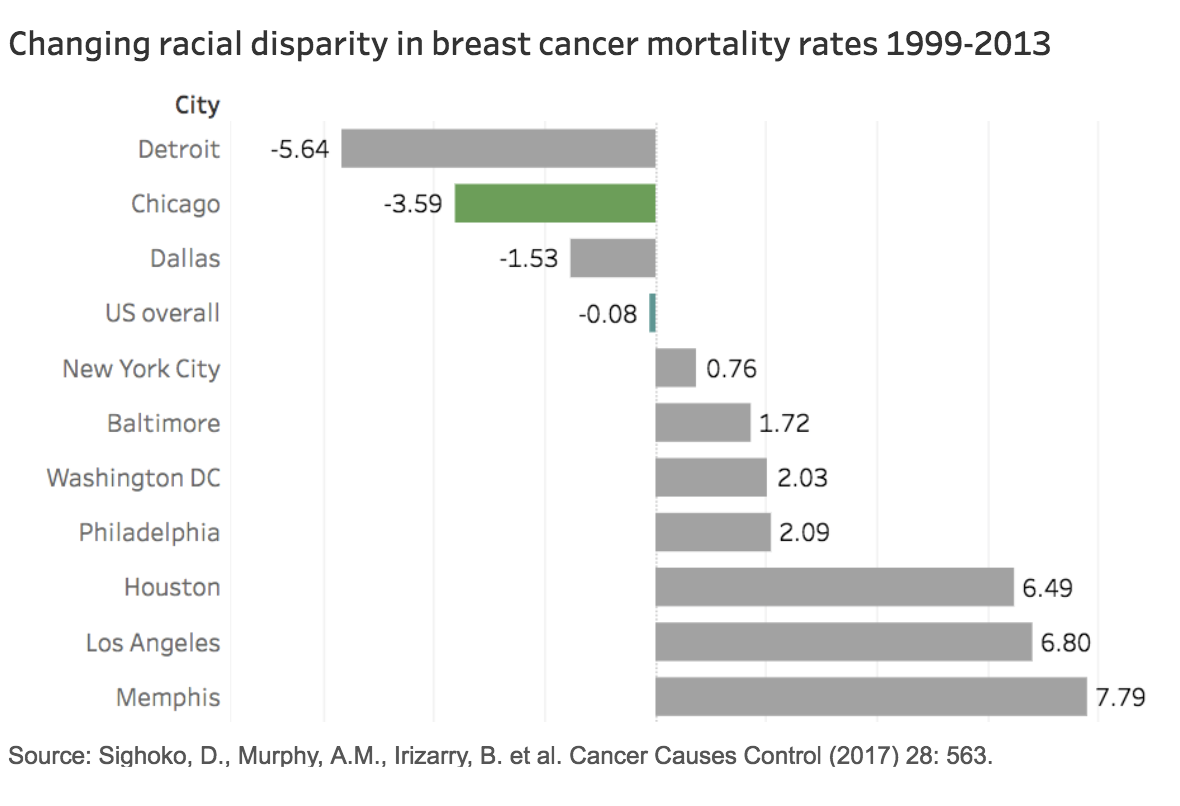
“People said that black women had higher mortality rates because they develop a more aggressive type of cancer. But, by analysing the geographical data, you can see, for example, that Los Angeles has a much higher disparity than New York City,” said Sighoko. Healthcare systems and access to care vary starkly from city to city across the US.
“It’s really about access to care and the continuum of care: how well does the system work to support a woman from screening to treatment,” said Ariel Thomas, the Health Policy Coordinator at the MCBCTF.
Improving that care has not been a matter of one simple fix. A whole host of initiatives focusing on saving black women’s lives have been tried by the MCBCTF and the city’s health institutions. And, the truth is, nobody really knows which ones have really made the difference.
“This is very complex, it’s not a straight line. Many things in tandem have contributed”
“This is very complex, it’s not a straight line. Many things in tandem have contributed,” said Thomas.
One of the initiatives run by the MCBCTF and now being copied in other cities across the US is the use of navigators – women who help those diagnosed with breast cancer to navigate the complexities of the health care system. They give emotional and practical help in a host of ways, booking appointments and screenings and attending them with the patients.
“The navigator is there to eliminate as many barriers as possible for the women trying to get connected to care. It’s a lay person, from the community, who helps the ladies make appointments, collect prior films, and identify if they have insurance or not,” said Thomas.
Hospitals in Chicago donate mammograms and diagnostic services to the MCBCTF for women without insurance, and the navigator will contact the facilities near where that woman lives and help get them access a free mammogram if they need it.
Those navigators directly help 1,500 women a year and reach 12,000 through outreach and educational programming. The city has recently made a further $700,000 available to the MCBCTF to expand this work.
In another initiative, the task force visits clinics and hospitals to collect and analyse data and find the gaps in care, such as it taking too long between screening and diagnosis.
"The threat of repealing all the work that’s been done to insure folks is very scary"
There is also ongoing advocacy work to ensure that the state safety net, which allows un- or under-insured women to get screening and treatment if they’re diagnosed, remains in place.
And health insurance is another key piece of the puzzle. “Illinois now also has the extension of Medicaid, which helps women access insurance. Other places didn’t do that,” said Sighoko.
Strikingly, women in their 40s have the highest racial disparities in survival rates, while women who are 65 and above have very low or no disparities. “That’s because it’s at that age they get access to Medicare, so everything is covered,” said Sighoko.
Recent extensions of coverage through the Affordable Care Act have allowed many more women to get insured, but that change may not last. “We’re all worried about changes to health insurance. We’ve already seen in the last two years folks who have signed up not being able to afford the higher premiums,” said Thomas. “The threat of repealing all the work that’s been done to insure folks is very scary.”
"In Europe, it’s almost impossible to do this type of work because they don’t collect ethnicity status"
From insurance to facility upgrades, mammogram awareness outreach, and the work of the navigators, it's not easy to point to one single initiative that has made the difference. But there are still lessons to be learnt from Chicago's work.
One is the importance of data in driving change. “For European countries, it’s almost impossible to do this type of work because they don’t collect ethnicity status,” said Sighoko.
“In France, it’s forbidden: there is a universal healthcare system, so everybody is supposed to have access to care. There’s a debate around what time a woman should start screening for breast cancer. In the US it’s 40, in France it’s 50, but black women's highest incidences of breast cancer are in their 40s - so those women don’t have appropriate guidelines,” she said.
Chicago’s data driven work has in no way solved what is a deep and pervasive inequality in access to health care. Black women there still face much higher chances of dying from the same type of cancers that white women survive. Across the US, black women are, according the most recent figures, 40% more likely to die from breast cancer. But, what Chicago has done is show the world that racial inequalities in heath outcomes are neither inevitable nor intractable.
(Picture credit: Rawpixell)
Odette Chalaby
odette.chalaby@apolitical.co
Make sure to share your own thoughts with the author by leaving a comment below

Log in or sign up to continue the conversation