
This article is written by Lisa Witter, co-founder and executive chairman of Apolitical
As a parent, these days it feels like I am quite literally juggling work and children.
I, like many others, am working from home where I’m also at the same time taking care of and managing the schooling of my 11 year-old and 12 year-old children. All in all, I am loving the extra time with my growing boys but it doesn’t come without challenges. And yes, I admit it, I have raised my voice more than once during lockdown.
According to UNESCO a staggering 87% of children are out of school today because of coronavirus related shutdowns. And while the majority of these children and parents are making it work in loving, creative ways, we also know that this sudden change has made some children more vulnerable.
We know that for children who are exposed to violence in the home, that violence often increases during disease outbreaks and in situations where large populations are confined. Factors that contribute to this are high levels of stress and anxiety, consumption of alcohol and overcrowding.
In many countries affected by COVID-19, there has been a massive increase in the number of victims who seek help for family violence. Reports from affected regions in China have shown a threefold increase in reports of intimate partner violence, while other countries report that calls to their helplines had risen by 10% to 50% in the first few days of the confinement period.
Evidence-based solutions
Parenting for Lifelong Health, a collaboration between UNICEF and WHO, has developed a range of evidence-based programmes to overall support a nurturing environment for children and to help prevent and reduce abuse in the home.
These 12 tips sheets, provide parents/caregivers with effective skills to:
- reduce conflict in the home, through increasing warmth (i.e. through praise):
- improve child/adolescent behaviour (see below);
- use non-violent discipline options;
- reduce caregiver stress and alcohol use:
- reduce family economic stress; and
- and provide skills to manage anger and frustration.
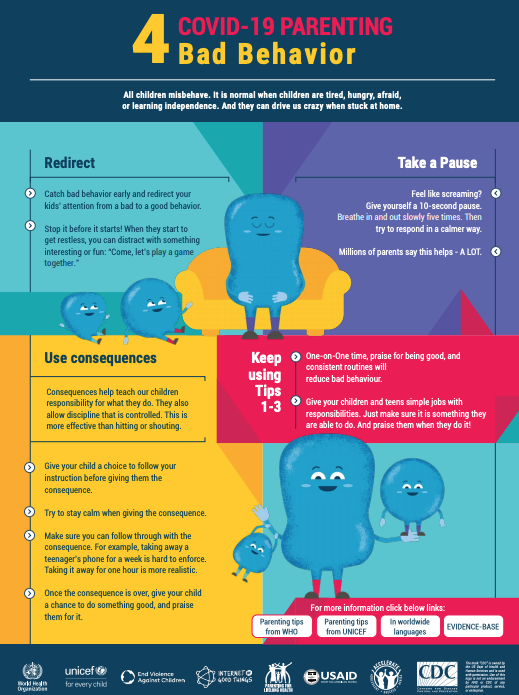
One of 12 graphical tip sheets developed by Unicef and WHO to help parents resolve conflicts with their children in lockdown without resorting to violence: Source
The goal is to give all parents and caregivers around the world concrete, evidence-based tips to help them cope with lockdown. This is a sensitive topic, as there is and continues to be a lot of stigma around violence and conflict in the family, but it's important to say that these tips are not just for parents in violent households.
So even if you are part of the vast majority of people who never resort to violence, I think we can all be honest and say that there are times where we need a friendly reminder to be the best parents we can be. I know I have found these tips helpful (while still enjoying my occasional glass of wine).
Get the word out
Governments are and can use social media channels and influencers to get the word out in creative ways.
Finland has made use of social media influencers, overall, in the work to communicate with the public on COVID-19. They have done outreach to bloggers, rappers and writers to get to those not reached by traditional media. Bangladesh has turned to Instagram to connect with citizens. The UK government is working with YouTubers.
The pandemic makes it more challenging for governments to address and identify the violence that takes place behind closed doors. While some sceptics might argue that a communications campaign won’t make a difference, I would argue that it is a lot better than nothing. And the tips are overall good for parent and children dynamics.
Based on popular demand, the tip sheets are being translated into 100 local languages. The resources have already been adapted for use in the Philippines, Honduras, Jamaica and many other countries.
Take a minute to not only tweet out one of the social media messages but also forward this piece to a colleague working in education, violence prevention and family support. It can’t hurt but it can stop hurting and shows solidarity for all those juggling parents. Here's mine:
 View on Twitter here.
👋 You can create a post like this one! Share your thoughts with a community of public servants. Learn more.
(Picture credit: Death to the stock photo)
Make sure to share your own thoughts with the author by leaving a comment below

Log in or sign up to continue the conversation