
This opinion piece was written by: Peter Bragge, Fraser Tull, Kim Borg, and Liam Smith (BehaviourWorks Australia); Jessica Kaufman (LaTrobe University); Justin Halliday and Cameron Knott (Victorian Department of Premier and Cabinet); and Stephen Pellissier, Kim Sutton and Megan Beasley (Victorian Department of Health and Human Services).
A key public health principle is to reach "herd immunity" — where vaccination rates are high enough to protect a whole population, including those not vaccinated. For human papillomavirus (HPV), that requires [80% vaccination coverage.](https://www.thelancet.com/journals/lanpub/article/PIIS2468-2667(16%2930001-9/fulltext)
Victoria is Australia’s second largest state by population, with 6.3 million residents. Federally funded HPV vaccinations are delivered to Victorian children aged 11–13 through a school program, coordinated by local councils. The HPV vaccination rate across Victoria is approximately 70–80%.
BehaviourWorks Australia (BWA), an applied behaviour change research unit based at Monash University, was funded by the state's department of premier and cabinet to test if behavioural science could improve HPV vaccination rates to reach that critical immunity level.
• For more like this, see our public health newsfeed.
A rapid literature review was conducted to understand the challenge and identify some potential solutions. The literature found that reminder or recall strategies harnessing new media - for example, an SMS message to parents of adolescents - positively impact vaccination rates.
Research has also established that vaccine refusal rates due to personal, philosophical or religious beliefs are low in Australia (1–3%). This means that the herd immunity threshold of 80% for HPV can be exceeded without needing to tackle these complex issues.
A picture of HPV vaccination practice in Victoria was then built through collaboration with the state’s health department. This involved examination of historical HPV vaccine data and visits to local councils and school vaccination sessions.
Numerous behaviour change opportunities in various actors and settings were identified in the chain between the distribution of consent forms and vaccination. These became the focus of three randomised controlled trials.
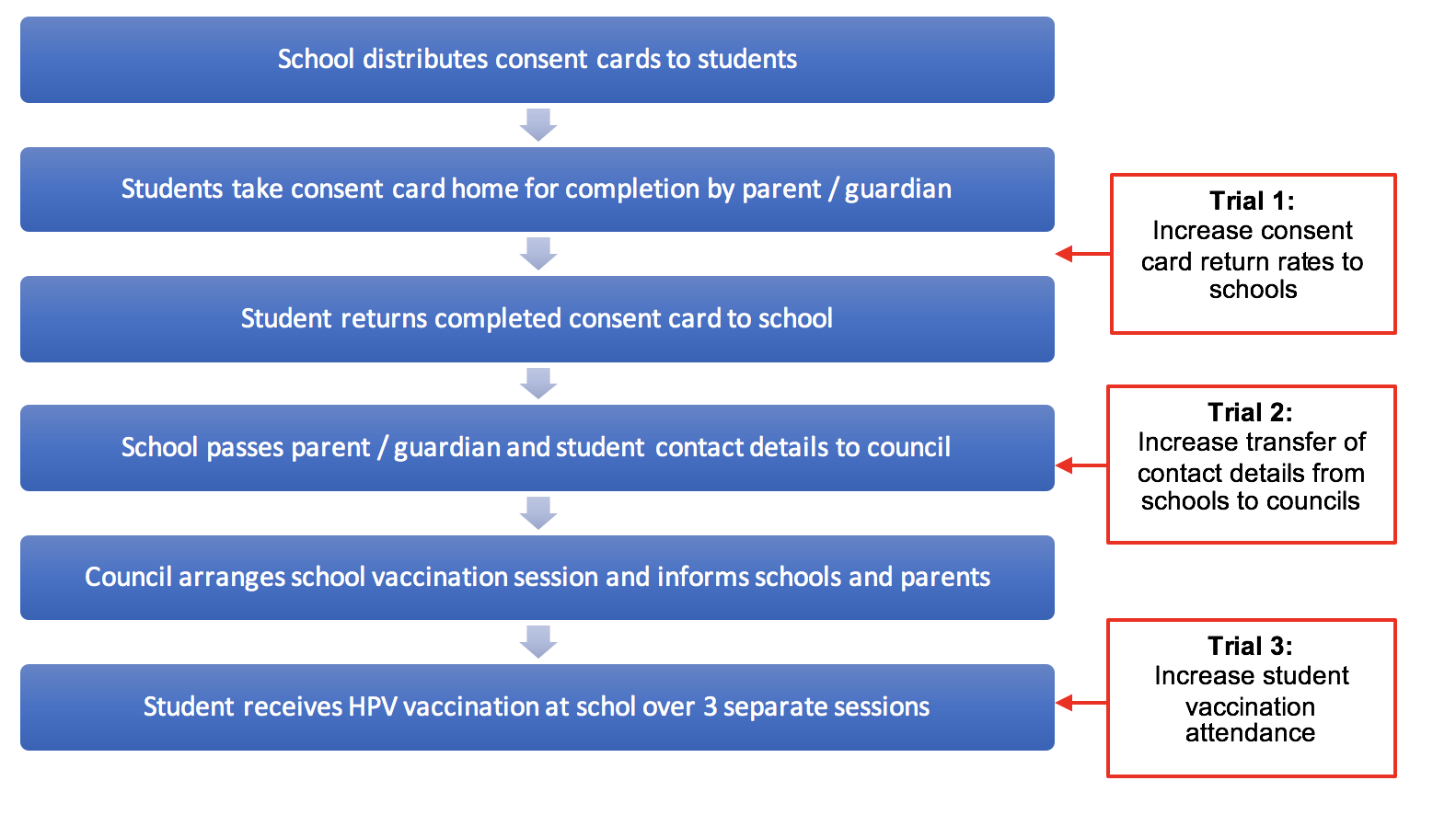 HPV vaccination behaviours and opportunities to intervene
Trial 1: Increased student vaccination attendance with text messages
In this trial, an SMS reminder message (making a simple request to plan for the vaccination) was sent to 1,418 parents and guardians who had consented to their child receiving the HPV vaccination. A motivation message (reinforcing that disease susceptibility increases if not vaccinated) was sent to 1,442 parents and guardians. Both types of SMS messaging were effective, and each resulted in a 2-3% boost in immunisation rates compared with control groups.
Trial 2: Increased consent card return rates to schools
A letter sent by the health department to schools covering 8,171 students nudged schools into action by outlining their consent card return rate compared to other schools. This draws on social norming principles used in behavioural science. Consent cards were also sent directly to schools, rather than via councils as in the past, to encourage schools to take greater ownership of the program. The trial was a success: there were increases in consent card return rates (92.1% vs. 89.1% in the control group), and, critically, HPV herd immunity was achieved in the intervention group (80.6% vs. 78.9% in the control group).
Trial 3: Increased transfer of contact details from schools to councils
Councils need a way of contacting parents and guardians to enable follow up of non-returned consent cards or missed HPV vaccinations, and to improve the accuracy of vaccination databases. A letter and action planning sheet to encourage schools to provide those contact details to councils was tested in 307 schools. The action planning sheet harnessed research that shows compliance with written requests can be enhanced when individuals are given an opportunity to formulate their own action plan. The letter also drew upon the behavioural principles of [using plain language](https://books.google.com.au/books?id=HxEUdrXx6CIC&pg=PA6&lpg=PA6&dq=Kools,+M.+2011.+%27Making+written+materials+easy+to+understand%27,+in+C.+Abraham+%26+M.+Kools+(eds.%29.+Writing+health+communication:+An+evidence-based+guide.+London:+Sage&source=bl) and procedural fairness theory. Of the schools that received the letter and planning sheet, 54% provided parent/guardian contact details to councils, compared with 41% of schools in the control group.
When government collaborates with academics
Much was learned from these three research trials. All results were statistically significant – meaning that there is high confidence that the differences between the groups were not due to chance. All three trials demonstrated the value of ‘nudging’ across three separate links in the behavioural chain for HPV vaccination — consent card return, data transfer and vaccination attendance. Crucially, in this setting, nudging was shown to boost immunisation rates beyond the herd immunity threshold for HPV. However, this was only possible because there was already a relatively high base level of immunisation coverage of 70-80%.
The trials also underpin the value of collaboration between academics and government. Many solutions to the world’s toughest problems rest in marrying research knowledge to the lived experience of people on the ground. The research program incorporated a day-long, Chatham House Rules forum bringing researchers and policymakers together. As a result of the insights gained from these (and other) collaborative activities, two of the three trials did not focus on public health messaging - the most obvious, first line target of ‘nudge’ strategies - but on strategies to optimise the data that can facilitate such messaging.
"In the era of fast data transfer, social media and instant answers, the simple act of investing considerable time in collectively understanding wicked public policy challenges may be the most salient lesson of all"
And the value of prolonged and meaningful academic-government collaboration extends beyond these trials. Although Victoria has a highly successful childhood vaccination program (nearly 95% of children fully vaccinated by age five), rates vary in other age and disease groups. For influenza for example, traditional government communication and program activities have not yielded desired results. Trialling behavioural science approaches through research, although uncomfortable for those tied to old practices, encouraged renewed questioning of individual parts of programs rather than the whole. The health department now intends to integrate this approach to new vaccination programs as well as to the ongoing education and communication of immunisation providers.
All of these outcomes underline that in the internet era of fast data transfer, social media and instant answers, the simple act of investing considerable time in collectively understanding wicked public policy challenges may be the most salient lesson of all.
(Picture credit: Flickr/PAHO)
Peter Bragge_
Fraser Tull
Kim Borg
Liam Smith
Jessica Kaufman
Justin Halliday
Cameron Knott
Stephen Pellissier
Kim Sutton
Megan Beasley_
Make sure to share your own thoughts with the author by leaving a comment below

Log in or sign up to continue the conversation