
America’s opioid crisis is claiming the lives of more than 115 people every day, with a total economic burden on the nation of around $78.5bn per year.
Some of the lesser-known victims of this epidemic are new-born children. Thousands of infants are experiencing opioid withdrawal – neonatal abstinence syndrome (NAS) – which may lead to premature birth, seizures and even birth defects.
One of the doctors on the frontline is Dr Stephen Patrick, a neonatologist at Vanderbilt University Medical Center, which treats infants with various complications, conducts research on new treatments and works to shape local and national policy.
Patrick — who recently gave evidence at the Senate Committee on Health, Education, Labor & Pensions — spoke to Apolitical about how the crisis should be tackled, and what government can do to help.
What symptoms do infants with opioid withdrawal display?
I most commonly describe infants having drug withdrawal as a colicky baby times five. They’re fussy, they have difficulty feeding, weight loss, tremors, increased muscle tone and sometimes seizures.
"Mums are often going through massive feelings of guilt"
Some literature suggests there may be some long term negative impacts, things like issues with attention, visual issues, speech problems and maybe even a few points of IQ. But that literature’s pretty hard to interpret: a lot of it’s old, it’s confounded by other exposures like alcohol in many cases. One thing that we need now are large robust studies to understand what’s going on.
How many babies are affected and why has there been a surge?
The path has gone exponentially since the late 2000s in terms of rates of NAS. In 2014, about one infant was born every 15 minutes on average having drug withdrawal in the United States. This has been occurring more in Caucasians, but we see pockets, particularly among native Americans, of higher rates of NAS. We’re just beginning to talk about what’s happening in several reservations around the US, where there’s limited access to treatment. In small communities, often stigma really becomes a barrier.
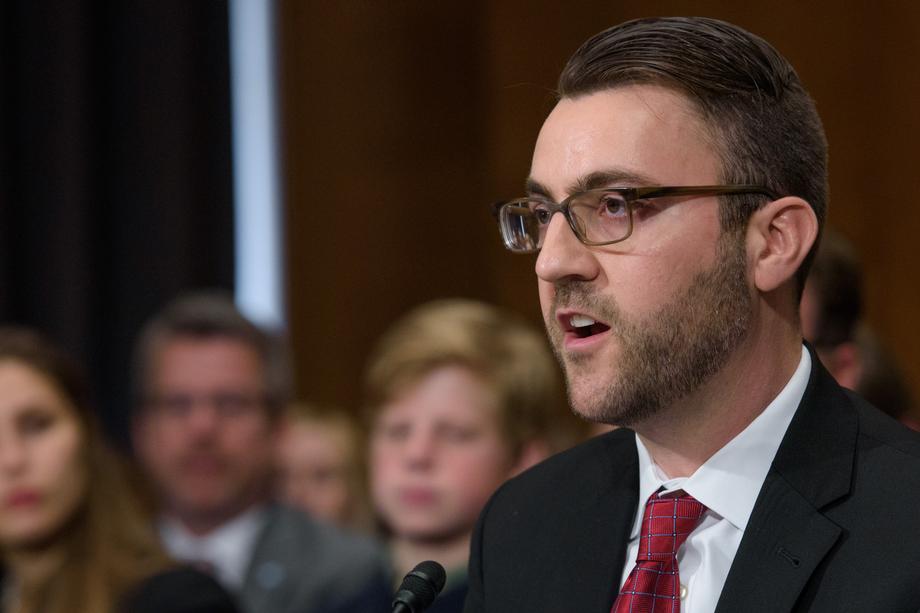 Dr Patrick testifying before the Senate Health, Education, Labor and Pensions Committee
The reasons are probably two-fold. One is the availability of drugs and opioid-prescribing patterns, but the other is the environment: what’s happening to communities around employment. I was born in West Virginia, and in my hometown and other parts of that state the enduring effect of the great recession we had in 2008 to 2010 is real. A lack of opportunity, lack of jobs – that’s still an enduring impact.
How can hospitals like Vanderbilt help families most effectively?
A supportive structure is so important. Traditionally, a family would’ve been put in two separate parts of the hospital, separating mum from baby. In our program we keep them together. Too often our system puts extra barriers in front of people that are really trying to do the right thing.
Mums are often going through massive feelings of guilt. I’m thinking about a mum I met on call a couple of months ago, just bawling as her infant was starting to develop signs of drug withdrawal. She feels this inner angst about what’s going on with her infant and how to change things.
Really holistic coordinated care I think will begin to improve outcomes. A broad context of things are happening around that baby, mum and family that you have to understand. Many of the mothers come from trauma-filled childhoods, so for us as providers it’s important to know that. I think oftentimes our solutions are too focused either just on the baby or just on the mum.
Which government policies in the US have been successful?
The state of Massachusetts is doing some pretty innovative things to combine different sources of data, such as Chapter 55. They have a ton of data about outcomes as well as needs, and they’re beginning to apply that to public health infrastructure.
In Ohio, Governor Kasich has put significant investment into this issue, mostly through the Medicaid program funding the state perinatal collaborative, and that’s beginning to show dividends. Our state too: Tennessee has done a lot in terms of decreasing both opioid prescribing where it’s unnecessary and controlling pill mills.
"Rapidly decreasing supply of opioids without increasing treatment capacity may lead to an increase in heroin use"
Reducing supply has a lot more to do with creating the environment for alternatives – that’s important. Increasingly, primary care visits in the US are pretty short, and funding things like physical therapy and occupational therapy have been difficult in the past.
There’s also the worry that rapidly decreasing supply of opioids without increasing treatment capacity may lead to an increase in heroin use. We’ve certainly seen a rapid spike in heroin, which increases the risk of low-birth weight and pre-term birth for the infant, and increases the risk of overdose for the pregnant woman.
How can you scale things that are working, and affordably?
In the US, Medicaid is financially responsible for more than 80% of infants with NAS. I think Medicaid could play a role in beginning to scale best practices but also measure best practices.
There are probably short-term results that would be cost-saving and better for families. If we just, for example, reduce length of hospital stay by a couple of days, the cost savings nationally would be extraordinary. Imagine those savings being invested further upstream in access to treatment for pregnant women, or downstream in care coordination, home-nurse visitation or earlier intervention services.
"There are many things that are divisive right now about our politics, but this isn’t one of them"
Being in the neonatal intensive care unit is expensive, particularly in the US. If you just begin to standardise what you do, you decrease length of stay, sometimes by a lot. There’s one study from Ohio comparing hospitals with strict protocols versus without. The difference in length of hospital stay was 30 days vs 17 days – a huge difference.
And, if we just keep mum and baby together, there’s good evidence now showing decreased length of stay and treatment. That’s a common model in many parts of the world, just not parts of the US.
What role can political leaders in Washington play?
There are many things that are divisive right now about our politics, but this isn’t one of them; there’s a lot of agreement from people from all walks of life and both parties. This is an apolitical issue, and I hope that helps provide additional resources and focus.
The Senate has a lot of focus on pregnant women and infants. I’m hopeful that the legislation that they put out – it will grow and modify over time, but something similar to that – will be passed and signed by the President. I do think it’s a substantial step forward.
(Picture credit: Pexels, Senate Photography Studio)
Jack Graham
jack.graham@apolitical.co
Make sure to share your own thoughts with the author by leaving a comment below

Log in or sign up to continue the conversation