
This article is written by Ksenia Cheinman, l****ead content strategist at the Canada Revenue Agency.
If you’re reading this, chances are you think the services governments offer are important, especially government digital services. But when is the last time you considered how these services are communicated?
Content professionals are some of the unsung heroes of the public sector.
In January 2020, I set out to understand what skills are being used and are considered important among content professionals across the Canadian public service, as well as what skills are needed. I wanted to find out what are the content professionals’ skill gaps in the public service to then determine how to best train and develop them. Given that many government organizations do not have specific content roles on their teams, the skills gap analysis could be valuable to any digital transformation or user experience design team wanting to ensure that their services are effectively communicated and understood. I collected data through the bilingual Content design in the Canadian public service survey and started documenting the findings in an open graph.
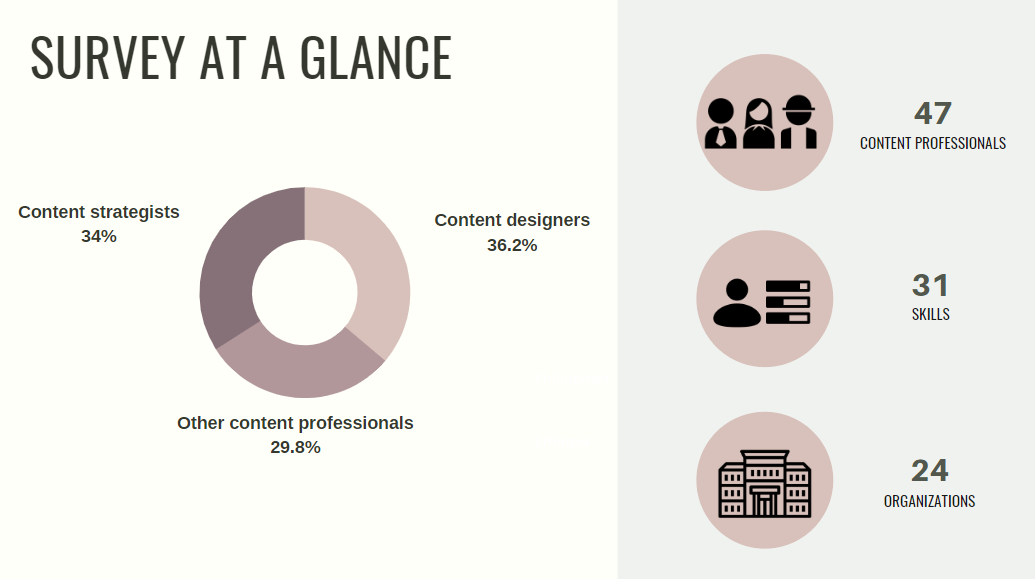 The survey at a glance: 47 Content professionals from 24 organisations took part in the survey, which covered 31 different skills
The survey included a mix of open and close-ended questions as well as a matrix of 31 skills where participants were asked to identify whether they know these skills, do them in their current job, need them, think they are important for content professionals, or if they do not apply to them. They could include multiple answers for each skill.
Since content-specific roles related to digital communication are still not very common or well-defined in the public sector, even though the population size of this group must be quite large across Canada, 47 respondents who self-identify as content professionals might be a relatively small but informative sample size for a study that aims to learn more about the current state and make incremental improvements. While the richness of qualitative data and my experience as a researcher and practitioner in the field give credibility to the findings, to generalize broadly from these insights would require further research.
This research builds on my earlier research into design competencies and my experience developing and delivering design training for the Canada School of Public Service Digital Academy.
In the context of this research, content is what we communicate through design. A content professional is anyone who contributes to how the government's digital information is delivered to people. And “content design” encompasses the various skills that are important to content professionals.
Strengths and opportunities in the public sector’s content design
Analysis of responses from 47 professionals across 24 different organizations reveals a few important insights.
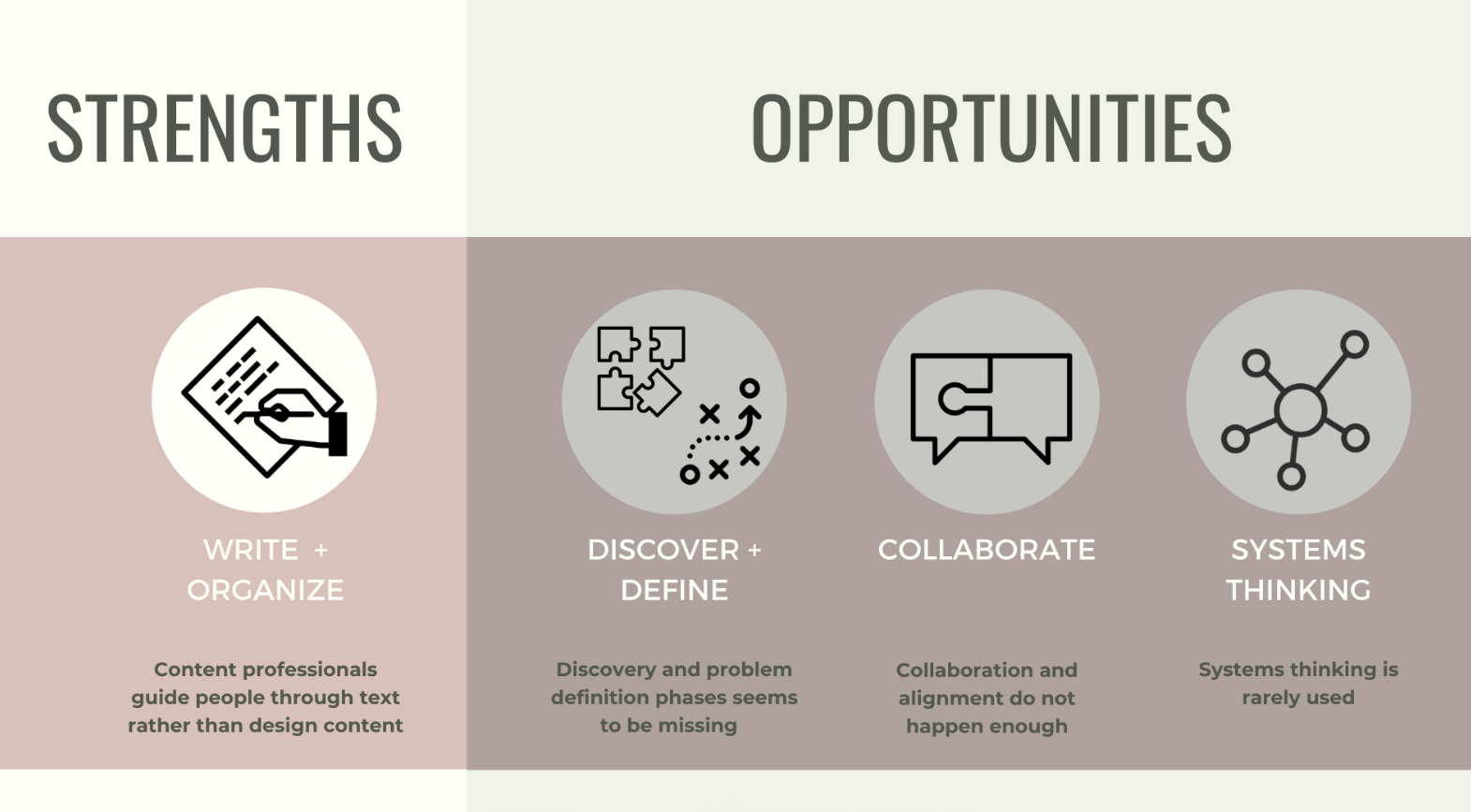
The strengths and opportunities identified in the survey:
- Based on the most commonly used skills, content professionals excel at guiding people through text, rather than designing content, which they feel they lack support to do effectively
- Content professionals say they routinely come in too late in the design process where everything is rushed, so there is no time to think through the problem, analyze and use data, and properly define success metrics
- Specialists feel they cannot exercise their full range of skills due to limited collaboration with partners who do not see the value of content design
- Systems thinking is rarely used, evidenced by large gaps in information and knowledge management, lack of communication channel definition strategy, as well as limited use of content modelling and designs that consider experiences beyond webpages
While content professionals in the government excel at writing and organizing information, systems thinking is not part of their system. It appears that content design in public service is suffering from institutionalized myopia. The result is a content landscape that many professionals describe as dense, unapproachable, complex, and disaggregated.
While this research focused on the Canadian public sector, based on conversations with colleagues from the UK and other countries, similar patterns seem to emerge in many other countries
Writing and guiding people through information is where content professionals shine
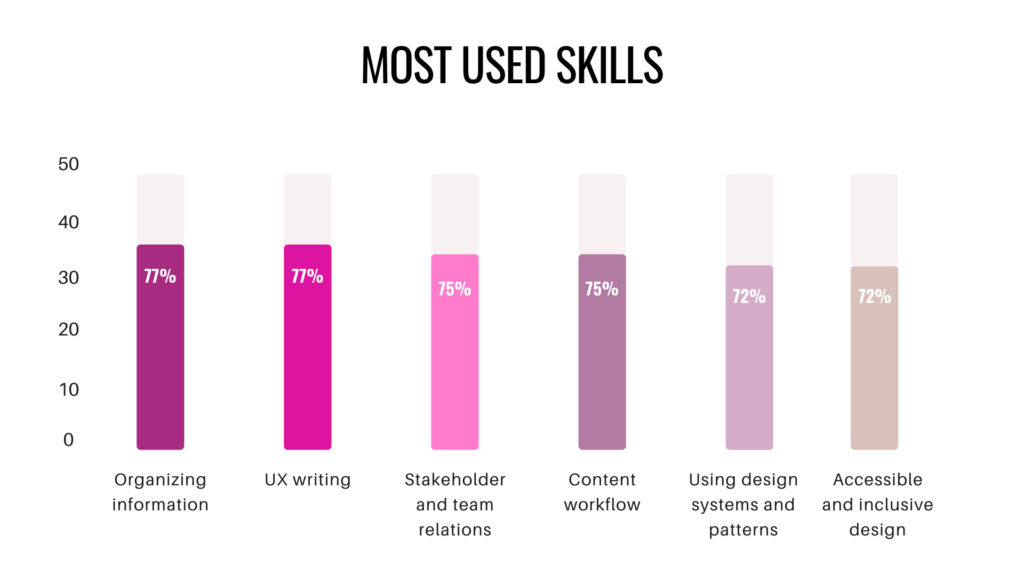
_The top 6 skills that are used most frequently on the job, from highest to lowest, are: Organizing information (77%), UX writing (77%), Stakeholder and team relations (75%), Content workflow (75%), Using design systems and patterns (72%), Accessible and inclusive design (72%)_The survey data about the skills content professionals in the public sector use most tells us that they are good at and focus primarily on writing and organizing information. They follow rules of accessibility and design systems frequently, understanding their importance. Working with others is an important part of their job, yet it can be a bit of a challenge because, as some professionals point out, among partners “content is considered publishing and just requires a button to be pushed [and] content design [is] considered a barrier to publishing content.”
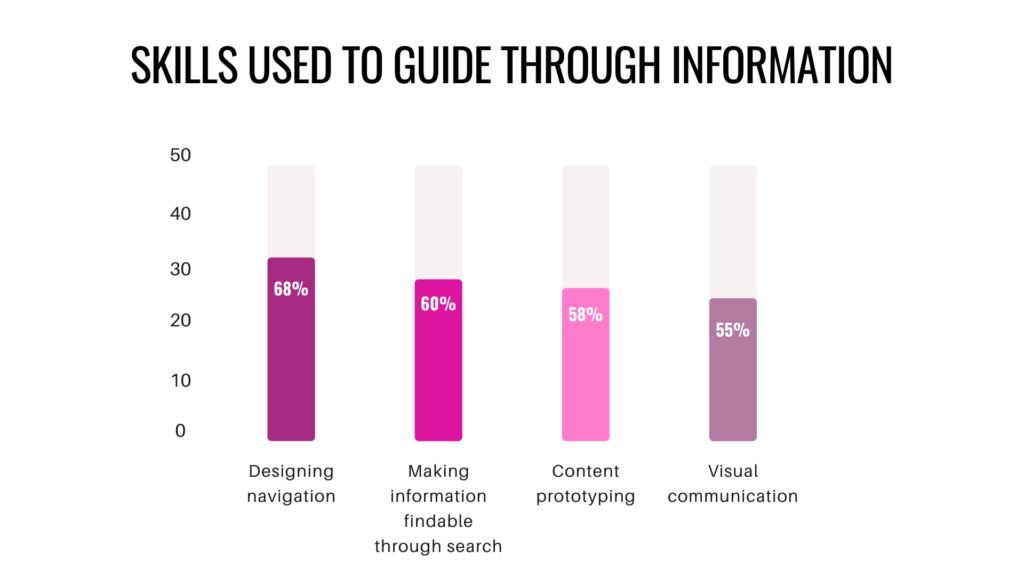
_The skills content professionals use to guide others through information_They also help people navigate through layers of content and find information through search — if it is in their control. On occasion, they get to prototype what an experience would look like with real content and help shape the final outcome, but they do not often get to influence the visual communication of products.
Content practitioners' roles seem to be rather narrow in scope focusing mostly on writing, arranging, and guiding people through textual content that is often already determined by others, rather than designing and shaping the content’s medium and delivery. As one practitioner notes, “the writing part is too often separated from the design process”.
Content professionals come in too late in the process which then is rushed
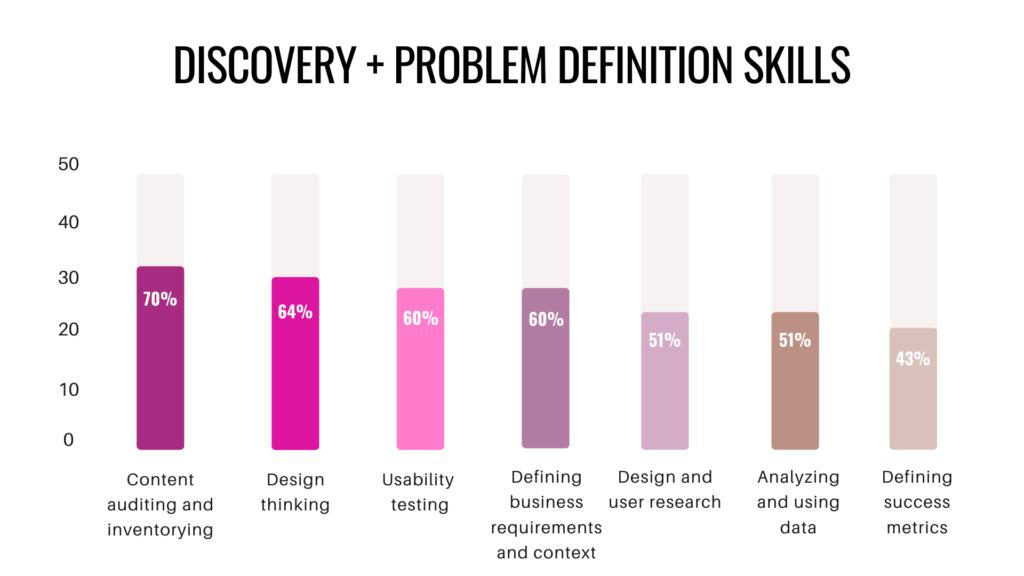
_The skills content professionals use for discovery and problem definition_Content professionals should do a lot more than writing or editing new content, but that is not their current reality.
Depending on a project, they might assess existing content. Sometimes problems come up, so they use design thinking. If opportunities arise, they advise on getting to the root of business needs, understanding the context and users’ needs, and testing content with users, but do not lead this work directly. Content professionals rarely get to interpret and use data in their work. They have ideas about what success metrics should be, but don’t often get to provide input on these.
Content professionals are rarely involved in user research, usability testing, data analysis or problem framing. This means that somebody else (or nobody) may be doing this work. While this might seem like a logical distribution of labour, this prevents content professionals from identifying the most effective content solutions. David Travis, a UX strategist, has highlighted this pervasive neglect of the ‘discovery phase’:
“… there is this important phase in discovery where you are trying to understand the needs of users before you come up with any prototypes or any ideas about the way that thing could look. But most people forget that first part of the design process, or gloss over it.”
A few content professionals echo the importance of investing in time and space for reflection and critical sensemaking: “good content takes time and research”, yet “everything is rushed”.
Specialists don’t get to exercise their full range of skills
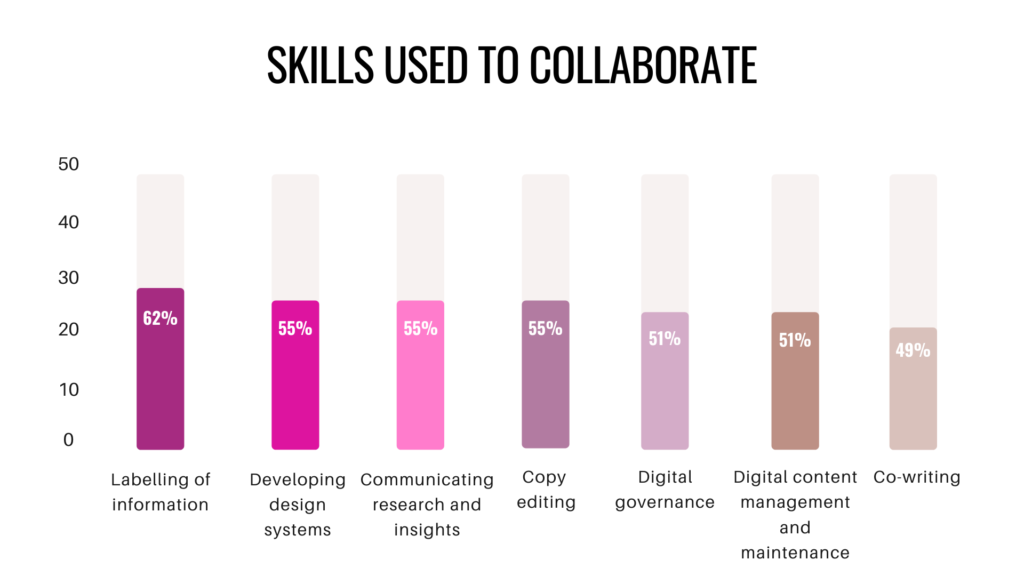
_The skills content professionals use to collaborate and align_If they are lucky, content professionals get to name a few things in ways that make sense to the people who use this information.
Certain activities are seen as outside the scope of their work and only if they are particularly proactive do they get to develop design systems supported by research and insights and edit partners’ content. Advocating for broader governance and the importance of managing the entire content lifecycle is often as close as they get to practising this. Content professionals are happy to co-write content with partners when they are willing, but currently, this is not a common part of their practice.
"Government or non-profit sectors seem to focus on the immediacy of the solution and prioritizing skills that put long-term sustainability and coherence on the back burner”
Based on data, it appears that collaboration, aligning with partners on priorities, and working towards a common goal is not happening frequently. So despite “Stakeholder and team relations” skill ranking high (75% do it), these relationships might not be as positive or strong. Some practitioners note that there is a “lack of engagement (everything has been approved on this content that has taken 6 months to develop and needs to be online tomorrow, and that we're just giving to you now), content design [is] seen as [adding] no value”.
There is also a common sentiment of having little power to make content changes due to the persisting culture where the “client owns the content”. It is no surprise then that compared to “Organizing information” (77% do it), ‘Labeling of information’ (62% do it) and “Copy editing” (55% do it) are not used as much.
Aside from the challenges in collaborating on content creation, working together on managing content is an even bigger struggle, as professionals feel they can’t “change structures in how content is created and managed”. The place of ‘Information management (30% do it) and “Digital content management, governance, and maintenance” (51% do it) reflects the growing concern about lack of content stewardship: “government or non-profit sectors seem to focus on the immediacy of the solution and prioritizing skills that put long-term sustainability and coherence on the back burner.”
While most survey participants have indicated that they are part of a community and connect with others to get advice or share best practices, 34% are not networking with their peers.
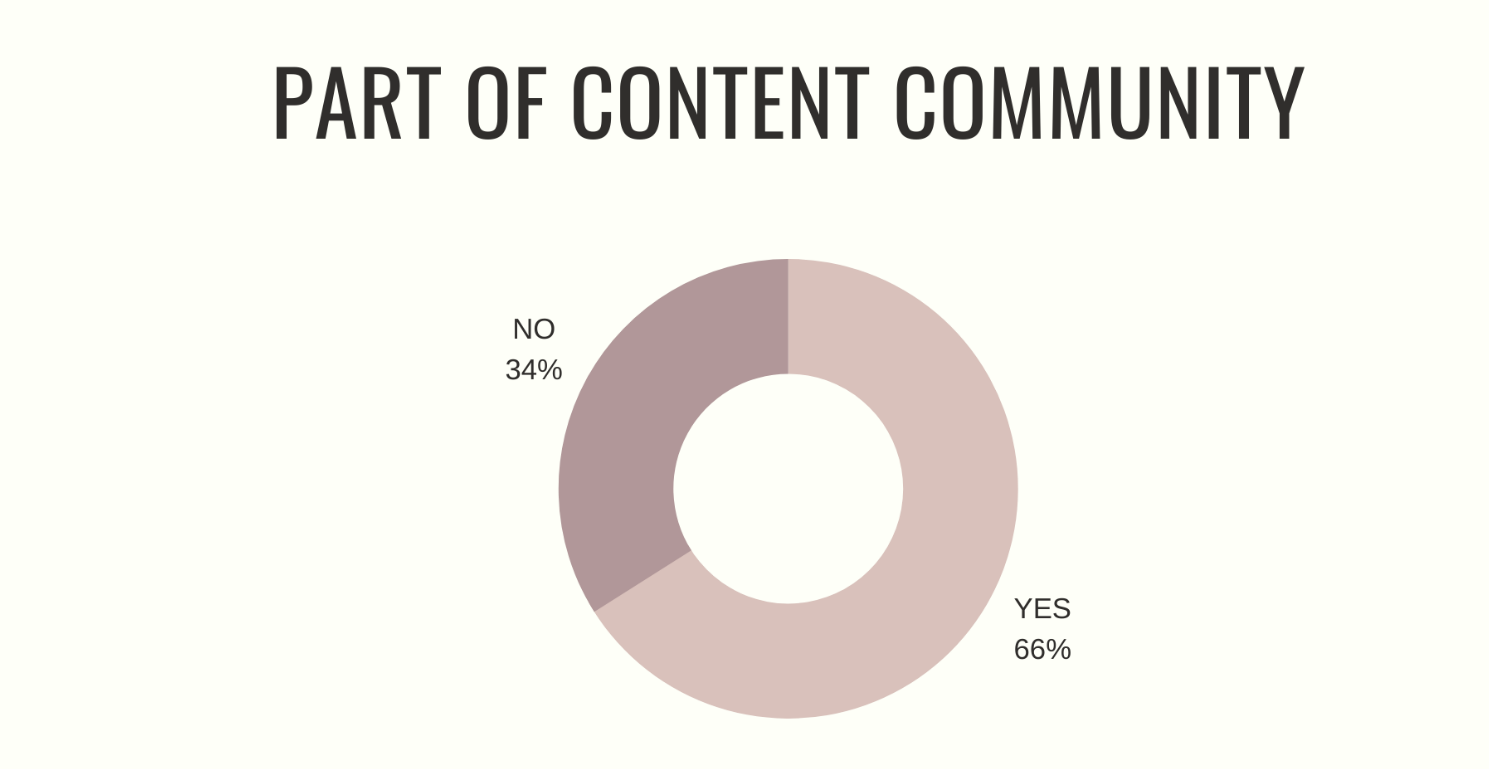 Two-thirds of respondents felt they were part of the content community
Networking with other practitioners and participating in communities are not just tasks, these are the skills of the future. According to a 2017 design industry roundtable, “drawing on the power of networks to realise new design outcomes through new practices”, participating in communities of practice, and network agility is essential for design practitioners.
If content professionals cannot shape the language of government services while making meaningful connections with partners who will willingly take care and continuously improve this content, then the public sector is creating a number of disconnected, short-lived outputs that are neither successful nor sustainable in the broader context.
Systems thinking is not part of the system
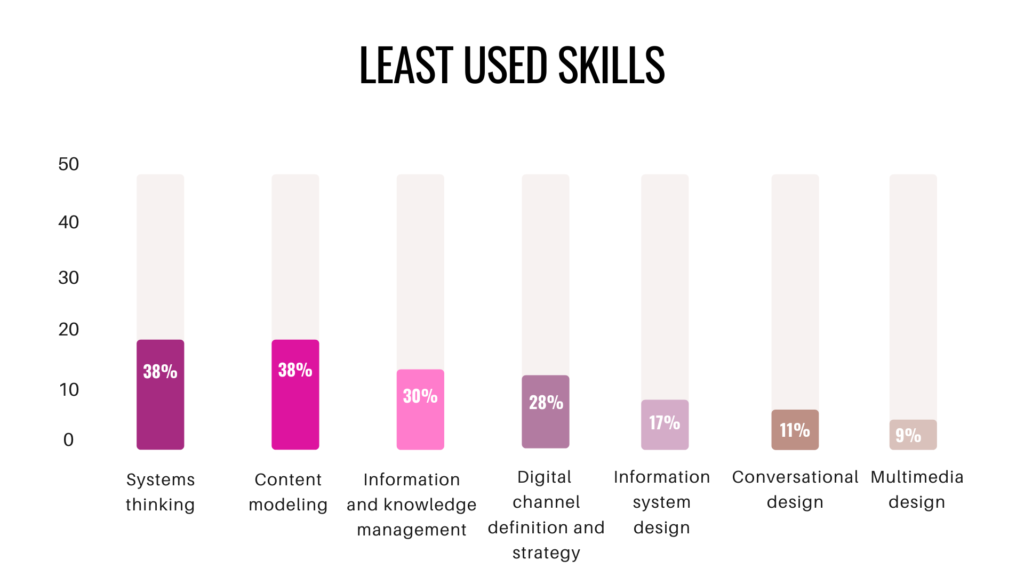
_The skills that are the least used on the job, from highest to lowest, are: Systems thinking (38%) Content modelling (38%), Information and knowledge management (30%), Digital communication channel definition and strategy (28%), Information system design (17%), Conversational design (11%), Multimedia design (9%)_Systems thinking, which is a way of making sense of complexity, and content modelling are not well supported or encouraged in content professionals’ work. They don’t see information management (done by information managers), channel definition (done by marketing) and system design (done by IT) as their areas of expertise, while conversational design is too new and they have not had the opportunity to support it. Content professionals are rarely asked to provide input into anything other than text; multimedia design is not part of their portfolio.
Survey respondents identified that the main challenges in content work are that government organizations “over-prioritise internal needs and language” and “put EVERYTHING online without thinking critically about its usefulness and purpose for users”, “focus[ing] on quantity not quality [resulting in] overlap between departments”. One professional shared that “projects start with creation of new content rather than review and assessments of what is there to help inform the best strategy; there is no systems thinking or ecosystems mapping, no comprehensive content inventories or audits, resulting in disconnected service offerings”. In other words, our budgets, departmental priorities, and outdated view of effective communications make us blind to the broader ecosystem.
In his book Intertwingled, Peter Morville, the co-author of the seminal book on information architecture, talks about the importance of recognizing that each organization is part of a bigger system: “We think we’re making software, websites, and experiences, but we’re not. We are agents of change within complex adaptive systems … In the era of ecosystems, seeing the big picture is more important than ever, and less likely. … Tomorrow belongs to those who connect. … What matters most isn’t what we build but the changes we make.”
To fail to see that content is part of a complex system of information is to fail to serve the people the government is meant to support
With the Discovery phase largely missing, it is not surprising that only 38% of content professionals use “Systems thinking”. This, in turn, produces a domino effect where content modelling, design beyond pages, channel definition, and content governance are also the weak spots, as these require the organization to see how the content affects the broader ecosystem.
In their study of the shape and structure of the Australian online state, scholars Paul Henman and Timothy Graham highlight that governmental organizations need to be aware of the different communications channels and their interconnectedness. Specifically, they demonstrate the importance of the commercial sector, including key social media sites, in the ecosystem of public service information. In other words, social media channels and communication beyond words should be key areas of content professionals’ work and yet they seem largely unaddressed. According to the survey data, more professionals know (26%) “Multimedia” design than do it (9%). This finding suggests that it is not a lack of skills that causes content professionals to focus on text-first solutions, but rather the organizational culture and the scope/boundaries of content professionals' work (53% think this skill is not applicable to them).
We are all connected by content! What government organizations publish on their websites and external platforms touches upon content from other organizations that offer services on the same topic. To fail to see that content is part of a complex system of information is to fail to serve the people the government is meant to support, as content is service.
How your organization can start treating content as a system
In their study of the Australian online state, Henman and Graham advocate for the importance of “examining government on the web as a web ecology, an interrelated system of government and non-government websites.” They argue that this perspective is critical for the strategic management of government’s web portfolio and to the understanding of how people experience information across a myriad of resources, sites, and platforms. Their findings are an excellent illustration of why treating content as a system is so important for good user experience:
“The online state makes up a tiny proportion of the web. In 2005,
government websites (.gov) accounted for only 2% of all Australian
(.au) websites, and 5.5% of all Australian webpages.”
To start treating content as a system, leaders can try out a few of these suggestions:
- Map your content ecosystem to understand the parts and the whole and how they affect each other. Then map your content ecosystem to the broader system (if you need an example to inspire you, take a look at Systems Thinking to Improve the Public’s Health). Then share the map with others, openly, broadly and invite feedback. Better yet, invite them to co-create it.
- Help others see themselves as part of the system by bringing partners in to co-analyze, co-interpret, and co-design whatever you are working on.
- Acknowledge content work as a problem-solving methodology, where making sense precedes communication and design, then check all design and content-related job description to ensure critical sensemaking skills like systems thinking are reflected in them.
- Encourage content professionals to network with peers by including this in their job description and duties.
- Change workflows and processes to develop a connected content process. Create time and space for discovery in every problem, with content professionals as active participants.
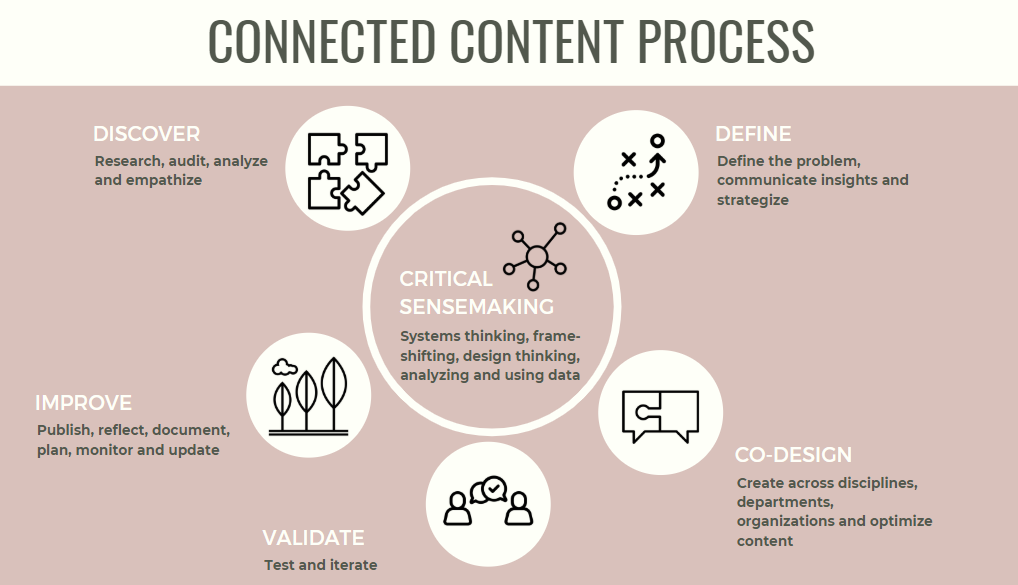
- Position the culture. Consider how we might tackle problems rather than projects. Is project-based content work the most effective approach? How might we work on content challenges differently?
- Reframe the impact criteria. What if the success measure for content was based on (or at the very least included) the principle of whether it works for the most vulnerable?
A more detailed version of this article with additional recommendations is available on Medium. You can also access large images of various graphs from the survey. — Ksenia Cheinman
(Picture credit: Death to stock photo)
Make sure to share your own thoughts with the author by leaving a comment below

Log in or sign up to continue the conversation