
This article was written by Anup Malani, a professor at the University of Chicago Law School and Medical School and the Director of the International Innovation Corps; Luis Bettencourt a professor in Ecology and Evolution and Director at the Mansueto Institute at the University of Chicago; Jonathan Gruber a professor in the Economics Department at MIT; Vaidehi Tandel an economist at IDFC Institute; and Satej Soman, a researcher at the University of Chicago.
As Covid-19 cases in India cross the million mark and as several parts of the country are experiencing a resurgence, state governments have reinstituted state-wide and city-wide lockdown measures. Decisions regarding the location and duration of such policies can be taken effectively through an approach known as adaptive control.
To understand the logic behind adaptive control, it is useful to think of infection control as an activity we are familiar with: driving a car. When you drive, you have two basic goals — maintain your speed and avoid obstacles. These goals are analogous to keeping the Covid reproductive rate ( i.e., how many people an infected person herself infects) below one and to slow down economic activity in case of outbreaks.
When driving, you avoid extreme actions. You rarely “put the pedal to the metal”, which is akin to allowing abandoning all social distancing. Similarly, you try not to slam on the brakes, which, similar to total lockdown, probably means something went horribly wrong or there was an obstacle in the road. Instead, you want to keep an eye on the dashboard. When your speed rises above the speed limit, you tap on the breaks. When it falls below your goal, you tap on the accelerator.
Adaptive control is a tool that could allow countries, states, or cities to bring infection rates under control – through policies like voluntary social distancing – while allowing modest levels of economic activity.
Adaptive control: the three principles
Adaptive control is not a fancy new technique. Our approach draws on lessons from earlier versions of lockdown in India. India announced a nationwide lockdown on March 24 (known as Lockdown 1.0), one of the most severe shut-downs worldwide. Mobility, as measured by Google Mobility reports fell by 40%. This policy taught us how much we can actually slam on the brakes if required. However, that policy was economically very costly, especially for the poor and daily-wage workers.
On April 21, the Government of India announced Lockdown 2.0, which allowed some states to relax controls in certain places. Lockdown 3.0 introduced the idea that some areas are riskier than others and the government then calibrated lockdowns according to local risk. Both of these are important elements of adaptive control – data on Covid allows authorities to determine how risky different areas are and they can then design policies to respond to those risks.
Then, on May 17, the Ministry of Home Affairs announced Lockdown 4.0, which allowed states to take the driving wheel. This facilitates balancing local infection risk against local economic impact. Adaptive control provides guidance on how to do so.
Adaptive control has three basic principles. First, set a clear target. The target may be partly related to Covid, for example, a target may be to reduce the reproductive rate below 1 or ensure that deaths are flat or declining. The target may be related to healthcare capacity, such as the ratio of hospital beds to hospitalizations. Alternatively, it may also be economic activity: allow as much activity consistent with that Covid-related goal.
Setting clear targets helps officials understand what they need to achieve to open up economies. This facilitates coordination amongst officials and the population. By announcing targets it makes the government’s future response to people’s behaviour predictable. It also lets the public know how to gauge the importance of their social distancing. Clear targets also increase the legitimacy of lockdown policies, which can be politically unpopular.
Sanctity of the data the government uses is also important for buy-in. When setting targets, the government should account for incentives to manipulate data. If the target is the level of Covid cases, officials may have an incentive not to test for Covid. A better policy is to use a combination of testing rates and death rates. When officials have to meet testing rates, they have a harder time hiding cases by not looking. Moreover, it is harder for officials to suppress reporting of deaths than of cases.
The second principle is to gradually adjust social distancing policies to achieve the target. The lockdown or complete release of all restrictions are extremes. They may be potentially harmful. The lockdown was tough, especially to the poor, who have fewer savings to draw upon to survive months without income. The full release may cause the disease to flare back up, merely deferring the curve of infections rather than flattening it. Smaller changes – revisited every one to three weeks – allow the government to better learn how policies affect disease rates and employment levels and calibrate its response appropriately.
The third principle is to make decisions at the district and perhaps at the municipal level. Local policies allow governments to balance the risk of infection, which varies across areas, against the loss of business.
How finely they can calibrate policies depends on the level at which the travel restrictions can be enforced or the ability to control the movement of people. An advantage of local policymaking is that if there is an outbreak in an area, it can be cordoned off while other areas are allowed to continue functioning.
Overcoming challenges
While adaptive control may seem like common sense, implementing it requires care. It is important to set clear and thoughtful targets and pay attention to how the population responds to different policies. Because India does not have much experience with social distancing, it has to learn how different rules affect mobility and disease.
Another challenge is knowing what policies control infection rates, and at what cost in terms of economic gains.
Two things complicate matters. First, it is not obvious what policies will work. Take, for example, limiting store hours. This would seem to limit activity, but limiting hours does not reduce the number of people who want to shop at the store. As a result, there are likely to be more people at the store at the same time, which can increase contact and thus infections.
Second, there is a lag between when policies are enacted and when they affect the disease and a lag between dates of infection and death. Looking at current infections or deaths to decide policies can lead to errors. One may underestimate or overestimate the cases that are actually occurring when policy finally has an impact on cases. Instead, governments should project what will happen with cases in one week or deaths in two weeks to determine what changes need to be made today.
Our simulations suggest that adaptive control can benefit most Indian states — some states more than others. The simulations are based on a quantitative epidemiological model called a susceptible-infected-recovered (SIR) model. We modified this model to allow separate compartments for each Indian state and for migration between states. Details are provided in this whitepaper. The figures below provide simulated examples for the states of Maharashtra, which has the most number of confirmed cases, and Karnataka.
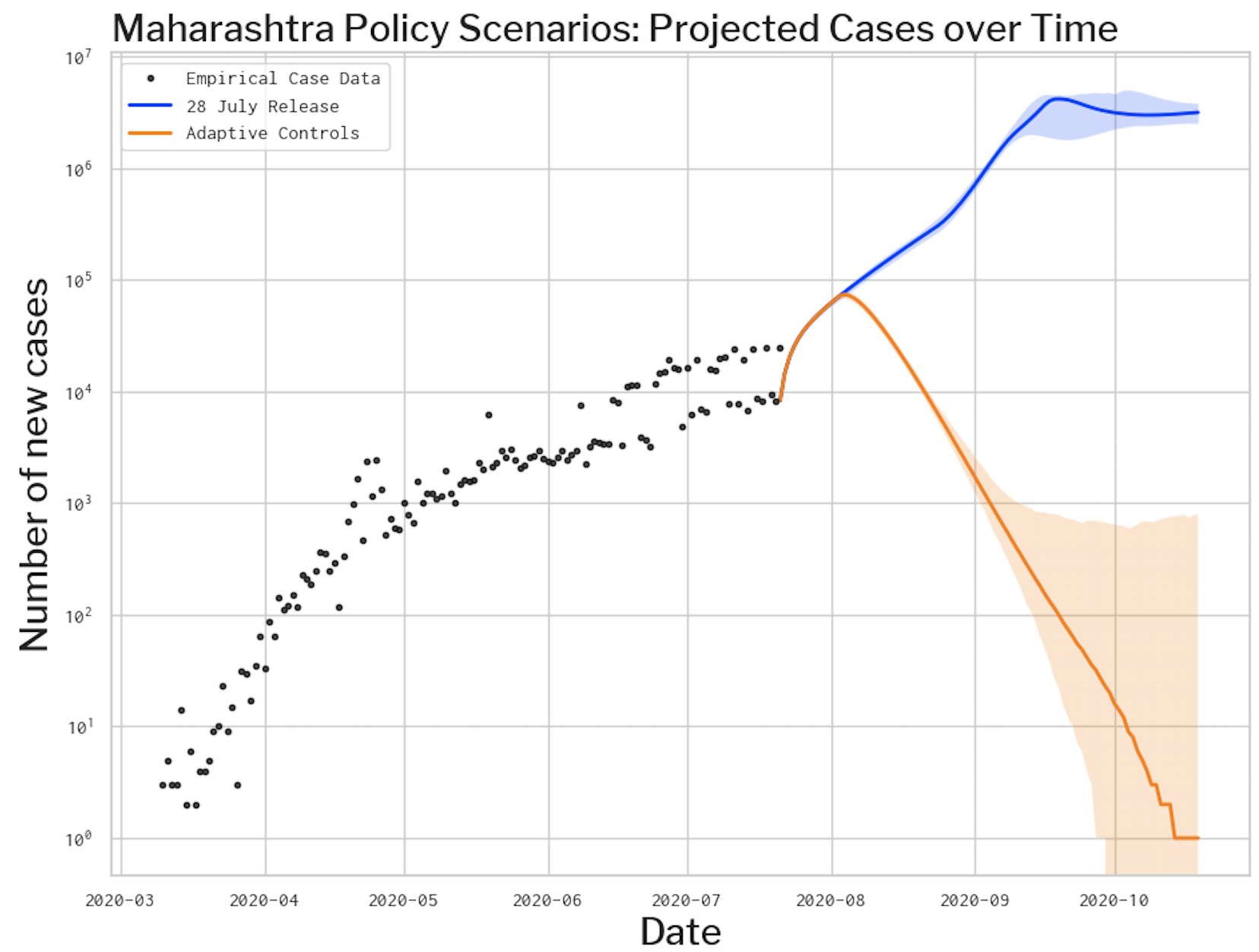
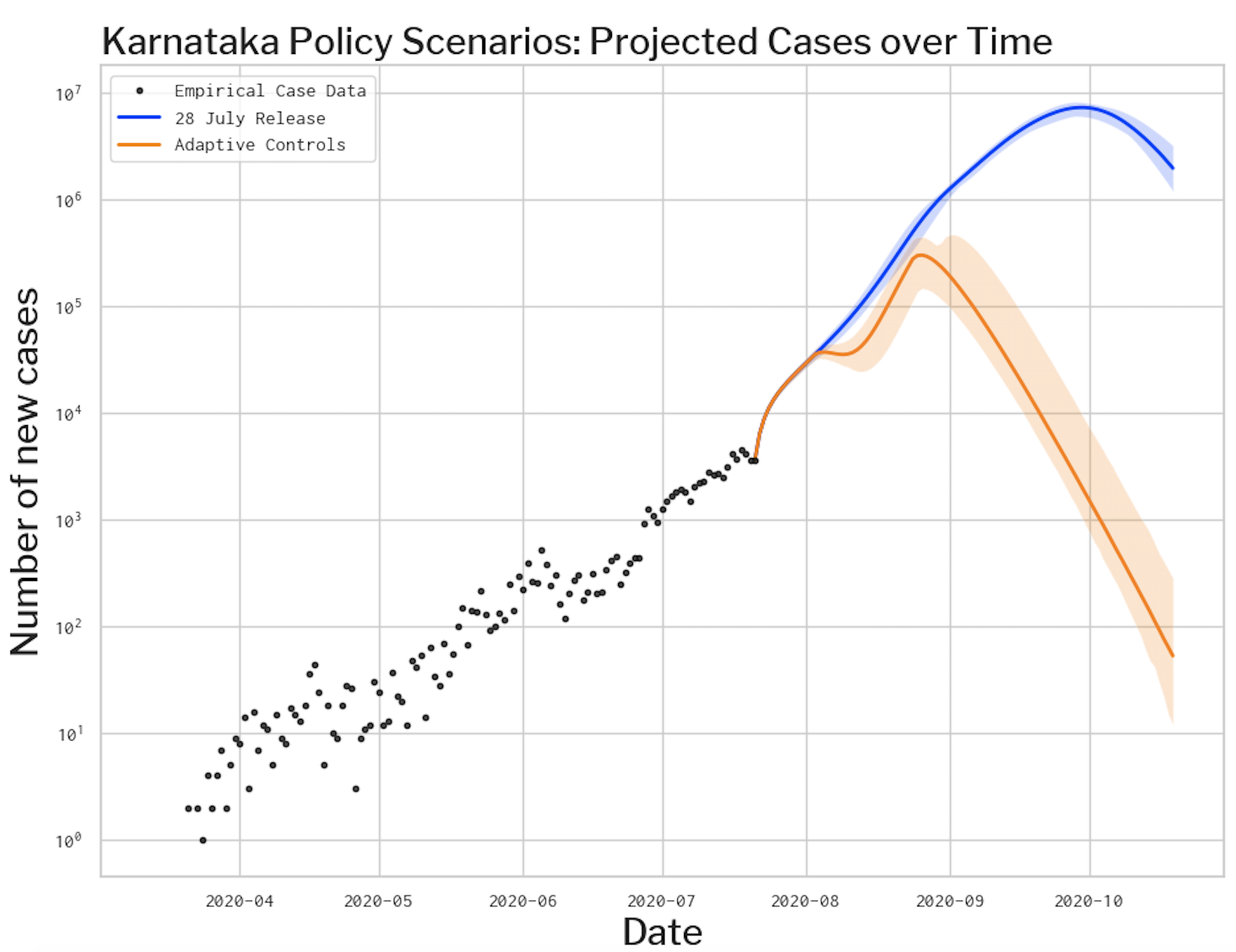
In both states, we simulated what would happen over 90 days if the states used adaptive control to keep the reproductive rate below 1 as opposed to allowing all activity. Maharashtra would experience a quick reduction in Covid infection (as seen by the orange line) while Karnataka would initially see an increase in cases but a reduction over time.
The reason is simple: with adaptive control, states have a choice. They can always choose activity over infection control or vice versa, depending on what is best.
What adaptive control provides is a north star to guide states. Decisions are less ad hoc and more transparent. Both governments and their citizens can be assured by this. – Bettencourt, Gruber, Malani, Soman, Tandel
This team has been advising states on infection control. The authors thank Reuben Abraham for feedback.
(Picture credit: Unsplash)
Make sure to share your own thoughts with the author by leaving a comment below

Log in or sign up to continue the conversation