
This article is written by Anthony McGinness, policy design director, and Marcel Jacobs****, design lead, from Mentally Friendly, a design and innovation studio based in Australia.
A note about COVID-19 and the wellbeing of individuals and teams:
In writing this article, it is important to acknowledge the current COVID-19 crisis and its widespread impact on the wellbeing of people and teams. We will not address this directly in this article, but here at Mentally Friendly, we have been thinking a lot about how we need to redesign our organisations, teams and services for the new world we find ourselves in. We have been sharing our thinking and running a rolling conference series designed to help us to look outwards from our organisations and challenge our thinking. You can find out more via this link.
The emotional journey of problem-solving
We all want to solve problems that matter. We feel connected to the decisions we make, the policies and services we are designing, and the impact they have on people.
This is certainly true for us at Mentally Friendly. We’re an Australian design and innovation agency that partners with organisations to build confidence and momentum together. This includes working with government to design and launch new products, services and policies that deliver wellbeing outcomes. The reflections in this article are grounded in our experience working with design and innovation teams within government, and a broad spectrum of policy-makers, regulators and service delivery staff who are solving complex, critical and urgent problems in areas such as health, mental health, education, financial wellbeing and community services.
When we are working on these sorts of important problems that we all care about, it becomes an emotional process. The “design squiggle” is a common way of visualising the emotional journey as teams progress from high levels of uncertainty to clarity and focus.
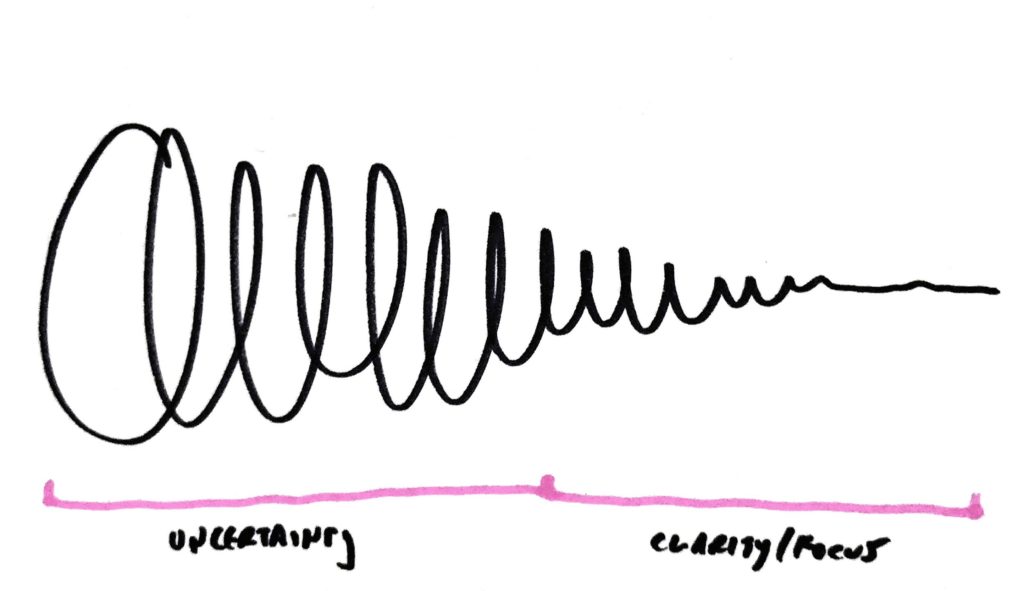
But this is the textbook explanation of how “design” feels. Despite the spiral, it is represented and interpreted as quite a linear process where we move from uncertainty to clarity and focus. However, it doesn’t quite convey what it feels like to be inside the design and innovation process. In real life, it actually feels more like a roller-coaster with a series of ups and downs. This can put added strain on any team trying to get an important job done together.
It is human nature to judge progress by how we feel, rather than by actual progress. And because of these ups and downs, we often feel uncomfortable, and this can lead us to hold a distorted view of progress. We are ruled by emotion (black line) rather than evidence of where we are (pink line).
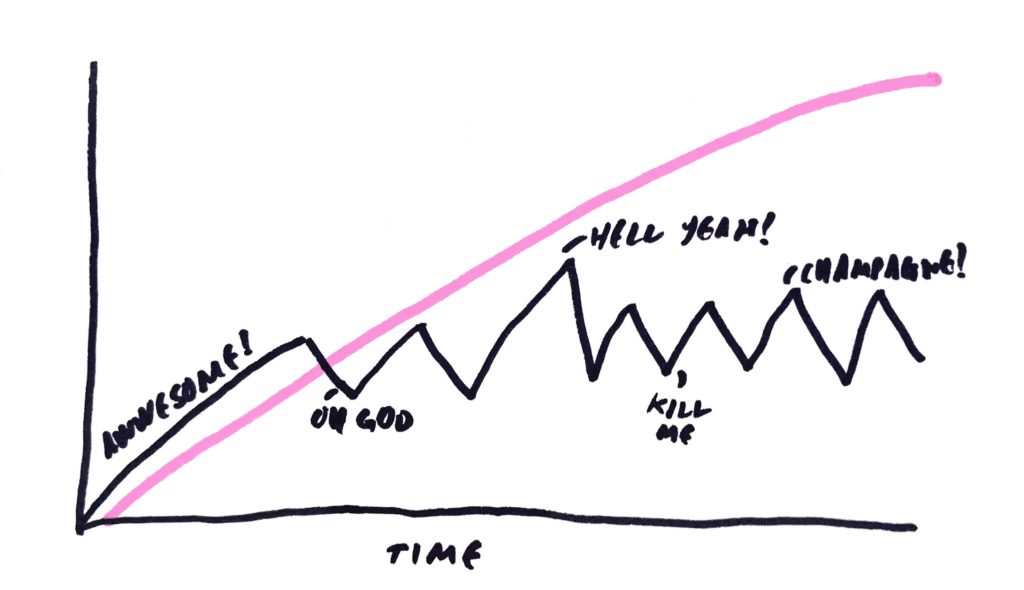 Credit goes to the American entrepreneur Scott Belsky, who introduced us to this thinking and representation.
Our emotional experience of progress, although entirely natural, can lead to misguided conclusions and breed inertia (lows) and complacency (highs).
Some of these common highs and lows that we experience include:
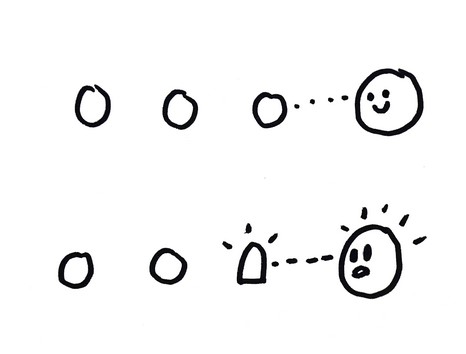
False certainty low: where your plan did not produce the outcome you thought it would, so you feel you got it wrong. But the reality is that working out what does not work might be just as important as finding the ways that do.
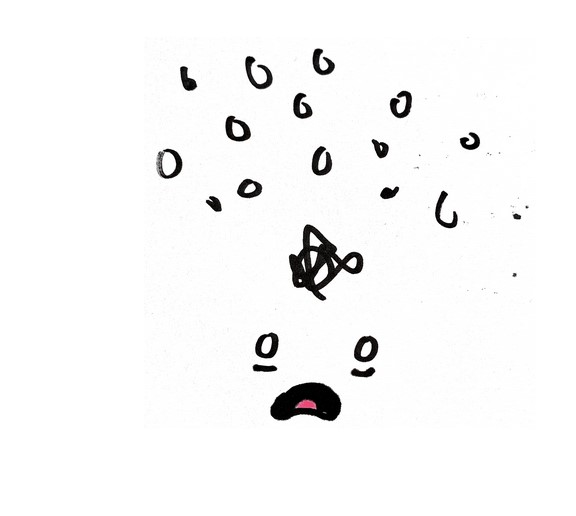 Analysis paralysis low: where teams have done lots of research, but are paralysed by where to start, sometimes triggering a desire to commission even more research. To overcome this, we need to find even the smallest possible way to get started and push forward.
 We nailed it: high when it works exactly as we intended it, which is great, but can lead to an overwhelming sense that you are a genius and have solved the problem. It is important to stay grounded and focus on the next step to continue building confidence in the broader project goals.
 My Boss Finally Gets It: high when someone of influence agrees with you. However, this doesn’t mean you are right. It is important to know the difference between being great at selling your idea, and your idea actually being good. This comes through building evidence, running credible experiments, and drawing clear and accurate insights from the research.
So how can we as individuals, teams and leaders help navigate these types of ups and downs, and maintain a better sense of progress based on evidence?
We have found that our most powerful ally is building team awareness of the emotional process and its highs and lows. By giving these highs and lows a name everyone understands, we effectively create a shared language around this journey. This means we can recognise these moments for what they are and support people through them. It also helps in avoiding the pitfalls of inertia or complacency, and ultimately builds momentum through uncertainty.
What these highs and lows look like for each organisation, team and individual will differ, but they are sure to take an emotional toll on us no matter the situation. So we need to establish practices to introduce this new shared language and understanding into methods that allow us to better navigate that journey. Here are some practices that have worked for us at Mentally Friendly.
Team framework
It is essential that teams have clear and predictable ways to engage with advisors and decision makers.
We formalise this through our sprint cadence, which has bi-weekly check-ins and fortnightly demos/showcases, and a team framework that defines who is involved in these rituals. This framework is designed to promote collaboration, engagement, role clarity, points of escalation, reporting and support. It defines a “core team” who work full-time on a project, an “advisory team” of senior team members that focus on blockages and risk, and a “stakeholder team” of people affected by the project who offer expert advice. This ensures that the right people are involved in the right conversations throughout the project. It also provides a forum for advisors and team members to regularly address issues as they arise and provide support and direction as needed.
Some additional information on our team framework can be found in a deck we have shared publicly.
Check-in cards
While you are deep in project delivery, it can be hard to objectively assess where you are at and whether you are on track. We use either physical or digital check-in cards to capture written feedback from key advisors, decision-makers and stakeholders during project rituals. We visualise and share this feedback with teams so that we can act on the results and track progress and confidence over time. This approach provides a channel for feedback and surfaces data on sentiment and progress. We have found this to be the most effective and intentional way to track team health, project confidence and progress.
We recently shared our team check-in tool and process on our Instagram feed.
Personal retros
Obtaining feedback from our managers and peers is one of the most important ways to get different perspectives on progress and provides a platform to establish ways to navigate our highs and lows. Personal retros are a team-based feedback tool that is designed to relieve all of the burden on managers to provide feedback by including team-mates in a safe, positive and energising way.
It is based on two core ideas — building trust by revealing information about you to others, and learning about yourself from others to help you make sense of your unique value to the team. As humans we have a strong desire to grow, but also a strong sense of identity. This conflict makes giving and receiving feedback difficult. The personal retro provides a framework for people to share feedback safely and constructively.
We have a dedicated site on our approach to personal retros, including an instructional video, which you can find here.
A great way to get started would be to map your team’s own emotional journey across some recent or current innovation projects, and identify the common highs and lows they experience
These three tools and frameworks give us the best chance of keeping teams focused on progress through evidenced-based measures and milestones, providing consistent support through advisors and check-ins, and enabling personal growth through regular face-to-face feedback.
What measures you use or choose to adopt in the future is going to be highly contextual to your organisation. But a great way to get started would be to map your team’s own emotional journey across some recent or current innovation projects and identify the common highs and lows they experience. Give these highs and lows a name, and design and test ways to support teams and individuals, better understand progress, and build momentum through these moments.
What are some typical highs and lows for your team? We’d love to hear from you. you can reach us at anthony@mentallyfriendly.com and marcel@mentallyfriendly.com.
— Anthony McGinness and Marcel Jacobs
(Picture credit: Unsplash)
Make sure to share your own thoughts with the author by leaving a comment below

Log in or sign up to continue the conversation