
Last week, for the fourth time in two years, Iceland found itself with a new prime minister. Katrín Jakobsdottír is a world expert on Icelandic crime thrillers. She’s also an environmentalist, a pacifist, and a feminist.
She was sworn in deep in the midst of political crisis. The country has been in shock from recent swirling - and often graphic - sexual harassment allegations made by a group of more than 600 female politicians. Until Jakobsdottír's appointment, there had been no government since October elections, which were characterised by various scandals and voter mistrust.
In other words, plenty for the new prime minister to deal with. Yet, on her first night in office, she went directly to an international summit at the iconic Harpa convention centre on Reykjavik's shores.
This was the final night of a three-day convention that gathered hundreds of female political leaders from all over the world. The long-time Prime Minister of New Zealand, Helen Clark, was there. So too were the female Presidents of Lithuania, Estonia, and Malta, as well as two former leaders of Bermuda and one of Canada - to name a few.
The annual Women Political Leaders summit is growing year-on-year, with more than 400 participants this time around. It aims to promote gender equality inside and outside of the political sphere.
Katrín Jakobsdottír, the world’s newest leader, sat on stage at the closing ceremony for her first public appearance - looking almost unnervingly calm and collected - next to the world’s first ever female elected head of state, Vigdis Finnbogadóttir. She became president of Iceland back in 1980 after she defeated three male candidates. She is credited by many as a driving force in taking the country to where it is now: the only one to spend 10 years at the top of the World Economic Forum's (WEF) gender equality rankings.
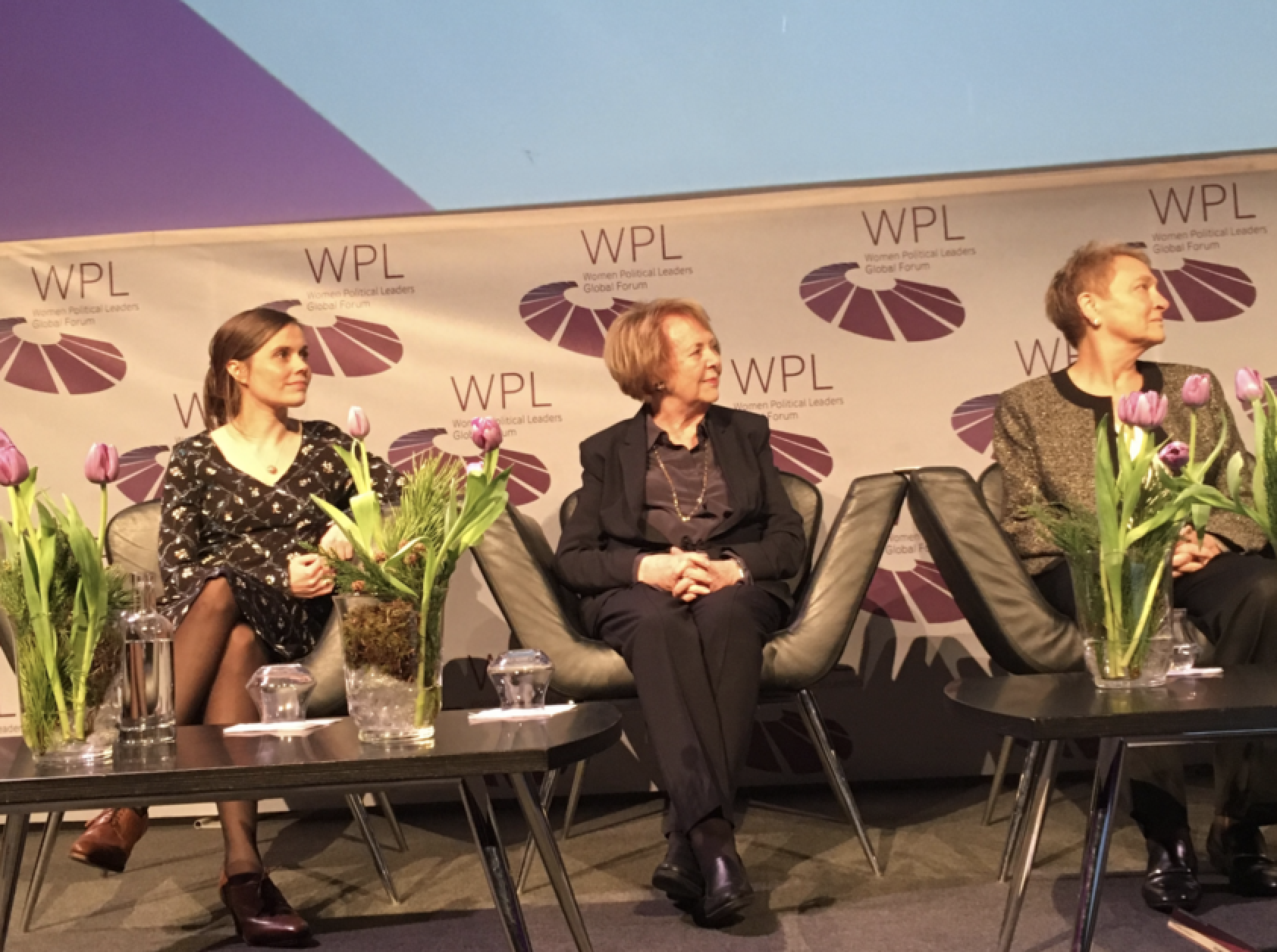 Iceland's new Prime Minister Katrín Jakobsdóttir (left) at the WPL summit with the world's first elected female head of state Vigdís Finnbogadóttir (centre) and Laura Liswood (right)
The new prime minister was quick to point out the significance of the moment. "Just having a president who is a woman, a prime minister who is a woman - it just becomes the norm and not something abnormal, and that’s so important for the younger generation,” she said.
Yet, for most of the world’s residents, the prospect of a female president - in fact, even a female MP - is still far off. Less than one quarter of the world’s MPs are women, and women are still a mere 7% of the world’s heads of government. Progress has been slow.
And even in Iceland, held up as a shining example to the rest of the world at the conference, there is still much darkness. The country has troubling domestic violence issues, a significant gender pay gap, and hundreds of MPs reporting harassment.
"Just having a president who is a woman, a prime minister who is a woman - it just becomes the norm, and that’s so important for the younger generation”
“Iceland has for many years been seen as one of world’s best for gender equality, topping the WEF rankings,” said Steingrímur Jóhann Sigfússon, the speaker of Iceland’s parliament (the Alþingi). “But is not an El Dorado of gender equality. The setback we suffered with female MPs in recent parliamentary elections is a reminder that this is a continual struggle.”
Former Prime Minister Bjarni Benediktsson, who was brought down by the recent scandals, agreed with the sentiment. “Yes, Iceland may rank number one in the world at the moment - we are proud of our achievements - but we are fully aware Iceland is not an equality haven. We face an array of challenges and we want to meet them with innovative policy solutions,” said Benediktsson on the first day of the summit.
Throughout the three days in Reykjavik, the stark scale of these - and other - challenges for women was rarely forgotten.
Yet, the feeling in the room was really one of hope and excitement. It was the one of the largest ever gatherings of its kind, with over 100 nations represented by more than 400 MPs, senators, diplomats.
[video width="1280" height="720" mp4="https://apolitical.co/wp-content/uploads/2017/12/IMG\_2382.mp4"\]\[/video\]
“These kinds of forums are important because they give women a chance to network, to learn from each other, to learn best practices, and to find mechanisms for how to do it [achieve better equality] at home,” said Lithuania’s current and first female President, Dalia Grybauskaitė.
And, perhaps most important of all, there was a real focus on solutions. These included a training program for women wanting to run for office called “From Harvard Square to the Oval Office”, a “Barbershop Toolbox” which helps people run events aiming to engage men in the fight for gender equality, and initiatives like “Girl2leader” which aim to bust stereotypes at an early age and encourage girls to see themselves as leaders.
The Estonian President, Kersti Kaljulaid, talked about her role in creating a “start-up country” where everyone has a digital identity and almost all services are accessible online. “Going digital is a great equaliser,” she said. “Time-saving is important particularly for women – we’re so used to doing 10 things at the same time".
The Icelandic government officials also spoke of some of the policies that have helped the country to climb to the top of the gender rankings. The former prime minister pointed to the importance of paternity leave, gender quotas for company boards and public committees, gender responsive budgeting, and the legislation this year on equal pay, which fines companies that cannot certify they are paying employees equally.
With the dark Icelandic winter, a political world reeling from ever more sexual harassment allegations, and the looming prospect of a volcanic eruption with the reawakening of Öræfajökull, the summit could easily have been a less positive occasion. But every participant - myself included - seemed to leave inspired and awed by their international colleagues; a testament to the strength and passion of the hundreds of women who have made it, despite the odds, to become world political leaders.
(Picture credit: Flickr/NordForsk)
Make sure to share your own thoughts with the author by leaving a comment below

Log in or sign up to continue the conversation