
This opinion article was written by Arturo Bris Professor of Finance, IMD Business School and was originally published by The Conversation. For more like this, see our digital government newsfeed.
Cities are fast becoming “smart”, and the impact on people’s lives can be immense. Singapore’s smart traffic cameras restrict traffic depending on volume, and ease the commute of thousands of passengers every day. In Kaunas, Lithuania, the cost of parking is automatically deducted from the bank accounts of drivers when they park their cars. In many cities, the timing of public buses is announced at each stop with almost perfect accuracy. And free WiFi is now accessible across entire cities, including Buenos Aires, Argentina and Ramallah, Palestine.
Today, improving urban services through digital transformation is a huge industry, dominated by the likes of Cisco and IBM. But the idea of a “smart city” encompasses more than the clever application of technology in urban areas. That technology must also contribute to making cities more sustainable, and improving the quality of life for the people who live there.
We were surprised to find that cities well known globally for their adoption of new technology did not make it to the top of the ranking
That’s why a team of researchers from IMD in Switzerland and SUTD in Singapore – including myself – put together the Smart City Index. For the first time, we attempted to assess people’s perceptions of technology – as opposed to the quality of the technology itself – as a way to characterise the “smartness” of a city. We did this by conducting a massive survey among citizens of 102 cities, to assess how favourably they viewed the technology made available to them.
Problems with perceptions
Take Paris, for instance – a city which has embarked on an ambitious project to redesign its urban landscape. The initiative – called Reinventer Paris – started by receiving suggestions from citizens about how to use and renovate obsolete and disused buildings. At the same time, the velib public bike-sharing program introduced about 14,000 bicycles into regular use throughout the city, with the aim of alleviating congestion and reducing pollution.
But five years after its introduction, citizens are still not feeling the benefits. Our smart city index ranks Paris 51st out of 102 cities in the world, in terms of the ability of the city’s technology to improve lives. Our participants from Paris gave their city a low score of 22 out of 100 – where zero indicates total disagreement and 100 signifies complete agreement – in response to the statement that “air pollution is not a problem”. By contrast, citizens of Zurich gave their city a score of 60 in response the same statement.
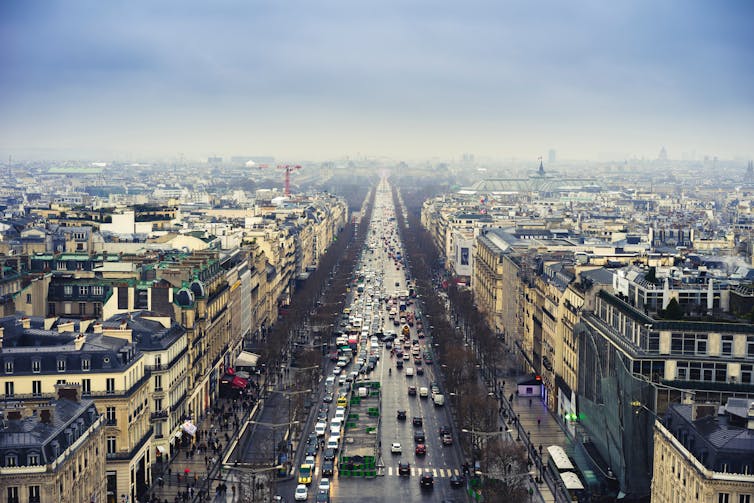
Paris haze. Mr Ced/Shutterstock.
And although Reinventer Paris was specifically designed to be a bottom-up, participatory process, Parisians give a score of 36 out of 100 to the statement that “residents provide feedback on local government projects”. By comparison, the city of Auckland received a score of 71 from its residents, putting it in sixth place in the overall ranking.
The global picture
Only to the extent that digital technologies make a meaningful difference to people’s lives, can cities efficiently become smart. Our ranking puts Singapore, Zurich, Oslo, Geneva and Copenhagen in the top five, followed by Auckland, Taipei, Helsinki, Bilbao and Dusseldorf. Cities at the bottom of the ranking are all in developing economies or emerging markets, including Bogota, Cairo, Nairobi, Rabat and Lagos.
We were surprised to find that cities well known globally for their adoption of new technology did not make it to the top of the ranking. This was the case for several cities in China – which have received intensive investment from the Chinese government to increase their access to technology – including Nanjin (ranked 55), Guangzhou (57) and Shanghai (59). Likewise, Tokyo shows up in 62nd position, New York City in 38th and Tel Aviv in 46th place.
Smaller, smarter
Smart cities only make sense when technology meets citizens’ needs. A bike-sharing scheme will only seem useful if the city’s infrastructure facilitates cycling – and believe me, only the brave would dare cross Place Charles de Gaulle in Paris at noon on a bike.
At the same time, people recognise when technology solves a problem, because their lives get better. In an extensive study of 16 cities – published in our new book Sixteen Shades of Smart – we found that Medellin has become a very successful smart city because technology targets citizens’ main problem – safety. Similarly, without massive investment, public WiFi in Ramallah has done more for its people by providing them with access to the outside world in a walled city, than any air pollution monitoring system.
the real test will be whether citizens feel the benefits
We have also found that large cities and megacities find it difficult to become smart. Most of the cities on the top of our ranking are mid-size cities. It is easy to extend the benefits of technology to people in San Francisco (ranked number 12 with a population of 884,000) and Bilbao (ninth, with a population of 350,000); but it is much more difficult to do the same in Los Angeles (35th, population of 4m) and Barcelona (48th, population of 5.5m).
There are 29 cities in the world with a population of more than 10m (including their metropolitan area), and that’s expected to grow to 43 by 2030. The differences between cities – even those in the same country – will continue to grow, as leaders seek out digital solutions to urban problems. But the real test will be whether citizens feel the benefits.
This article was originally published by The Conversation. To read the article, click here.
(Picture credit: Unsplash)
Make sure to share your own thoughts with the author by leaving a comment below

Log in or sign up to continue the conversation