
In 2017, Oxfam revealed that eight billionaires own the same wealth as the half the world’s population. That's eight men on one side of the scales balancing 3.6 billion people on the other.
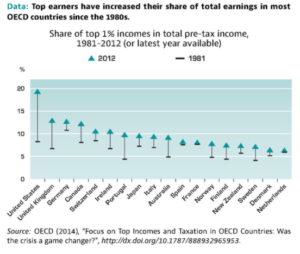
All countries have tolerated inequality to varying degrees. No one can have been under any illusions that the richest weren’t doing very well for themselves. But it has become harder to stomach in the wake of the 2008 financial crisis.
Credit Suisse reported that the richest 1% now own 7.5% more of the world’s wealth than they did in 2008. While many suffered privations, they continued to accumulate wealth.
This widening of inequality is far from harmless. It correlates with violence, pollution and far-right voting. It's also stifling innovation and productivity, thus damaging the economy. The Davos elite have noticed too: this year's meeting was spent fretting about inequality over vintage wine and canapés.
Published here is an edited transcript of a conversation with Danny Dorling, the Halford Mackinder professor of human geography at Oxford University and an expert on inequality – as well as the wider economic, political and health statistics that correlate with it.
What is the state and trajectory of inequality in the world right now?
It’s pretty bad in the UK and the US, but the rest of the world is doing OK. In fact inequality is falling in many parts and we’ve recently seen some very fast drops in infant mortality. A baby is more likely to survive in urban China, which is most of China, than in most of the US. That’s quite incredible.
Within Europe, the UK is an exception. Pick another country at random and you’ll find their inequality is much lower, their understanding of each other is much higher, schooling systems are more inclusive, the list goes on and on.
But things are starting to change, and not just at the fringes. The middle of the road is moving. This summer we found out that the average pay of chief executives in the UK dropped from £5 million to £4 million in just a year. Things are moving quickly.
How was that sort of inequality justified?
The ideology that emerged in the 70s was that we must reward talent. Britain from the 30s until then had become much more equal internally, but at the same time became much less powerful worldwide. Those two were equated. And it was plausible, so we let inequality rise.
Now it’s becoming clear that high inequality is bad for the economy. It reduces innovation and productivity. But I don’t think we are quite at the point where there is a consensus yet. The concern you get from many conservatives is that they want higher social mobility: inequality is fine as long as the really able people can get to the top.
Is there an ideal amount of inequality?
That’s a fascinating thought experiment. The problem at the moment is that the most equal countries in the world – Japan, Norway, Finland, Iceland and Denmark – don’t appear to be suffering from being too equal. What we really need is for one of the affluent countries to become even more equal, and for things to go wrong. Until that happens, we can’t say we’ve found the turning point.
Beyond the economic effects, you’ve written about the wider correlations with inequality. You found unequal societies consume more, pollute more, have higher levels of violence, greater vote shares for the far right, and much less trust: just 5% of Brazilians trust their fellow citizens, whereas 64% of Norwegians do.
And it’s goes further too: look at the obesity statistics. The UK is the fattest nation in Europe!
Those correlations are fascinating, and they’re only just beginning to be noticed. I think what the inequality measures show is how well or badly a society is being run or organising itself. Scandinavian societies are well organised in many other ways, from education to transport. So I think you get all these correlations because of that: they’re all connected.
Another thing that’s worth pointing out is that the most equal countries in the world have weird languages that are very hard to learn, for example Finnish and Japanese. The most unequal countries are English-speaking. They’re easiest for corporations to move between and advertising can have wider effects. And more unequal countries also have more immigration, partly because there are lots of badly paid jobs.
So how can inequality be addressed?
Tax is the big one. The rich countries that managed to avoid great inequality are the ones that managed to keep their high tax rate on top incomes. The reason for having a 70% tax rate on the really high earners is not really to raise more money: it’s to stop people being paid that much in the first place. And of course part of the reason people want such high salaries is that other people are getting them. Tax brings everyone’s top salary down, then prices go down, and then no one loses out.
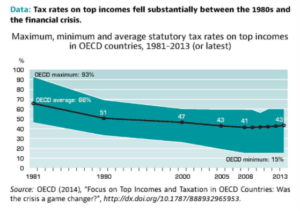
And if the firms are paying those at the top a bit less and everyone else a bit more, that makes people more productive. The reason why France is more productive than the UK is partly because the median family there gets about €4,000 a year more and people work better when they’re being properly paid.
Income tax is one thing. But inequality is accumulated in wealth and assets. What about taxing those?
Governments in the future, particularly in countries like the UK, may well need to tax wealth and assets. I think we’re going to see a land tax come in, a bit like the Irish land tax, which is 0.18% of the value of the land per year. And the immediate effect when you bring in a tax like that is that land and property prices begin to fall. And that would be a really good thing for the UK: our prices are twice what they should be. You can’t say it on TV, but we need them to halve over the next 30 years.
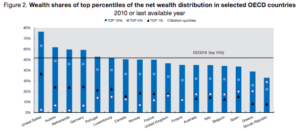
Then the other important element is international tax coordination.
In Scandinavia, everyone’s income and tax is published. So if you see that your neighbour is declaring a very low income but has a couple of Land Rovers outside their house, you just make a phone call. That’s how you enforce the tax system. We might think it’s a slightly Stasi system, but tax avoidance is by far the biggest form of theft in Britain. Every year you’re burglarised a thousand times by the people who aren’t paying tax, but you don’t see it like that. You don’t see that your chances of surviving a road accident are less because our health system is less well funded.
So we could start by properly enforcing our own tax systems. Then a land tax of course we can enforce because we know where the land is and we’ve got Google Earth. But on top of that we do want to start controlling Apple and Google and the Paradise Papers folk. And the great irony is that the one country with the most power to do that is the UK, because we sanction the islands. They couldn’t be tax havens without us.
One thing people talk about as a solution that would certainly do something for poverty, and perhaps something for inequality depending on how it’s funded, is a basic income.
I like the idea. My preference would be to introduce it at a low level and slowly increase it to see what happens. [Former UK Prime Minister] Gordon Brown actually had a basic income modelled for the whole of Europe. The level that was discussed was around €1,000 per year per adult. That goes a long way in Romania – and encourages you to stay in Romania. It’s not so much in London, but it would still be very welcome.
Basic income is efficient. It means you could get ride of a lot of the state apparatus. But the most important thing about basic income for me is that if you can get it up to a subsistence level, it allows people to consume at a very low level if they want to and they don’t want to work. I don’t think we can carry on creating really useful full-time work for everybody. And if you can let people who want to lead their own life not require paid-employment, consumption and pollution will fall very rapidly. If you would rather sit in a yurt strumming a guitar, you should be able to – it might be better for you and the world.
(Picture credit: Flickr/Harrie Van Veen, OECD, OECD, OECD)
Make sure to share your own thoughts with the author by leaving a comment below

Log in or sign up to continue the conversation