
Technology often throws up a dilemma for parents and educators. Spending hours in front of screens can be detrimental to child development, but children need to be tech-savvy to prepare them for modern life.
Singapore’s preschools have found a way around the problem. The government has introduced screen-free robots which help children prepare for STEM (science, technology, engineering and maths) subjects at school. By programming the robots to complete simple tasks, like moving in a certain direction or shining a light, children between four and seven can learn the basics of engineering and sequencing.
The award-winning "PlayMaker" program introduced robots to the curriculum in 160 preschools in 2016, the first wide-scale use of this new technology, and is being expanded to more preschool settings. So what can these robots do, and what impact will they have on early education?
"A paradigm shift"
The project demonstrates “a paradigm shift” in how technology is defined in the preschool sector, said Adrian Lim, from Singapore’s Info-communications Media Development Authority (IMDA), which directs and funds the project. As opposed to using screens, which often involves children passively consuming content on smartphones or tablets, they actively engage with the robots and each other.
One of the robots being used in Singapore is called Kibo, a machine on wheels which can be custom-built with sensors, lights and motors. It has a scanner, by which it receives instructions from barcodes written on wooden blocks. For example, a child can tell the robot to beep, then move forwards, and then shine a light, by scanning the barcodes from the relevant blocks in that order.
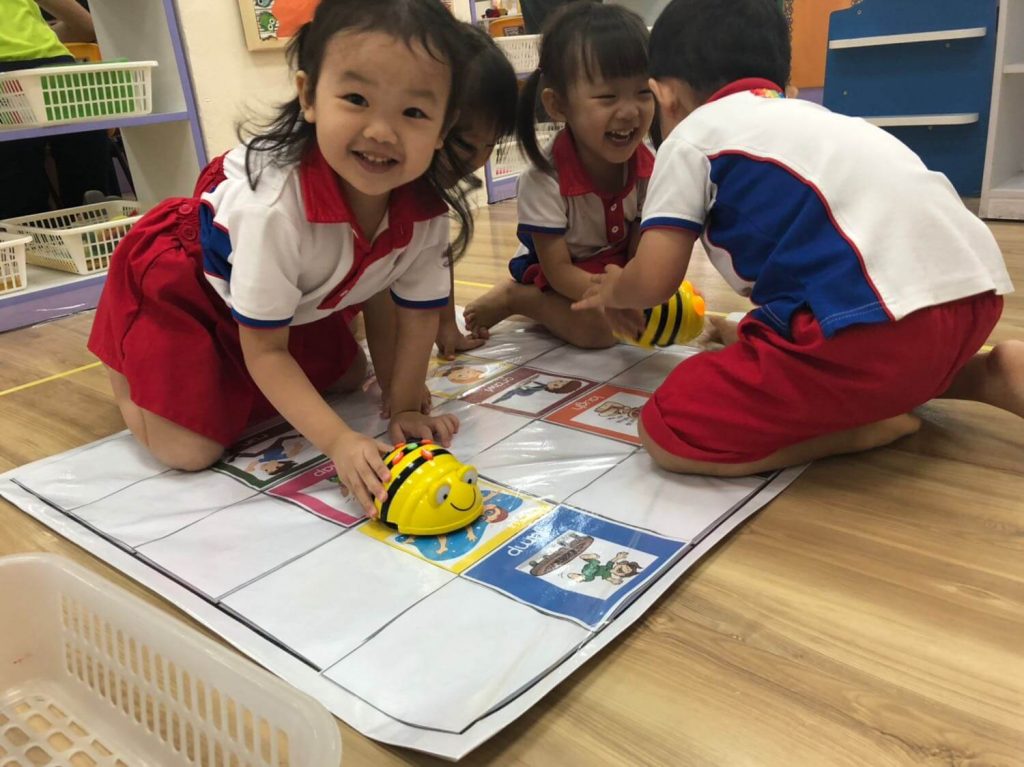 Children play with the Bee-Bot robot in a Singapore preschool
A similar robot called Bee-Bot is particularly popular. The small plastic bee has buttons on its back which children can use to program its movement. Teachers can use the bot in a number of different exercises: for example, placing Bee-Bot on a chart with multiple coloured squares, and asking children to work together to program its move to a certain colour.
“Why not start engaging girls early, before gender stereotypes are deeply-ingrained?”
The evidence shows that children in the pilot mastered programming concepts very quickly. By completing tasks which create orders of instructions for the robots, kids learn to make sequences. This an important pre-maths and pre-literacy skill, said Amanda Sullivan, a researcher at Tufts University’s DevTech team, which created the Kibo robot.
Encouraging girls
Singapore boasts one of the best-ranked education systems in the world, but it still shares a common struggle with educational authorities elsewhere over getting girls into STEM subjects. The ratio of female to male STEM researchers in Singapore is seven to 20.
“Why not start engaging girls early, before gender stereotypes are deeply-ingrained?” said Sullivan. When children play with the robots, differences between genders are hard to discern, she said, before gender norms set in that see far more boys than girls become interested in STEM. Though there is no wide-scale study yet, Sullivan has found from surveys that girls are significantly more interested in being an engineer after using the robots.
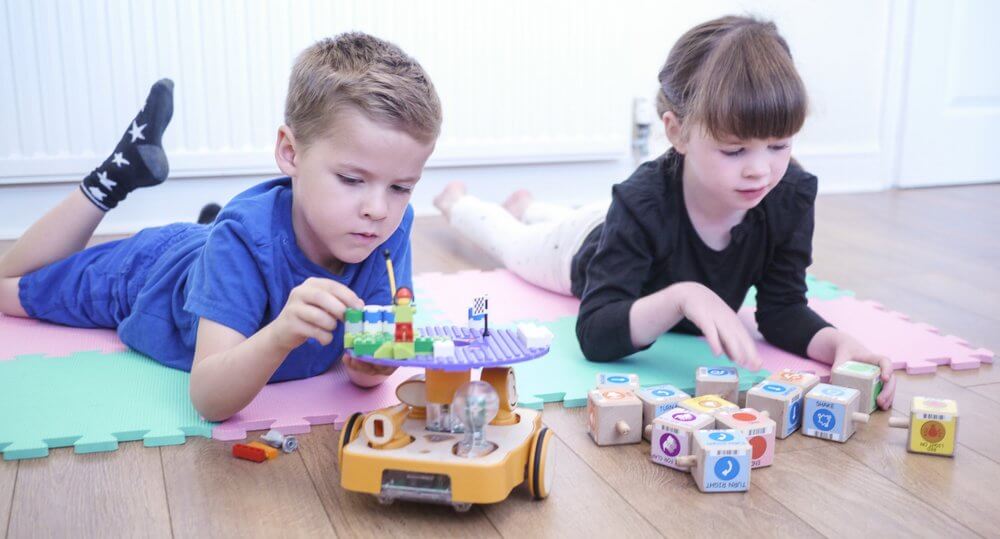 Kibo can be decorated and given instructions by scanning bar codes on wooden blocks
As well as the traditional STEM subjects, Singapore also incorporates the arts as a priority — adding an "A" to create "STEAM". Research has suggested that art and design can help to stimulate learning and innovation, and there has been a growing movement worldwide to give them more prominence. This is reflected in the PlayMaker program. For example, as well as programming Kibo, children can design what it looks like from a very basic core machine.
Slow progress
The Playmaker program itself funded support for 160 preschools, which have incorporated the robots into their curricula. These preschools own the robots, while other centres in Singapore have to buy them. A Kibo robot costs between $229 and $499 depending on its features, while Bee-Bots start at less than $100.
To expand access, IMDA has partnered with the Association for Early Childhood Educators for Singapore (AECES), an organisation which supports the early childhood workforce, to provide workshops for teachers on how to incorporate the robots into their curricula. With the costs covered by Singapore’s SkillsFuture Singapore Agency, AECES trains teachers for two and a half days. They then try what they’ve learned in the classroom, and return to the AECES centre for feedback.
The association aims to eventually train Singapore’s 17,000 preschool teachers. So far, though, progress has been extremely slow. Since the partnership began in 2017, only around 60 teachers have been taught, said AECES General Manager Ivy Kok. The organisation is therefore embarking on a program of seminars and short introductory workshops to broaden reach. Once teachers are trained, the hope is that more and more preschools will buy the technology and incorporate it into their work.
In the modern economy, STEM skills like engineering and coding are at a premium. Robots like Kibo and Bee-Bot could prove vital resources in education. Singapore has taken the first big step in using them. — Jack Graham
(Picture credits: IMDA; KinderLab Robotics)
Make sure to share your own thoughts with the author by leaving a comment below

Log in or sign up to continue the conversation