
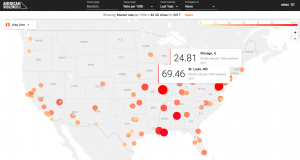
When it comes to violent crime, context matters. Chicago’s body count is rising rapidly — and grabbing national attention. But the most recent data suggests that its murder rate per capita is still less than half that of St Louis.
AmericanViolence.org, a new online data tool developed by social scientists at New York University, has aggregated the most recent murder statistics for more than 80 of the US’s largest cities. It allows the public and policymakers to map and visualise both the most recent murder stats and long-term trends.
“Americans have such a distorted view of how much violence there is in different places and how violence in changing,” said Patrick Sharkey, one of its developers and author of an authoritative book on the US’s long-term crime decline.
That distortion fuels fear among the general public and knee-jerk reactions by policymakers.
For policymakers, the tool is important in two key respects. First, it provides more current figures than the annual FBI Uniform Crime Reports offer, allowing policymakers to track whether their initiatives to reduce violence are actually working.
And second, the historical and geographical scope of the data provides context for violent crime spikes.
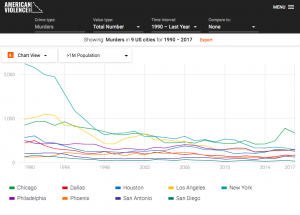
New York City’s murder rate might still be higher than policymakers and police departments would like, but 2017 saw 1,864 fewer murders in the city than in 1990, despite a population increase of more than one million people over the same time frame.
And while Chicago’s recent uptick in killings is cause for concern, it fits a seasonal pattern that can be tracked over decades.
“Cities across the country have data available and are making it open access, but it’s hard to interpret and access all the different sources from different cities,” said Sharkey. “The goal is to take what’s out there put it all into a common, standardised form ... to show how things are changing.”
For now, the program only tracks murders, but a second version — due at some point in the next year — will provide data on shootings at a neighbourhood level in 30 to 50 cities, offering a more granular view of urban violent crime on a smaller scale.
That could be a significant cost- and time-saver for cash-strapped local governments, said Sharkey.
“If a city is implementing a violence prevention program, we want them to be confident that they don’t also have to carry out a new data collection effort to work out if that program is working,” he said.
Monitoring and evaluating projects is a stretch on already tight local government budgets.
The project is, nonetheless, dependent on the calibre of data produced by city governments. Where that data is unavailable, the program sheds no light.
“The idea here is to get the infrastructure in place,” said Sharkey, “and as more and more cities start to make data available, it will expand.” _— Edward Siddons
_
(Picture credit: Flickr/Steve Calcott)
Make sure to share your own thoughts with the author by leaving a comment below

Log in or sign up to continue the conversation