
“Well, it never did me any harm” is perhaps the most common justification you’ll hear for smacking a child. But mounting evidence suggests the impact of corporal punishment — which covers any form of physical punishment — is far-reaching and overwhelmingly negative.
The biggest study to date, published in 2016, reviewed 75 studies published over 50 years involving over 160,000 children. Its conclusions were damning. It found links between corporal punishment and worse educational outcomes, higher levels of aggression, impaired brain development and a range of mental health issues, including anxiety and depression. Even witnessing violence as a child makes you more likely to enter into violent relationships in later life, either as the perpetrator, if male, or the victim, if female.
The movement to ban corporal punishment is well underway, but progress remains slow. While no definitive data on the global prevalence of corporal punishment is currently available, at least half of the world's children experience violence — including violent discipline — during childhood. To date, 53 states have outlawed corporal punishment in all settings, including the home, and 56 others have committed to a blanket ban. That means that, of the world’s one billion children, only 10% of them are comprehensively protected from violent discipline.
With some studies calculating the cost of violence against children at a staggering $7 trillion, banning corporal punishment remains urgent — but legislative reforms are only one part of the puzzle.
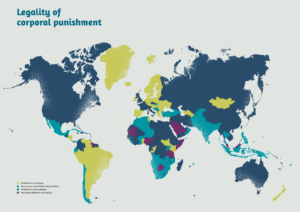 In green, countries with full prohibition. In turquoise, countries committed to full prohibition. In navy, countries with partial prohibition. In purple, countries with no prohibition. Graphic correct as of May 2018. Credit: Global Initiative to End All Corporal Punishment of Children.
Equal justice
“It’s one of the most common and accepted forms of violence against children,” said Anna Henry, Director of the Global Initiative to End All Corporal Punishment Against Children, a research and advocacy body. “It’s not even seen as violence in many places – it’s just seen as legitimate discipline.”
For Henry, there’s a fundamental legal imbalance at play: if adults are protected against assault, why aren’t children?
Sweden was the first country to outlaw the physical punishment of children in all settings in 1979. The proportion of children who have been hit plummeted from 90% to around 10% over a 35-year period. Over half of parents supported the use of corporal punishment before the law was introduced. Today, that figure is barely 10%.
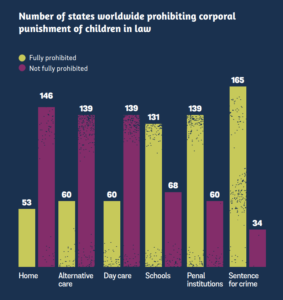 Graphic correct as of May 2018. Credit: Global Initiative to End All Corporal Punishment of Children.
Uneven progress
Progress on the issue remains uneven across regions. Most of South America has banned all corporal punishment outright, while Africa lags behind. But legal reforms, driven by a swathe of civil society groups who campaigned to put children’s rights on the agenda in Latin America and the Caribbean, only tell part of the story.
“Just because it is illegal does not mean it doesn’t happen here,” Lydia Guarin, a Latin American child protection expert from Save the Children, cautioned. While legal change filtered down to change social norms and attitudes in Sweden, Guarin warns that many Latin American children are yet to reap the benefits.
Now, the civil society movement has widened its focus. Programs to raise awareness about legislative bans and the harms of corporal punishment are underway in Peru. And parenting programs to reduce physical punishment are in pilot in El Salvador. Changing a culture takes more than legislative reform.
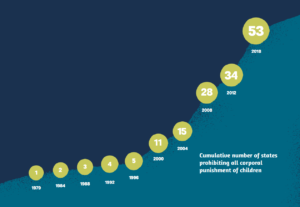 Graphic correct as of May 2018. Credit: Global Initiative to End All Corporal Punishment of Children.
Next steps
Ending corporal punishment remains some way off, though Henry expresses optimism that it is achievable. Advocacy through globally recognised legal documents such as the Convention on the Rights of the Child have proved fruitful for the Global Initiative, and there is no shortage of tried-and-tested projects that can slash the rate of corporal punishment.
In Uganda, a toolkit to transform the culture of schools cut the number of primary school children who experienced violence from school staff and teachers by 42%. In the US, a simple questionnaire for Baltimore paedeatricians cut mothers’ self-reports of violence against their children dramatically. While in Afghanistan, a “peace curriculum”, which taught conflict resolution skills in schools and to community leaders, slashed the rate of violence in the home.
According to Patricia Horna, a Latin American specialist at World Vision, “to end violence against children, you need to change the culture.”
(Picture credit: Global Initiative to End All Corporal Punishment of Children)
Edward Siddons
edward.siddons@apolitical.co

Log in or sign up to continue the conversation