
Developed countries like the US, Germany and Japan are some of the biggest manufacturers in the world. But almost all of them have seen a huge drop in their manufacturing job base over recent decades.
There are two broad reasons for this: globalisation and technology. It became cheaper to make things abroad, and technology increased productivity per worker—meaning fewer workers were necessary. Some jobs are now completely automated, and only more will go that way in the future.
It’s not that countries like the US manufacture less stuff than they used to. In fact, its output is greater than ever. It just doesn’t need the same manpower to do it.

Economists were once sanguine about the loss of manufacturing jobs. They thought people would relocate, retrain and return as more productive workers in another sector. A fluid economy would become a more efficient one.
However, the UK provides a cautionary example. Since the 1980s, it has swung hard from manufacturing to a service sector economy. To be sure, the economy has grown; but its resilience has been eroded, its imbalances exacerbated. It’s no coincidence that the UK’s recovery from the 2008 financial crash has been patchy and weak.
Since then, political opinion has gone into reverse, calling for a broad-based, more inclusive and resilient economy. Either way, it’s clear that governments need to do something about the loss of manufacturing jobs.
They could take steps to revive or reinvigorate their manufacturing. Or they could manage the decline, making it as gradual and cushioned as possible, while creating new opportunities for the people and places left behind. Here’s what governments across the world are trying.
Cushion the blow
When a factory closes, it can be a ruinous double blow for a city’s finances: lost tax revenues and a raft of unemployed workers. The key is anticipating it.
Huntley, a town in the US, recently lost the coal-powered Huntley Generating Station. But they saw it coming and clubbed together to create the Huntley Alliance, a coalition of local government, unions and green activist groups. This alliance worked together to produce a credible transition plan for the area which they then took to New York lawmakers with a plea for support. They walked away with a $45 million cash infusion to sustain the town while it reinvents its tax base.
It was the first time a US state has offered a financial cushion to a community that was financially reliant on a coal-fired power plant. Instead of spending millions to prop up failing industries, they used the money to help the community make an economic transition. It bought Huntley seven years to rethink its identity.
Reinvention
If cities accept that their manufacturing days are behind them, then they need to find a new source of jobs. Although increasing numbers of jobs are being automated, new jobs are still being created. And some sectors are booming, particularly healthcare, tech and tourism.
There are opportunities to be taken, and Germany has become a model for post-industrial reinvention—the Huntley Alliance even visited them for inspiration.
Germany’s Ruhr Valley has been dealing with job loss for decades. In the 1950s, its mines employed 650,000. Today, only two hard coal mines remain. Unemployment is above the national average, but it’s far better than it might’ve been. The government avoided the worst by funding worker retraining programs, recycling old production plants, and rejuvenating spaces sullied by industry.
Take the Zollverein mine: it’s now a museum that still employs its former miners as tour guides. It draws 1.5 million visitors a year. But it's not the only attraction: there are other museums, gardens and galleries—and hotels to support them. Industrial spaces have become trendy homes for businesses. Meanwhile, the Emscher Park initiative is restoring the green space of a 300 square mile tract that was devastated by mining. The Ruhr, a place once famous for its mines and grey, coal-choked sky, was even named Europe's cultural capital in 2010.
Retrain laid-off workers
In the long run, low-skill manufacturing jobs are in decline—that much is unavoidable. But it’s also true that employers are struggling to fill other types of jobs, including high-skill manufacturing.
Government funded job training can bridge these narratives.
A good example can be found in Rochester, where Great Bay Community College has developed degree programs together with the local engineering industries. This meant that their courses were demand-driven and specifically tailored to industry’s needs. Moreover, those companies guaranteed interviews to graduates and actually end up employing a substantial number of them.
But still, even when options to retrain are available, they often aren’t used. There are surely many reasons for this, but a little guidance and support can go a long way to fixing them.
Job security councils are unique to Sweden—and a shining example of how to support laid-off workers. Employers pay them a percentage of their annual payroll and, when they are going to lay-off employees, they let the councils know. The councils are then ready to catch the laid-off workers, providing them with counselling and hefty financial support to tide them over and help them retrain to get back into the workforce.
The results are impressive: in Sweden, 85% of laid-off workers are back to work within the year.
The system isn’t perfect. The workers on average end up accepting slightly lower wages for their next job, and a small portion of them professionally "downgrade." But it’s better than what laid-off workers can expect in other countries.
Help laid-off workers become self-employed
A new pilot initiative in Rotterdam, the Netherlands, involves microfranchising. The essence of the idea is that an established brand identifies individuals who have been out the labour market for some time and gives them the opportunity to use their skill set, for example by working as handymen.
Issues of branding, price setting, administration and payment are all dealt with centrally. The individuals are licensed to sell the franchise’s products or services within a certain area. In exchange for annual licensing fees, they get to set up a company based on a proven trademark, and they have immediate access to the tools and infrastructure needed to succeed.
It’s a concept that started in developing countries but is now being trialled in developed ones. It clearly cannot recreate the culture and camaraderie of traditional manufacturing work, but it can give people the opportunity to earn a living with their hands while embracing the future of work.
Make relocation easier
This is the efficient solution favoured by many economists.
In the past, if economic opportunities dried up in one place, people would up sticks and seek them elsewhere. This smoothed out the income imbalances between cities, since people would move where the pay was better, and the change in labour supply meant that wages went down where they moved and up where they left.
But in many countries, this has stopped happening, and the cost of housing may be the problem.
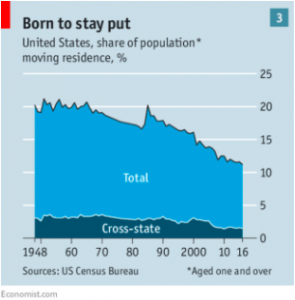
There are relatively good wages in economically vibrant cities like New York and San Francisco, but housing prices are so high they outweigh any gains people stand to make. It’s not worth it for low-income workers. So, within and across states, cities are diverging.
A two-fold solution could be removing development restrictions and building more affordable housing in thriving cities, and then providing subsidies for moving expenses when people want to relocate there. Many governments have toyed with the idea, but vested interests have thwarted the former, and charges of callousness the latter.
Basic income
A future with dwindling numbers of jobs is part of the reason why so many governments are seriously considering a basic income: simply giving their citizens enough money to live on, no strings attached.
Several new trials of the idea have kicked off this year, but the one in Ontario is explicitly aimed at supporting the poor in a province where manufacturing jobs have recently evaporated. Many laid-off workers are now either unemployed or working in precarious jobs that have lower pay, are less secure and often completely without benefits.
The overarching plan is a familiar one: to shift Ontario from a traditional manufacturing economy to knowledge-based one, with jobs in areas like medical research and financial technology. The government thinks a basic income could help that transition by supporting people while they become entrepreneurs or to go back to school and retrain.
Their strategy might create new jobs, but they'll be very different ones. And that's a problem that will be faced everywhere. In the short-term, the decline of low-skill manufacturing can only be undone so far. In the long run, it's likely inevitable. Workers and governments will probably need to meet halfway: people may need to accept that a return to the old days isn't possible; governments need to do much more to help them and their cities find new work and purpose.
(Picture credit: Pixabay, Federal Reserve, The Economist)
Make sure to share your own thoughts with the author by leaving a comment below

Log in or sign up to continue the conversation