
On Tuesday, 20th February, 17-year-old Abdikarim Hassan was fatally stabbed in Camden, North London while making his way home from school. When his mother arrived at the scene, police were still identifying the body. According to a neighbour, it was only when she called his mobile and heard his phone ring that she learned the lifeless figure was her eldest son.
Abdikarim is the 16th fatal stabbing in London since the start of 2018. Last year, 80 Londoners lost their lives to knife crime. But the problem stretches far beyond the capital: in the year ending September 2017, the police registered some 37,443 offences involving a knife or a sharp instrument in England and Wales – a 21% increase on the previous year.
While police forces in England and Wales struggle to confront a resurgent knife crime epidemic, Scotland has seen results few could have foreseen: in 2017, not a single person under the age of 20 was killed by a knife anywhere in the country. Glasgow, once dubbed the “murder capital of Western Europe”, has seen its murder rate plummet by 60% in the past decade.
How did Scotland do it? And could London – and other cities – follow suit?
The carrot and the stick
In January 2005, Strathclyde Police established the Violence Reduction Unit (VRU), a task force charged with analysing and preventing all forms of violence. Founded by John Carnochan, then Deputy Head of the Criminal Investigation Department, and Karyn McCluskey, then Chief Data Analyst, the Unit was born out of a realisation that policing alone could not adequately tackle the scale of Scotland’s violence problem.
“We were arresting people, processing them through the criminal justice system, and had really high detection rates – we were doing everything that policing, at the time, was expected to do. But it wasn’t making a damn bit of difference,” recalled Will Linden, the present Acting Director of the VRU, who has been part of the team since its inception.
The VRU reconceptualised violence in Scotland: no longer was it seen exclusively as a criminal justice issue – but also as a public health crisis that could be combated through tactics similar to those used to contain and control epidemics.
“Public health gave us a whole new lexicon: it allowed us to speak about harm reduction, primary prevention, and early years,” said John Carnochan. "It demanded collaboration from different fields and an iterative approach to diagnosing the problem, analysing underlying causes, examining what works and developing solutions."
Glasgow, once dubbed the “murder capital of Western Europe”, has seen its murder rate plummet by 60% in the past decade
The first major program of the VRU is now the stuff of legend in Scottish policing. In an effort to tackle Glasgow’s rampant gang problem, Carnochan and McCluskey developed the Community Initiative to Reduce Violence (CIRV), a focused desistance program adapted from gang reduction projects in Cincinnati and Boston.
The launch of CIRV began in 2008 in the Strathclyde Sheriff’s court, with about 80 known gang members in attendance. CCTV footage of gang-related crimes and individual offenders were projected on to the courthouse walls. The sheriff and police constable entered and, in the words of Linden, “read those boys and girls the riot act”.
According to Carnochan, the message was clear: “If you’re in a gang, and you step out of line, we’ll go after the whole gang – we’ll even go after your mother and father if we have to. If you’re antisocial, we’ll get you evicted. We’re going to make your life as difficult as we possibly can.”
Then, proceedings took an unexpected turn for the gang members.
“Mothers talked about losing their sons to homicide or prison; doctors talked about not being able to stitch up babies; but then they moved on to the bit that worked – people standing up and offering their help, saying ‘We’ve got jobs, services, people looking to help you with housing, school, and education,’” recounted Linden.
 Street and Arrow employs vulnerable community members to provide them with the skills, routine and structure to turn their lives around
“It was about certainty, carrot-and-stick certainty: if you offend, we won’t tolerate it. But if you want help, we promise we will work with you,” he added.
In the months that followed, an extensive team of social workers, counsellors and support services engaged gang members looking to leave criminality behind. Weekly football matches run by reformed offenders offered mentoring to those in need. Support workers helped CIRV clients get into training or education, and social workers helped those dealing with the trauma or substance abuse issues that fuelled violent behaviours.
“Generally, we’re dealing with young people with lots of trauma who are making mistakes in their lives who don’t want to continue making mistakes,” said Linden. Perpetrators had often been victims, and many CIRV clients were tired of living in fear of reprisals from other gangs, either against them or, worse, their families.
“Public health gave us a whole new lexicon: it allowed us to speak about harm reduction, primary prevention, and early years"
Yet the approach wasn’t all softly-softly: “We doubled the potential sentences for carrying a knife from two to four years. If someone was caught with a knife, they were kept in custody and they were not liberated until the trial. We raised the ante,” said Carnochan.
By many measures, it worked: one evaluation noted that possession of a knife fell by 59% among CIRV clients but increased by 19% among non-participants. Violence, including serious assault and gang fighting, plummeted by 46% among the CIRV group compared to 25% in control.
The program was effectively wound up in 2012, having successfully dismantled much of Glasgow’s gang infrastructure.
Changing the system
CIRV’s success was no magic bullet for Scotland: as a relatively small-scale project focused on East Glasgow, the program cannot account entirely for Glasgow’s success in tackling violent crime, let alone Scotland’s as a whole.
The VRU’s work, though often reduced to the theatricality and notable successes of CIRV, also includes job training for ex-offenders through projects like Street and Arrow, and school outreach programs such as Mentors in Violence Prevention, in which older students lead programming on violence for younger pupils. Now, its priority intervention engages those newly admitted to hospital for violence-related injuries, whether domestic abuse, gang violence or suicide, in order to help them get away from damaging situations and behaviours and onto new paths.
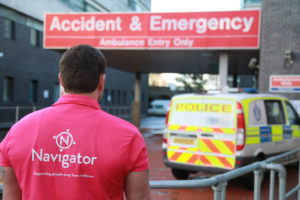 Navigators reach out to victims of violence at their most vulnerable point in the aim of helping them to change paths
Yet each of the VRU members who spoke to Apolitical was clear that specific interventions could not end violence in Scotland, which, while dramatically lower than a decade ago, is still approximately at the level of England and Wales. The reform the VRU helped engender was systemic, ranging from central government to community police officers.
“When we hear other forces talking about a public health approach to policing, they’re not quite getting the message: it’s a public health approach, full stop,” said Linden. “The public health approach is about having everyone deliver what they need to deliver, whatever their specialities are.”
Collaboration is the foundation without which public health approaches cannot succeed. At a governmental level, a formal collaboration between the health and justice departments has been integral to taking public health approaches to violence prevention nationwide. (Both Carnochan and Linden admit that much work remains to be done.) Departmental overlap also allows for collaboration in ways that are unique to Scotland. The Director-General for Justice is also in charge of education. “In that instance, you have natural collaboration,” said Linden.
"Over 50% of the prison population has been through the care system"
Also vital to the success of the public health approach was the unification of Scottish law enforcement under the aegis of Police Scotland in April 2013. According to researchers who spoke to Apolitical, ideas have germinated across the nation in a way that has not happened in England, where London alone divides policing between its 32 boroughs.
“The public health strategy in Scotland includes minimum unit pricing for alcohol (starting in May), raising the age of criminal responsibility for children, and a review of the care system because over 50% of the prison population have been through the care system,” noted Carnochan. That level of systemic reform is no quick fix, though it might be the only way to ensure lasting change.
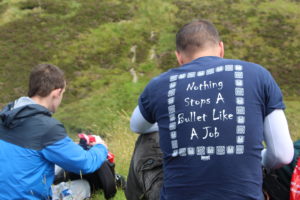 A VRU-affiliated support worker leads a hillwalking trip.
South of the border
Asked whether the VRU’s work could be replicated in London, Carnochan and Linden are cautious.
“You cannot just plug-and-play,” said Linden. “You have to understand what your problem is.”
First, the nature of violent crime in Glasgow lent itself to public health intervention. Christine Goodall, a surgeon and founder of a partner organisation of the VRU, Medics Against Violence, said: “The Scottish gang problem differs significantly from elsewhere in that it’s not strongly associated with organised crime. It’s a not-for-profit activity that tends to involve a lot of young teenagers indulging in recreational violence.”
According to Susan McVie, Professor of Quantitative Criminology at the University of Edinburgh, London’s knife crime epidemic also faces distinct challenges relating to policing.
“In London, part of the underpinning problem in community-police relations is driven by racial tension, which we don’t have – at least in the same way – in Scotland,” she noted.
London’s knife crime victims are overwhelmingly young, black men. Community policing is a precarious task, due to well-documented problems, including stop-and-search policies that target black men six times more than their white counterparts and widespread allegations of institutionalised racism.
According to McVie, “Scottish policing has always prided itself on being a more consensual model of policing – relationships between communities and the police in Scotland traditionally have been very good, ironically even in those communities where you had very high levels of violence that were policed heavily because of gang-related incidents and knife crime."
“The public health model could work in London, but it may not be appropriate for the police to be the lead partner given the level of tension in communities.”
(Picture credit: Scottish Violence Reduction Unit)
Edward Siddons
edward.siddons@apolitical.co
Correction: This article originally claimed that there were no fatal stabbings in Scotland in 2017. This was incorrect: in fact, there were no fatal stabbings of people under the age of 20. We regret this error.
Make sure to share your own thoughts with the author by leaving a comment below

Log in or sign up to continue the conversation