

This article is written by Adam Parr, former Oxford Blavatnik School lecturer and chief executive of the Williams Formula One team.
In my last article, I wrote about how strategy is a process. Specifically, strategy is the process where we overcome obstacles to achieve our goals. It’s a process of thinking and acting. You analyse your obstacles and resources, reflect on your past actions, and think about your next actions.
So how can you be strategic?
Your strategic horizon
Imagine you’re looking out at the future. You’re thinking about what you want to achieve and how you’re going to get there.
Start by thinking about 3 dimensions: technical, environmental and human.
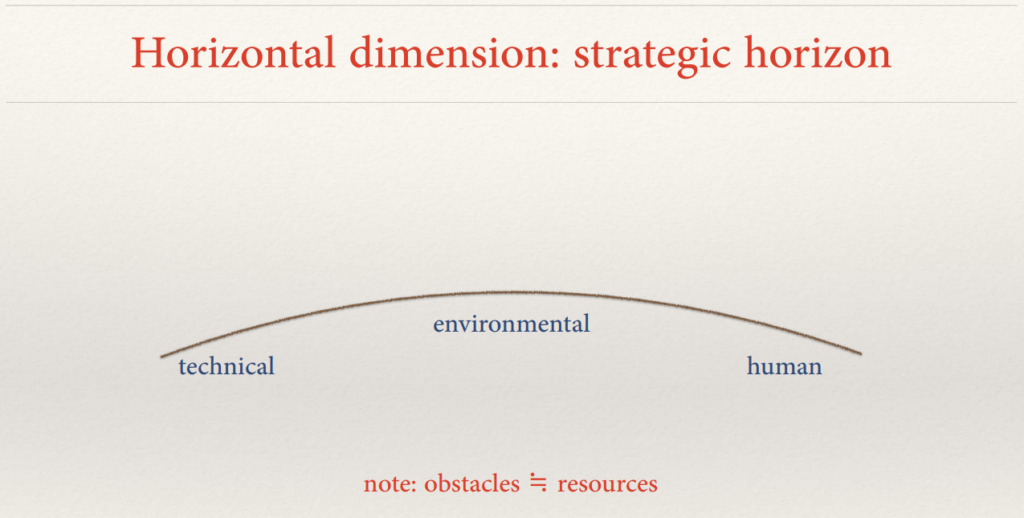
This is your strategic horizon. If you want to change the world, these are the 3 types of problems you’ll face.
Let’s say you want to redesign electric batteries.
Your technical obstacle will be: can you design solutions that are less damaging to the environment? This will be what you spend 99 percent of your time on.
But the second dimension is environmental. What budget do you have? What’s the regulatory environment? What is the market like? These things are mostly out of your control, at least in the short-term.
The third dimension is human. Even if you have a really good solution for something, it doesn’t mean people will use it. There will be people pushing back. They could have business interests, or they could be “satisficers” — the foe of all new product developers and other people promoting change — people who know they have a less satisfactory product but don’t want to invest the time or effort in making a change.
Technical, environmental, and human. These are the 3 categories of obstacle, but they’re also the 3 categories of resource. Your resources can be your technical capabilities and those of the people around you. Your environmental resources are the things that help you get the job done: the labs you work in, grants you can apply for, or changes in the law that could help you. Your human resources are people that can help you.
Every obstacle can turn into a resource, and every resource can turn into an obstacle. People can go from being your ally to your enemy, and vice versa.
The strategic hierarchy
The vertical dimension of your strategy is the strategic hierarchy. Your policy goal is at the top, followed by strategy and operational art, with tactics at the bottom.
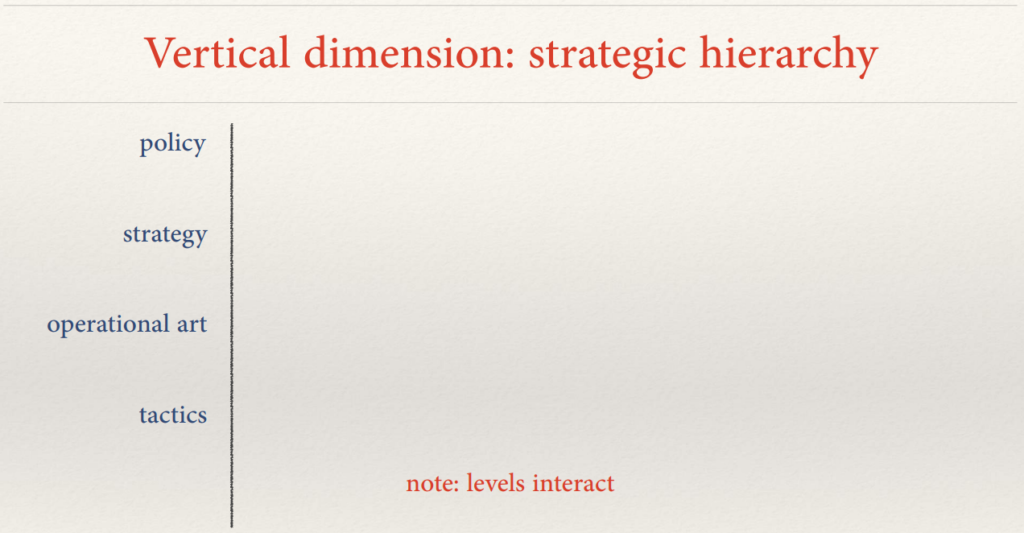
To illustrate, let’s stick with the example of redesigning electric batteries.
Our policy is to protect the environment and make the world more sustainable.
Our strategy is how we go about doing this.
Operational art is weaving together a series of initiatives that together create momentum. If you want to change the world, you need momentum and movement. (The concept was developed in the Soviet Union after the Russo-Japanese War, when they realised that in a complex industrial world, a tactical success doesn’t necessarily turn into a strategic success.)
Tactics are the lowest level in your strategy. A tactic is a negotiation, a transaction. You weave tactical steps through operational art into strategic success. But, remember, even tactical steps need to be thought-through in terms of process. A good negotiation, speech, presentation or pitch is never spontaneous.
Focus on the strategic/human
When you put these 2 dimensions together, you get a graph with a X axis and Y axis.
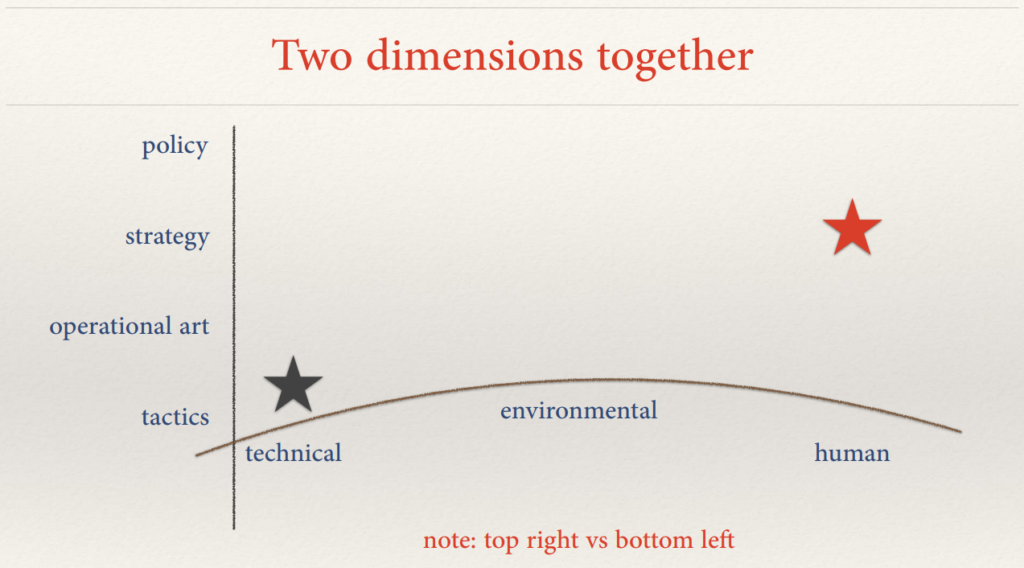
The bottom left, where the technical and the tactical come together, is where everyone focuses all their attention. But most strategic failure arises because this is the wrong place to focus.
The top right, strategic and human, is where you need to be, particularly if you want to change the world.
Some of the most influential people in this world don’t have a good technical understanding, but they appeal to a human level very well. Appealing to a human level is incredibly powerful.
You can be really good at the tactical/technical and still lose. In fact, it is well understood in the military that strategic excellence is never sufficient to deliver strategic success.
So what are the key takeaways on thinking strategically?
- Start thinking of strategy as a process of thinking and acting, not a plan.
- Use the horizontal and vertical dimensions to think in the right order about strategy. Think broadly about the obstacles and the resources available to you. Use your resources.
- Focus on the human and the strategic, as well as the tactical and the technical. A good strategy will survive tactical setbacks. But a bad strategy will never be rescued by good execution.
In my next article, I’ll show how you can translate your strategic thinking into strategic action. Through thinking strategically about your career, you can practice thinking in new ways about your goals — and taking immediate action.
👋 You can write an article like this one! Share your thoughts with a community of public servants. Learn more
(Image Credit: Unsplash)
Make sure to share your own thoughts with the author by leaving a comment below

Log in or sign up to continue the conversation