
This post is written by Natalia Herbst, Senior Advisor at Vice Presidency, Buenos Aires Legislature, with support from Kieshka Preuilh.
The problem: We need to increase the number of people that recycle in Buenos Aires.
Why it matters: There is space to increase the current recycling rates, leading to an improvement in the city’s waste management, and broader environmental impacts by opening a local dialogue about sustainability and its relevance.
The solution: Transforming the approach to recycling by creating a multidimensional recycling programme that combines cultural transformation and improvement of the waste management service and its transparency.
For the cultural transformation chapter of #BARecycle our strategy focused on lowering barriers that would incentivise behaviour change. These kinds of transformations often prove challenging as they involve modifying recurrent habits that are part of people’s routines and practices that happen in private spaces such as home or work. Our efforts to affect these spaces - usually out of reach to governments - included several complementary actions:
Making recycling easy: As we identified the need to bring the system closer to people, we reconfigured the design of the location-of-disposition network, to bring one green container in which to dispose of recyclables to a maximum distance of 150 metres of every household in the city.
Provide tools: As a complement to making recycling easier by bringing disposition points closer to everyone, we knew 34% of our citizens reported “not having a container” as their barrier to recycling. As a response we launched the Ecotacho (ecobin), a tool to be distributed to every household in the city, designed to i) contain clean and dry recyclables, ii) be easy to transport, iii) be easy to store without taking space when not used. We designed a territorial strategy in partnership with borough presidents and leading NGOs in the sustainability field to approach the task of knocking on every door in the city - during a pandemic - to offer this element and raise awareness about the relevance of recycling, as well as provide information on the basics about how to do it. In the 19 weeks from late August 2021 until the end of the year, we gave out 206,000 Ecotachos, and we are looking to complete the remainder of the one million homes in the city during 2022.

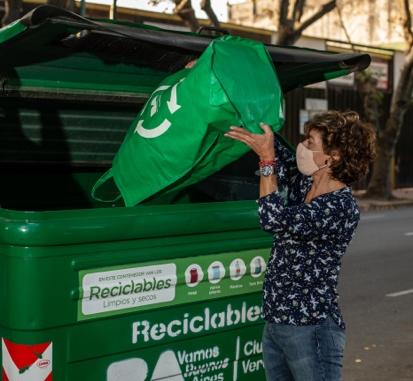
The pictures show the Ecotacho and the recyclables disposing containers installed within 150 metres of every household
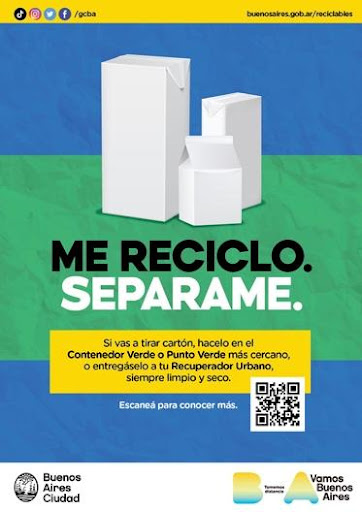
- Mass communication campaign: A mass communication campaign was launched with a presence across the city and in mass media, focusing on a first phase of reminding citizens which materials (paper, cardboard, metal, glass) could be separated at origin to be recycled.
Incentives: A points-earning system called Ecopuntos (ecopoints) was developed in which people could earn points by sharing photos via the city’s chatbot every time they disposed of recyclables at the city’s locations. These can later be exchanged for products that support sustainable habits such as bicycles, compost bins, seeds, etc. The program reached more than 3,100 participants in 2021, 29% of whom are part of the Green Ambassadors network.
Launch of the Green Ambassadors network: In April 2021 we launched a programme to create local neighbourhood networks among highly involved citizens with the sustainability agenda that wanted to find spaces of collaboration and/or volunteer on our territorial work. By the end of the year, we counted with the participation of 5,100 people, of which the average age is 41 and 24% are under 30.
Transparency: Another major barrier to people recycling was their distrust about what happened with their separated waste. For this, we increased the communication around the work done at the Green Centers run by waste picker co-ops and at the city’s state of the art Recycling Centre. In this case, we organised daily visits to its five plants (organics, PET, MRF, arid, forestry), and developed a virtual tour people can explore online to get to know more about the installed capacity the city has, and how their recyclables are treated to be reintroduced into the economy.
Creating constant conversation and awareness-raising: Investing in creating networks and providing resources (pamphlets, training, workshops, certifications) in diverse settings including schools, universities, companies, cultural events, sharing best practices with other local governments.
Penalties: During 2021 we deployed a surveillance team that inspected macrogenerators’ facilities to assess whether they were complying with the rules that mandate separate recyclables. During this process, warnings were issued to those that didn’t comply, who will be re-inspected this year subject to penalties.
"A positive surprise was the high rate of responsiveness to the Ecotacho distribution campaign."
The challenges
Among our challenges we found we fell short at being able to respond to the amount and speed of the Green Ambassador's demands as they wanted to implement further actions than the ones proposed by government. This led to an adaptation in our role from proposing the agenda and implementing it, to brokering it and focusing more on creating the platform for them to connect, rather than on setting the agenda and organising almost every initiative. This led to an increased citizen-driven impact of the network.
Another aspect that has proved difficult has been going beyond the niche audience that will respond and engage to government initiatives because they are already interested in the sustainability agenda, to also reach the currently disengaged citizens that we need to reach our 80% recycling target by 2023. In this regard, we are confident that the expected ease of Covid restrictions planned for the remainder of the year will allow us to participate in awareness-raising campaigns in massive-gathering opportunities unavailable since the beginning of the programme such as sports events, music festivals, cultural gatherings, etc.
On the other hand, a positive surprise was the high rate of responsiveness to the Ecotacho distribution campaign. In the Covid-19 context, a main concern we had at the planning phase was the potential resistance of people to engage with government agents at their door. Contrarily, we had a 40% rate of reception of the Ecotacho when knocking on doors, on average higher than other similar campaigns in the city. This is highly relevant because this particular aspect of the programme aims to reach every household in the city, opening a conversation about sustainability with the portion of porteños (residents) who were not previously engaged or aware of the relevance of recycling and sustainability and the services the city has to offer in this realm.
👋 You can create a post like this one! Share your thoughts with a community of public servants. Learn more
(Image Credit: Unsplash)
Make sure to share your own thoughts with the author by leaving a comment below

Log in or sign up to continue the conversation