
_This post is written by Diana Alarcón, Eduardo Zepeda, Juan Angel Martínez, Juan Carlos Molina and Marco Antonio Ramírez at the Coordinacion de Asesores y Asuntos Internacionales del Gobierno de la Ciudad de Mexico. The paper reflects the personal views of the authors. _
The problem: One of the greatest challenges for sustainable development is the implementation of consistent policies over the long term.
Why it matters: Failure to do so will not address the structural problems that perpetuate inequalities and environmental degradation.
The solution: Building a shared vision of the city we want in the future provides the social consensus needed for a consistent allocation of resources and efforts over the long term.
Mexico City is a thriving city. Its history, architecture, museums, universities and much more bring visitors from around the world. Its historical buildings, a sophisticated and diverse cultural tradition, the wealth of museums, and rich gastronomy are among the features that attract national and international tourists.
Beneath a dynamic city, however, lies a very unequal metropole across all dimensions of welfare. Inequality goes well beyond income distribution to include access to proper housing, water, education, health services, transportation, green areas for recreation and security. Economic and social inequality deepened in the last 30 years of neoliberal policies characterised by a retrenchment of the economic and social role of the state, shrinking budgets for social infrastructure, and privatisation of basic urban services.
"Building a prosperous and sustainable city for all requires a shared vision and dedicated resources over the long term to reverse entrenched inequalities and to restore balance to the natural environment."
In December 2018, a new government was inaugurated in Mexico City. Mayor Claudia Sheinbaum Pardo is introducing a completely different vision of development inspired by the radical transformation led by President Lopez Obrador at the national level. The government program 2019-2024 for Mexico City builds on the promise of decreasing social inequalities while restoring environmental sustainability: a city of Innovation and Rights.
The city government is faced with multiple challenges. About half of the working population is in the informal sector; about one quarter of households do not have water at home on a regular basis, even though they have a connection to the city water supply system; public schools are in need of regular maintenance and new high schools and upper education facilities are needed to enroll young people in marginalised areas; one in five families live in crowded housing and poor neighborhoods often lack proper sidewalks, street lighting, parks and green areas; people, especially poor people in the periphery, invest one hour and more to go to work. These are among the main social challenges the current government is set to address.
Equally challenging problems need to be resolved to bring environmental sustainability to a city that has been consuming its rich endowment of natural resources. Water sources are overexploited; hundreds of hectares of forest are lost every year to illegal logging and unregulated real estate development; air quality does not meet WHO standards three-quarters of the year; more than three-quarters of waste in the city is disposed in sanitary confinements without treatment; and a rapid loss of biodiversity is a threat to indigenous animal species.
Building sustainable development pathways
Building a prosperous and sustainable city for all requires a shared vision and dedicated resources over the long term to reverse entrenched inequalities and to restore balance to the natural environment.
The Mexico City government’s programme from 2019-2024 has started addressing some of the most pressing development challenges. Public investment increased substantially, when compared to the previous city government. The Covid-19 emergency was confronted with an unprecedented expansion of health facilities and universal access to the health system. Modernisation of urban infrastructure is focusing on the most marginalised areas to improve public transportation, water and sewage systems, street lighting and school maintenance. On the environmental sphere there are ambitious programmes for the restoration of green areas and public parks, substantive support to rural areas and people working within; restoration of remaining live rivers in the city; among many other actions. But building an equitable and sustainable city requires the continuation of these kind of actions into the future.
Citizens in Mexico City will soon engage in the discussion of a 20-year Development Plan that will be submitted to the City Congress later this year. It presents a great opportunity to generate the social consensus needed for the implementation of a long-term development plan able to guide the allocation of financial resources towards building an equitable and sustainable city. The figure of the “Doughnut” provides a very useful graphical representation of where we are and where we want to go to address the development challenges facing the city.
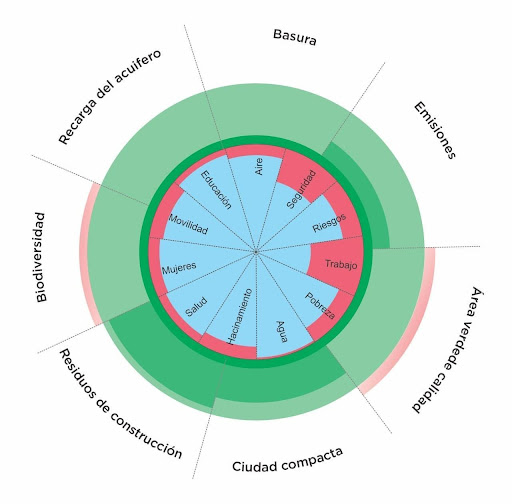
Kate Raworth’s "doughnut economics" provides a powerful tool to communicate development challenges. The circle in green represents a situation where all basic needs are met and there is sustainable use of natural resources. The green “doughnut” is the ideal society where people want to live. Figure 1 presents a "doughnut" for the current situation in Mexico City. It incorporates 11 social dimensions and seven environmental challenges.
"A long-term plan with a clear vision of the direction in which we want to take the development of the city can be represented in the “doughnut” 20 years from now"
Filling in the gaps
The gaps (in red) in the inner circle represent the effort that needs to be done to go from the current level in each particular dimension of welfare to the level where we want to be in the future. Taking the example of education, the proportion of youth that has completed 15 years of formal education (middle-high school) in the city in 2020 was 27%. If we want to increase that proportion to 80% in 20 years, we know we have a big gap to fill. Furthermore, taking that proportion to 99% of young people would require additional efforts beyond the 20 years plan. Following the same logic for each dimension, we have a good representation of the challenges to be met in all priority dimensions of welfare; all the red flags in education, health, poverty, housing, water provision, the conditions of labour, public transportation, air quality, and security.
A similar logic applies to the red areas outside the doughnut: they represent infringements on environmental sustainability. In Mexico City, overexploitation of water resources, for example, is compromising water availability in the future; restoring sustainability to water resources will need a great effort to reduce overexploitation of the aquifers and a more efficient water distribution system until we touch the outer perimeter of the doughnut and the water balance is restored. Similarly, public policies would have to address the key dimension of the environment to restore sustainability: GHG emissions, the loss of biodiversity, and waste disposal, to name a few.
A long-term plan with a clear vision of the direction in which we want to take the development of the city can be represented in the “doughnut” 20 years from now (Figure 2). The implementation of ambitious yet realistic policies in all priority areas would result in a much better place to live in. Still some gaps, mainly in the social dimensions of development, will require the continuation of effective policies to reach the aspirational level of development. Comparison between the current and future “doughnuts” provides a clear and powerful image of the efforts needed to achieve socially desirable goals for improved welfare and environmental sustainability. These graphical representations help to stimulate a discussion about the policy options and the cost of closing current development gaps.
Clearly, 20 years are not enough, but smaller gaps (red areas) in both the social and environmental dimensions of development are pointing in the right direction. Ending corruption and an efficient management of public resources, consistent with a shared long-term vision of development will take us much closer to the green area of the circle, the space where we all want to live in.
The purpose of this exercise is to present a suggestive picture of our development challenges and to facilitate the public debate on policy options and the cost of alternative routes to development that will help us identify the issues to tackle by public policies now and in the future.
Figure 1. Mexico City “Doughnut” in 2020

Figure 2. A plausible “Doughnut” for Mexico City in 2040
👋 You can create a post like this one! Share your thoughts with a community of public servants. Learn more
(Image Credit: Unsplash)
Make sure to share your own thoughts with the author by leaving a comment below

Log in or sign up to continue the conversation