
This article is written by Marion Lean. Marion is a textile design researcher and co-design coach leading policymakers who are engaging real people and communities to build better outcomes for Future Farming using design at the Department of Environment Food and Rural Affairs. Following the posting as Design Researcher for the Rural Gigabit Connectivity Programme at DCMS she also continues to explore modes for participatory rural research with the Centre for Digital Citizens at Newcastle University.
- The problem: Policymaking has traditionally been carried out behind closed doors in government.
- Why it matters: It is vital policies reflect people’s lived experiences and governments are open to new approaches that enable people to be heard.
- The solution: Apply the principles of data feminism to help to bring voices into the room that are typically excluded in policymaking.
I am a design researcher working in the Future Farming and Countryside Programme; my specific role is a co-design coach – I support policy teams to develop approaches for listening to and collaborating with members of the farming community. I also design and deliver different sorts of training experiences on creative and design methods for inclusive policymaking.
The aim of this article is to share my experience of neurodiversity at work and how my creative practice applying the principles of data feminism has helped me to express not just myself, but to also bring the voices of those who are not typically included as part of policymaking into the room. As an example of the type of work I do, a project I am particularly proud of was a piece of work undertaken during Covid-19 when we wanted to find out about the experiences of school children living with limited internet access. Travelling to locations to speak to families directly wasn’t possible so I had to be very creative to develop tools for collaborating which were both ethical and did not rely on internet connection (so no video calls!).
What is data feminism?
In their book, ‘Data Feminism’ (2020), Catherine Ignacio and Lauren F Klein offer seven “principles” which are informed by intersectional feminism as provocations to encourage us to challenge conventions on power using data science.
For the purpose of this article, I will focus on the principle ‘Elevate Emotion & Embodiment’, which particularly resonates with my experiences exploring my own neurodiversity. This principle encourages us to consider alternative forms of knowledge and understanding which use the body – for example, using the senses, emotion and movement.
“Data feminism teaches us to value multiple forms of knowledge, including the knowledge that comes from people as living, feeling bodies in the world.” (Ignacio & Klein, 2020)
Learning from lived experiences has become a bit of a buzzphrase recently but the methods and approaches to learning from different groups are really an art! At Defra, I lead on design coaching in a centre of excellence inside Defra which is championing methods for bringing people’s lived experiences into policymaking. A big part of this is learning about and trialling different methods for listening to people and helping people to feel heard so this is an area that I focus on learning more about.
Since I learnt about the principles of data feminism, I’ve expanded my own understanding of the value of different types of information experience.
As I was unable to travel to learn from rural communities during the project I undertook during Covid-19 lockdowns, I had to think around corners to come up with ways to listen to people, and one low-tech solution was to use postcards. These were really rewarding to receive in the post and provided an opportunity to interact with a different sort of tangible data experience – I could hold the cards and there was something really special about seeing different sorts of handwriting, which feels somewhat rare these days!
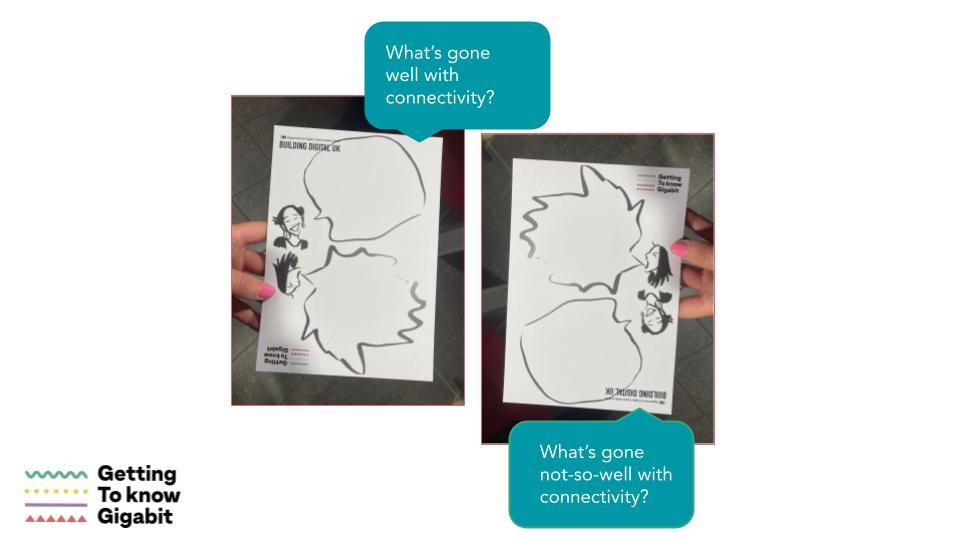
To get to this solution I experimented with a range of different ideas, sketching and testing prototypes and ultimately collaborating with different creative practitioners to develop a range of tools to use in hearing from and telling stories for policymakers as stakeholders. For more information about this specific piece of work please see this article.
How data feminism impacted understanding my neurodiversity
In the work I do, I am both embodying the principles of data feminism and using the power of data – this takes different forms, be it stories and experiences, visuals and objects or numbers to express myself as part of who I am at work. My experience of being neurodiverse is that it was not very apparent in previous roles which had mainly been in the creative and academic sectors – in studios and art school settings there is a lot more space to make a mess, and well, just be yourself.
At first in the policy environment, I tried to conform, but I felt stifled. I then worked with a really great line manager who helped me to:
a) get a diagnosis - this was facilitated through Occupational Health b) source a neurodiversity coach to help me work out the best conditions to deliver creative work and to help people to understand how to work with me. For example, I’m best in very intense and short bursts so sometimes people have expected that they’ll hear back in a week from me on a challenge but I’ve instead scrapped all my afternoon plans and gone to town developing some suggestions which I deliver the same day c) understand how my physical environment is really important to me – anyone sitting near me will know I spread out! I have explored different settings including home, offices and co-working spaces, but a big aspect is knowing that I’m trusted to be doing good work wherever I am and my colleagues are open to me finding inspiration at events or workshops that I can bring back to our practice.
Since I learnt about the principles of data feminism, I’ve expanded my own understanding of the value of different types of information experience. For example, I found the best way for me to understand more about ADHD is through memes, visuals and podcasts. The iceberg on the right (in the image below) is a collaboration with a colleague at Defra which we found to be a useful exercise for us to both understand more about ourselves (not everyone with ADHD is the same!) and to help others understand more about ADHD.
 The ADHD Iceberg by @FINUCCINIALFREDO
Embracing equity
This year’s International Women’s Day theme was embracing equity; I feel very fortunate to have been able to access not the same resources as colleagues but actually, the appropriate resources and support I need to deliver the work I do. Additionally, through my work with the Cross Government Policy Design Community, I have the opportunity to also help create the conditions for other designers and creative practitioners to thrive at work in the Civil Service.
Alongside my formal roles leading on the application of novel listening methods for policy development, I have used this time to develop my practice of designing and hosting ‘pop-up design studios’. The aim of these is to bring people together, learn new things and try out creative activities in a safe space.
👋 You can write an article like this one! Share your thoughts with a community of public servants. Learn more
(Image Credit: Unsplash)
Make sure to share your own thoughts with the author by leaving a comment below

Log in or sign up to continue the conversation