
This article is written by Miki Stricker-Talbot, a featured Apolitical contributor and Intrapreneur at the City of Edmonton, Canada. This article is part of her series on facilitating change from within the public sector
“There is a general understanding that innovation in the public sector — while the result of complex institutional and social dynamics — is fundamentally an individual human activity.” — OECD Observatory of Public Sector Innovation
In recent years public sector innovation has been a hot topic in government circles.
A plethora of wonderful tools, techniques, reports, frameworks, and approaches to support public sector innovation have been created, and I encourage you to check organisations like Nesta, OECD, The Centre for Public Impact, and What Works Cities for some excellent tools, methods, and frameworks. There have also been explorations about the concept of public entrepreneurs and how organisations can create the conditions for intrapreneurs to thrive.
But if we accept the premise that innovation in the public sector is indeed an individual human activity, as the OECD says, then we should be curious to ask: exactly who are these positive deviants? Why are they working in new ways to make the public good better? How and in which ways does the desire to innovate manifest within an individual public servant? What is the internal process for public servants that inspires them to want to make change from within their organisations?
After engaging in conversations with hundreds of government innovators since 2006, and hosting a community of practice for change agents at the City of Edmonton since 2016, I have begun to identify patterns in the feelings and emotions of civil servants that bring them to the place of wanting to make change for good. I have mapped these patterns, and on that basis created a framework for understanding how the desire to innovate manifests itself in individual civil servants. This evolution can be understood as the Personal Progression for Government Innovators.
There are 5 primary states along this Progression, along which individuals can move — Regressionary, Stationary, Fragmentary, Revolutionary, and Multi-Luminary — and each state is rooted in a different emotional place. Let’s examine each in turn.
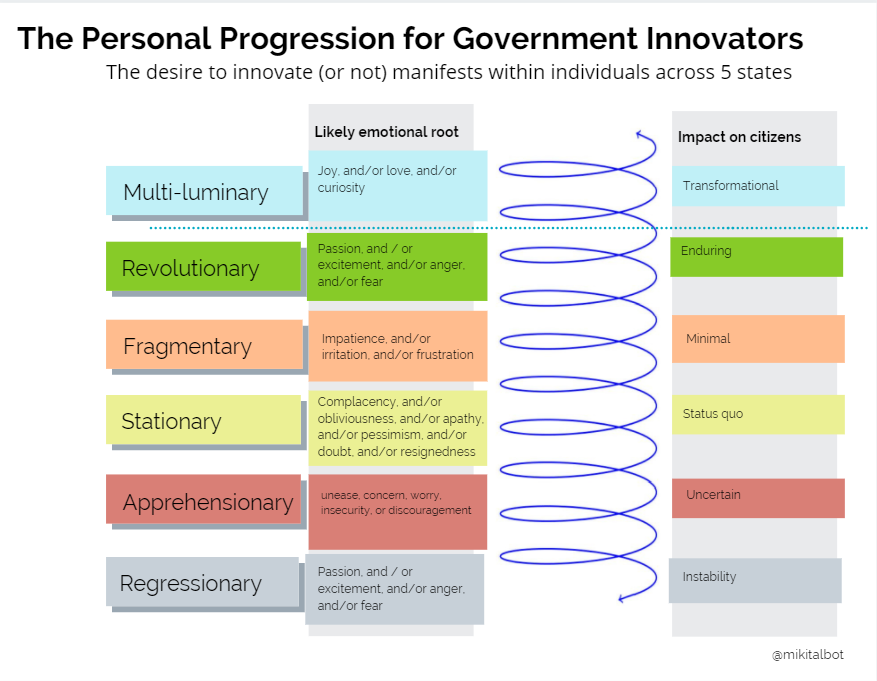
A diagram showing multiple boxes in different colours and a spiral to demonstrate the Personal Progression for Government Innovators
Regressionary
Civil servants in this state embody the sentiment: “let’s tear it down and go back to how it was before.”
These individuals demonstrate a longing to return to elements of the past that they see as better than the current state. The dominant emotions that manifest within individuals in this state are passion, excitement, anger and fear. Individuals might embody this state if:
- there has been a change in leadership (either in ruling parties or within government administrations or on specific teams);
- they fear a loss of power/agency or feel that they have lost power/agency;
- there have been — or there is the risk of — cutbacks;
- there has been a corporate reorganisation;
- they have experienced workplace trauma (likely in the form of bullying); or
- there is fighting between individuals or teams.
An individual in this state will long for an idealised past.
Operating from this state results in instability for citizens, because citizens are likely to experience these changes as being done “to them,” as opposed to being done “for them,” “with them,” or “by them.”
Apprehensionary
Civil servants in this state embody the sentiment: “I’m really not sure about this."
The dominant emotions experienced by individuals in this state are unease, concern, worry, insecurity, or discouragement. Individuals might embody this state if:
- they do not feel they have agency in their work, or in decisions that impact their work;
- they fear a loss of power/agency; or
- they feel like they are being left out or left behind.
No changes or innovations are made from this state. The immediate impact on citizens is uncertain.
Stationary
Civil servants in this state embody the sentiment: “everything is fine; we can make do as is.”
This can be understood as government’s natural state of being. The dominant emotions that manifest within individuals in this state are complacency, obliviousness, apathy, pessimism, doubt, or a feeling of resignation. Individuals might embody this state if:
- the current way of doing things is benefiting them in some way;
- they have been working in government for a long time;
- they are not engaged in their work; or
- they tried to make a change within the organisation and were met with resistance.
No changes or innovations are made from this state. The immediate impact on citizens is status quo, for both good and bad. In the long term, of course, external factors do change over time, regardless of what happens within the organisation. Depending on the specifics of the situation, the change could impact citizens in any of the ways outlined within diagram 1, but this happens at due to external factors, and not because of any actions taken by civil servants in the Stationary state.
Fragmentary
Civil servants in this state embody the sentiment: “let’s make it better than it is now.”
The dominant emotions experienced by individuals within this state are impatience, irritation, or frustration. Individuals within the Fragmentary state sense that there is a problem, and that something can be done to fix it. Individuals in this state are likely to see the potential for “quick wins,” and often arrive at this state if:
- they are directly experiencing a specific problem with (or within) “the way things are done around here,”
- have been told about a specific problems with (or within) “the way things are done around here”
Changes and innovations made from this state have minimal impact on citizens as they generally address symptoms of problems, not underlying causes.
Revolutionary
Civil servants in this state embody the sentiment “let’s change the system.” The dominant emotions experienced by individuals within this state are passion, excitement, anger, and fear. Individuals often find themselves in this state if:
- their efforts to make change from the Fragmentary state have been unsuccessful, or have been met with resistance;
- they feel they have a personal stake in the change or innovation they are trying to realise;
- they have experienced workplace trauma (likely in the form of harassment, discrimintation, or bullying); and/or
- they are highly engaged employees.
Changes and innovations made from this state have the potential to have an enduring impact on citizens because they start to consider the underlying causes of challenges. The keen-eyed reader may have noticed that individuals in the Revolutionary state experience the same dominant emotions as individuals in the Regressionary state.
This is because the Revolutionary state and the Regressionary state are both shadows and mirrors of each other, making both states tricky to navigate. We’ll unpack this in a future post.
Multi-luminary
Individuals in this state embody the sentiment: “let’s attune to what wants to emerge.”
Individuals in this state often experience the dominant emotions of love, joy, and/or curiosity. Individuals may arrive in this state if they:
- embody the principles of systems leadership and adaptive leadership;
- have worked through issues of power, and continually work through issues of privilege;
- build emotional, intuitive, and spiritual self-awareness;
- understand the self as an instrument;
- develop lifelong learning, unlearning, and relearning habits; and/or
- think in systems
Changes and innovations made from this state have a transformational impact on citizens because they shift paradigms.
Some Things to Consider
Although this progression might look static, it is not. There are a few important points to consider when applying the framework to your own work.
1. The progression is personal
The way any two individuals interpret this progression will not be the same. Further, an individual’s personal understanding of this scale will shift over time. What that means is that I can't tell you what a revolutionary act is, for example, because your level of comfort with risk might be very different than mine. But in the context of trying to make change from within government, your revolutionary act of, say, speaking truth to power, is no less revolutionary as my act of trying to make a change to a form. All variations and interpretations of revolutionary acts are required to make positive change for and within government.
2. Context is everything
The context surrounding an individual will shape their understanding of what it means to operate from any of these states. In the same vein as above, if you work in an environment that encourages open conversations and testing of new ideas, chances are your definition of a revolutionary act will look very different from someone working in a particularly rigid organisational structure.
3. This is a relative scale
This progression is not an absolute scale. That is to say, a person does not begin at a particular set point on the scale and only travel in one direction.
Instead, it is a relative scale, meaning that a person can start at any given point on the scale, and can progress in either (or both directions). A person can also exist at multiple points on the scale at any moment in time, depending on the subject at hand and their personal relationship to the topic. So, for example, a person who is particularly passionate about climate change might find themselves in a Revolutionary place while trying to implement a program to reduce waste.
That same person might find themselves in a Stationary place when it comes to implementing changes to a new corporate reporting process. (However, the person who is the driving force behind the corporate reporting change might be in their own Revolutionary place about their particular change, which could result in interpersonal conflict.)
I will be back next week with part 2 of this article to offer a personal story about a trip I took along the progression from the Fragmentary State to the Revolutionary State, as I tried to make a change to “make things better than they are now.”
This framework is still very much a work in progress, and will undoubtedly shift and evolve as more things that were once hidden become clearer. I warmly welcome your thoughts and insights. What is emerging for you? What have I missed? Where might this go from here? Catch me via email or twitter.
With thanks
I'd like to acknowledge the hundreds of civil servants who have trusted and entrusted me with their stories since 2006. Your efforts to enact change for the public good in government are needed, noticed, and deeply appreciated. I’d also offer my sincere thanks to the dear and brilliant people who helped sharpen my thinking to refine this progression in recent months (in alphabetical order): Anders Broend, Mark Cabaj, Milton Friesen, Abe Greenspoon, Ian Howatt, Imran Hussain, Dr. Jo-Louise Huq, Chryssa Koulis, Raffaella Loro, Naomi Mahaffey, Annand Ollivierre, Beth Sanders, Nour Sidawi, Bart Szopiak, Aaron Talbot and Sam Villis. You are all aces in my book.
Miki Stricker-Talbot is a featured Apolitical contributor. She writes a monthly article for Apolitical's readers, and this is the first article in her series about facilitating change from within the public sector. To find out more about how you can become a featured contributor, please get in touch.
Resources, references, and additional inspirations
- Michel Bachmann, Start with Who
- Mee-Yan Cheung-Judge, The Self as an Instrument — A Cornerstone for the Future of OD
- Marco Daglio. How Do Public Sector Organizations Innovate?
- Frederic Laloux. Reinventing Organizations: An Illustrated Invitation to Join the Conversation on Next-Stage Organizations.
- Donnella H. Meadows, Thinking in Systems: A Primer
- Yoko Ono, [Wish Tree](https://en.wikipedia.org/wiki/Wish_Tree_(Yoko_Ono_art_series)
- Margaret Wheatley and Deborah Frieze, Using emergence to take social innovation to scale
- The League of Intrapreneurs
- The Long Now Foundation
- The Presencing Institute
- The Tamarack Institute
This article has been updated on 15/02/2021 to include new reflections from the author, most prominently an added section on the "apprehensionary" state.
👋 You can create a post like this one! Share your thoughts with a community of public servants. Learn more.
(Picture credit: Unsplash)
Make sure to share your own thoughts with the author by leaving a comment below

Log in or sign up to continue the conversation