
This paper came out of a partnership with UNICEF and Apolitical for an exchange with over 100 policymakers from around the globe on how we can incorporate intersectional gender equity in the wake of COVID-19.
You can view a recording of the exchange and see more information on our Gender Mainstream Learning Exchange page. Apolitical will also be launching its Gender Mainstreaming course soon! We will update all members when it is live.
Top findings
This paper assesses how gender mainstreaming can best support efforts to build back better from the COVID-19 crisis with intersectional gender equity.
- Effective gender mainstreaming within organisations is both top-down and bottom-up, with senior leadership and middle managers playing a key role.
- All staff, including leadership, need to share common values of gender equality as well as skills and knowledge to integrate these principles in their work.
- Gender expertise is critical to supporting mainstreaming efforts, including to support gender analyses and prioritisation efforts.
- Current gender mainstreaming measures do not sufficiently capture the changes required to deliver transformative programming and address disparities. Updated measures are needed to ensure we effectively evaluate gender-transformative impacts and not just processes.
- Innovations — such as use of a human-centred design approach — and an understanding of what drives individuals are key to effective gender mainstreaming.
Introduction
This paper was produced in July 2020, approximately six months into the global COVID-19 pandemic — which both highlighted and exacerbated various inequalities, sparking calls for governments and organisations to ‘build back better’ in its aftermath.
The findings are presented in this context, and that of UNICEF’s previous work on gender mainstreaming. Most notably, this includes reference to the 2019 evaluation of previous Gender Action Plans (GAPs), which found that mainstreaming efforts required further attention. In addition, the evaluation noted that UNICEF’s targeted programming (for adolescent girls) had shown more tangible results than integrated efforts.
Both GAPs (2014-17 and 2018-2021), evaluated in 2019, sought to improve the internal environment for gender mainstreaming within UNICEF, as well as aiming to enhance the integration of gender equality within programming.The evaluation found that both GAPs included clear definitions and a developed theory of change, as well as close alignment to other global frameworks and the organisation’s strategic planning. However, the vision of gender equality provided was found to be pragmatic rather than aspirational, and the adopted programmatic structures risked reducing the complexities of gender equality into siloes.
Also framing this paper is UNICEF’s commitment to gender transformative programming, defined as that which "aspires to tackle the root causes of gender inequality and moves beyond self-improvement among girls and women to redress power dynamics and structures that serve to reinforce gender inequalities.” [1]
With an upcoming opportunity to influence UNICEF’s next Gender Policy, this paper highlights key considerations for effective gender mainstreaming.
Exchange
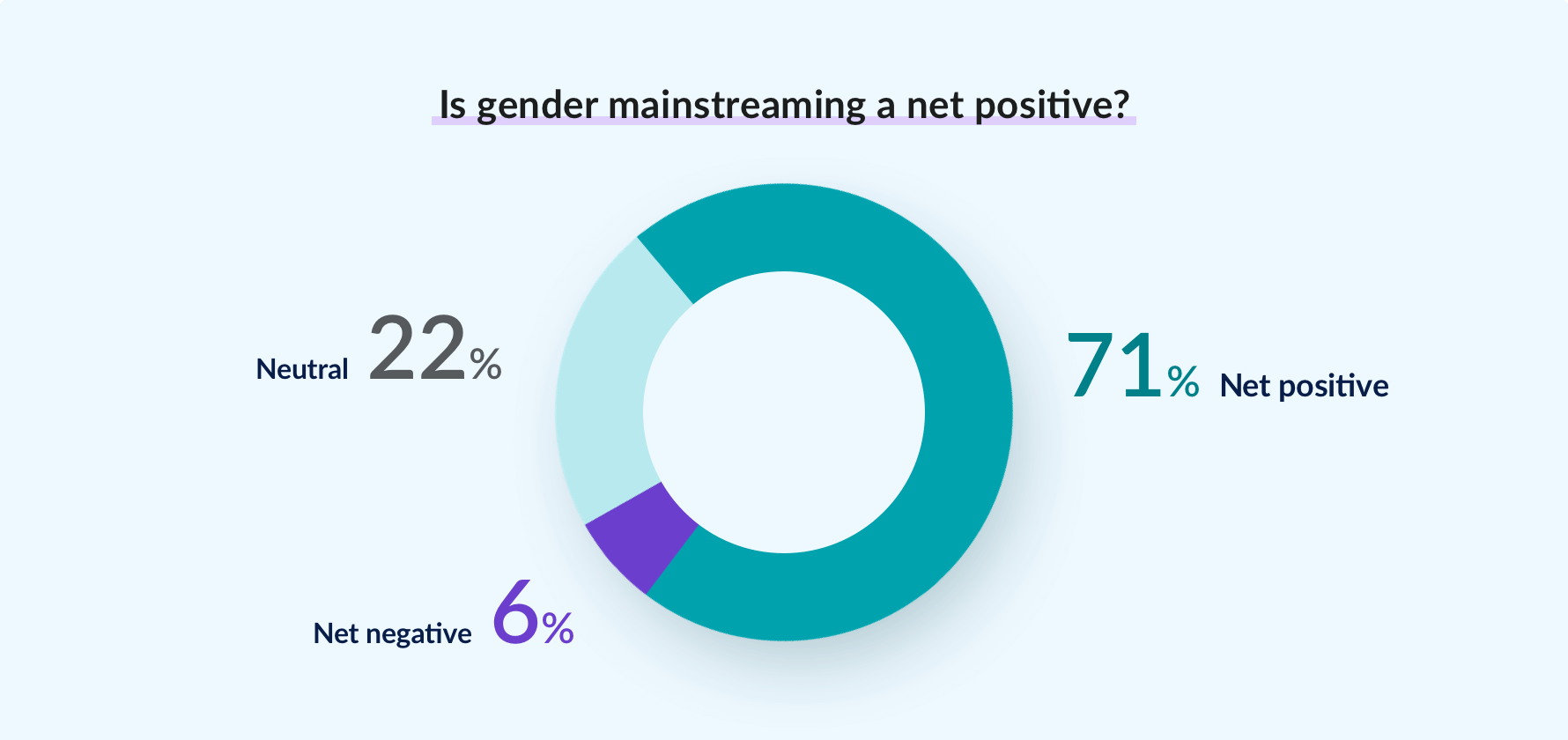
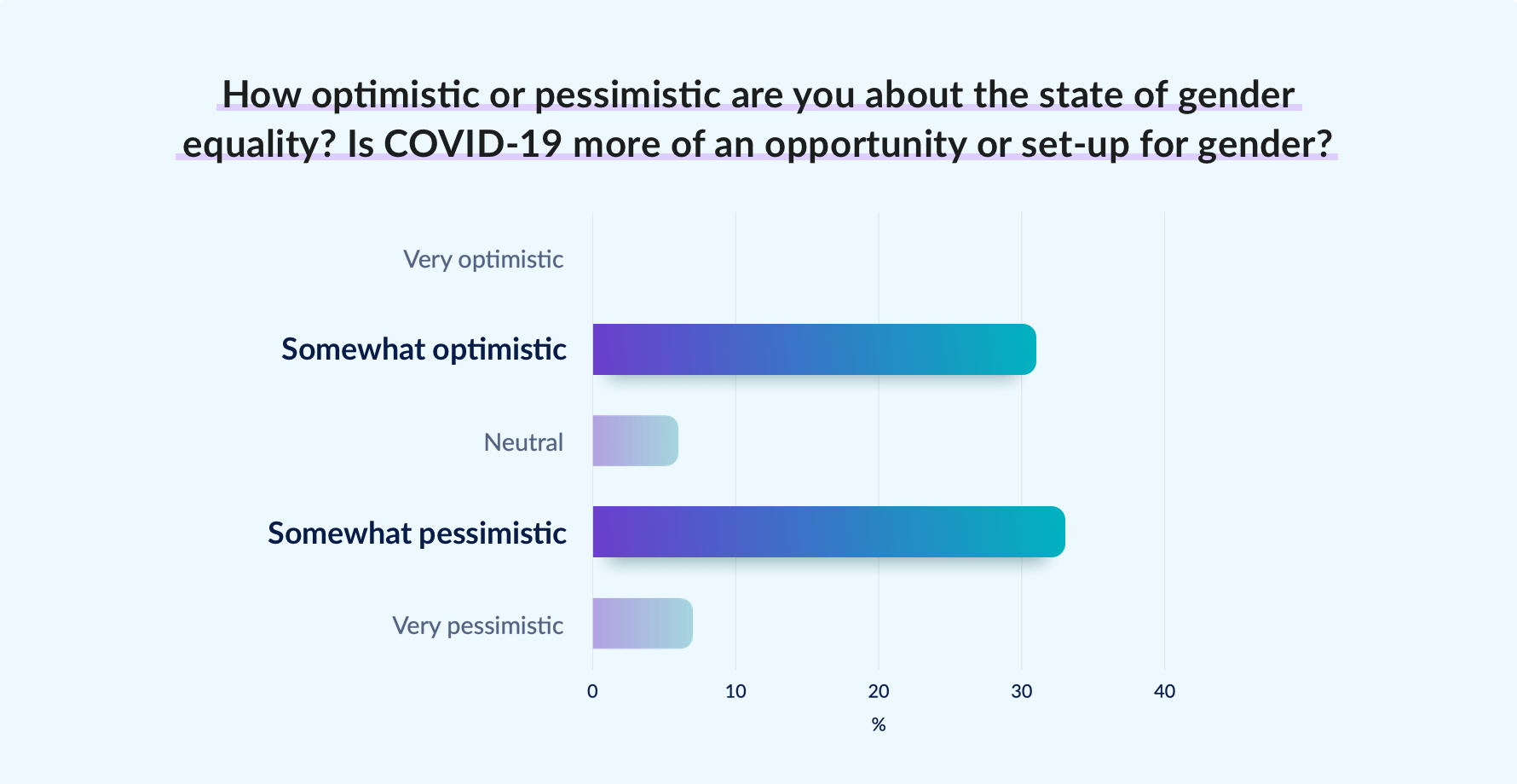
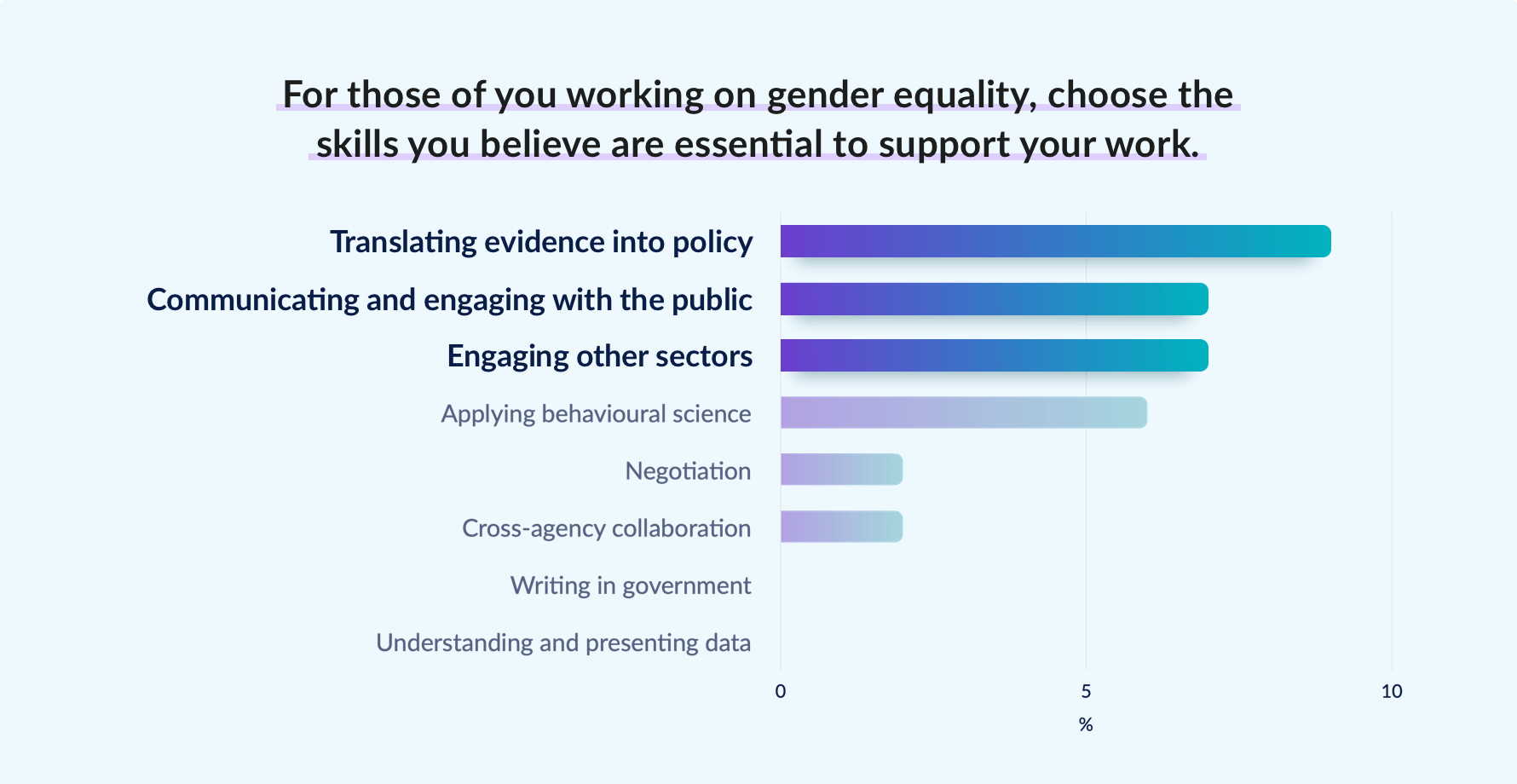
To support this work, UNICEF and Apolitical led a webinar that included over 100 gender practitioners and experts from across the globe in June 2020.The exchange focused on how gender mainstreaming approaches can be most effective in the aftermath of COVID-19, including discussion, live polling and a pre-webinar survey completed by 46 attendees.You can see some of the results of the polling below.
Definitions
This paper uses the following definitions from the Bill and Melinda Gates Foundation’s Gender Equality Toolbox.
Gender mainstreaming: A strategy for making the needs and interests of all genders an integral part of the design, implementation, monitoring and evaluation of programs, policies and organisational processes, so that everyone has the opportunity to benefit equally, and inequality is not perpetuated.
Gender lens: A perspective that pays particular attention to how gender differences and relations are relevant for investments and projects.
Intersectionality: A perspective that acknowledges the concrete experiences of inequality that result from the interaction of gender with other social markers of difference.
This paper also uses the UNICEF definition of gender-transformative programming, defined as that which "aspires to tackle the root causes of gender inequality and moves beyond self- improvement among girls and women to redress power dynamics and structures that serve to reinforce gender inequalities.” [1]
Key takeaways
It is important to understand gender mainstreaming as a broad approach that needs to be implemented in the right ways to be effective. In the past, gender mainstreaming has tended to be formulaic and process-focused rather than tailored to the specific needs of each organisation and its goals.The following points are intended to support the effective implementation of gender mainstreaming in policy and programming, leading to truly gender-transformative outcomes.
This paper is meant to support those working toward gender equity at all levels. Below we have shared takeaways both for those relatively new to the practice and for those deeply engaged in gender equity work who will benefit from more in-depth recommendations.
Takeaways for those new to gender mainstreaming
Commitment
- Central to effective mainstreaming is genuine buy-in within the organisation so that gender work ‘belongs’ to everyone and is integral to every role, rather than a silo or an add-on.This requires champions at different levels of the organisation, including within leadership.
- Lack of understanding and clear objectives are key features of ineffective mainstreaming [2]; time spent clarifying messages and setting tailored objectives will reap long-term rewards.
- While it is often said that ‘culture change’ within an organisation is required to advance gender work, it may be helpful to reframe the ultimate goal of mainstreaming as a societal change, with the organisation and its work as tools for achieving this.
Skills and expertise
- As outlined in the ‘areas for further exploration’ section of this document, further work is needed to produce a set of key skills for effective gender mainstreaming.
- A key skill identified by experts is human-centred design, or an understanding of what motivates individuals to change their thinking and to want to partake in advancing gender equality within an organisation.
- Also highly valued is the ability to bring multiple stakeholders and objectives together into a common agenda to create momentum.
Measurement
Traditional measures have focused on process over outcome- i.e., measuring whether a gender policy exists, or establishing a working group. Updated measures are required to ensure gender mainstreaming does not become a “tick box” exercise.
It is important that initiatives are strategic — not just cosmetic (for example, releasing public statements with no strategic actions attached) — and that indicators speak to gender specifically.
Resources
- A widespread belief that gender equality takes generations to achieve and requires extensive financial resources is a potential barrier.Those responsible for mainstreaming should balance achievable, time-bound goals with an overall transformative vision. At the same time, it is noted that gender equality priorities (such as violence against women and girls) are persistently underfunded and de-prioritised by partners. Low-resource mainstreaming options as well as targeted strategies for resource mobilisation for critical gaps are needed.
- Crisis moments such as COVID-19 can present new possibilities and resources, but practitioners must keep in mind the short-lived nature of crisis responses and focus on utilising these moments to ensure longer-term support.
Case study: Hawai’i feminist economic recovery plan
In April 2020, the Hawai’i State Commission on the Status of Women introduced the first state-level COVID-19 feminist economic recovery plan, Building Bridges, Not Walking On Backs.
“We decided to model for government what it could look like in a moment of crisis to still be engaging, doing our praxis, undertaking a collaborative process with the community to define their own future,” explains Khara Jabola-Carolus, Executive Director, Hawaii State Commission on the Status of Women. Created in a week using real-time participatory tools such as GoogleDocs, the plan was built by a broad coalition of women from across the state, representing a range of backgrounds, skill sets and experiences.
The approach, says Jabola-Carolus, was one of community organising and a “transnational feminism” that centred and spoke to women of color in a way that “academic, foreign, white-led” traditional advocacy could not. Crucially, it was “not about inclusion... it was about redefining women’s role in Hawai’i and using this moment to do that; to destabilise gender as an institution.”This resulted in a plan which calls for, amongst other measures, a restructuring of the state’s economy away from tourism and the military and a Universal Basic Income to separate economic self- sufficiency from work.
Within just three months, the plan had made a tangible impact, having been passed as legislation in half of the counties/municipalities in the state. Programmes emerging from the plan had already begun operating, while election candidates were running on a platform explicitly tied to the plan and its approach.
The lessons from Hawai’i are clear, says Jabola-Carolus. Ongoing investment into feminist community organising and building relationships and trust pre-COVID meant the Commission was ready to act immediately when the crisis hit. A grassroots organising model allowed them to do so quickly and responsively without forgoing buy- in from stakeholders. And, says Jabola-Carolus, “it just goes to show you don’t need a lot of staff and you don’t need [multi-million dollar investment] to change the culture in your state and open up conversations on gender.”
Project: United Nations University International Institute for Global Health
The United Nations University International Institute for Global Health (UNU-IIGH) is the UN’s global health think tank, tasked with generating policy-relevant analysis by applying a gender lens to the development, implementation and evaluation of health programmes. Amongst a number of projects at the UN and ground level is a piece of work looking at gender mainstreaming in institutions and the factors required to implement it successfully in programming.
Early findings indicate that there is “no real agreement on what success looks like,” says Dr. Michelle Remme, Research Lead at UNI-IIGH. For example, while health teams tend to focus on gender initiatives that improve health outcomes, gender teams emphasise gender equality work as an endpoint in itself. Additionally, there exists little evidence as to the effectiveness of gender mainstreaming; practitioners have become “good at measuring progress indicators,” says Remme, “but rarely do we focus on the measures of the change we want to see.”The result of this can be that gender work happens in silos, with a focus on process and small tweaks as opposed to transformation and structural change.
However, says Remme, “absence of evidence is not evidence of absence”. As the research draws to a close, UNI-IIGH hope to be able to support agencies with concrete examples of accountability frameworks within institutions and examples of measures which prioritise transformation over process. While there is a clear need for these improved measures and further evidence, gender mainstreaming remains a key approach for institutions. “The myth that societal change takes generations can be paralysing,” says Remme, “but evidence... shows that deeply seated gender norms can change within programmatic timeframes.”
Areas for further exploration
As UNICEF continues to work toward gender equity, the following are key areas for further research and learning.
Data and evidence gaps
As outlined above, while measures have been developed to evaluate the process of gender mainstreaming, relatively little evidence exists as to its success in producing gender- transformative outcomes.There is a need both to define and communicate what success looks like for gender mainstreaming in programming and policy, and to develop updated measures which go beyond those in the UN SWAP in order to gather evidence on gender-transformative outcomes.
Skills development and capacity building
A skills deficit is a key barrier for many practitioners [4] attempting to push forward gender mainstreaming. Further work is needed to identify and establish consensus on the key skill set required to develop these at all levels of the workforce. A lack of evidence on the effectiveness of different training and capacity building exercises should also be addressed to efficiently upskill staff.
Intersectionality and going beyond the gender binary
Understandings of gender have evolved since gender mainstreaming was first developed, and there is a need to think through how the approach applies to those outside of the gender binary, as well as how it can be most effective in improving outcomes for trans men and women and the entire LGBTI community. Intersectionality is also identified as a key mindset for effective gender mainstreaming [5] to recognise and address how race and gender interplay for women and nonbinary people of color. Understandings of intersectionality vary across organisations, as does the extent to which it is embedded in gender mainstreaming efforts.
References
- Definition of gender-transformative programming taken from UNICEF note “What is gender-transformative programming?”, Gender Section, PDHQ, June 2020
- Pre-survey results indicated that 67.4% and 34.8% of respondents respectively identified a lack of understanding and a lack of clear objectives as the most ineffective features of gender mainstreaming.
- 32.4% and 73% of pre-survey respondents respectively identified a lack of time and a lack of internal capacity/skills as the biggest challenges they face in integrating gender equality priorities into their organisation’s work, compared to 21.6% who cited a lack of resources for gender equality work.
- 73% of pre-survey respondents identified a lack of internal capacity/skills as the biggest challenge they face in integrating gender equality priorities into their organisation’s work.
- 71% of pre-survey respondents identified intersectionality as the skill or mindset they find to be most important for effective gender mainstreaming.
Photo credit: Unicef
Make sure to share your own thoughts with the author by leaving a comment below

Log in or sign up to continue the conversation